A weekly monitor of how Trump’s orders and actions are impacting planners and planning in America.


Since his inauguration, Trump’s executive orders and other actions have come at a dizzying pace. Planetizen’s Federal Action Tracker is here to cut through the noise and help you keep up. Each week, we monitor the impacts that new federal actions are having on housing, transportation, infrastructure, land use, and other areas of planning. We check in as various actions are challenged in court, altered, or reversed.
If you’re feeling the impacts of Trump’s new policies in your work, help us keep up! Tell us what you’re seeing on the ground and send us news articles, reports, or memos that are impacting your field of planning or your region. You can email us at [email protected] with the subject line “Federal Action Tracker Tip.” You can also send us a comment or DM on Instagram, LinkedIn or, Facebook, or submit through the comment box in the right-hand corner of this page.
Check in weekly on Wednesdays for new updates.
October 7
Land Use, Energy and Climate
-
The Trump administration revoked a $20 million infrastructure grant from Boston because less than 1% of the grant money would go to electric vehicle charging infrastructure: now, the city is suing.
Transportation
-
Federal surface-level transportation funding from the 2021 Infrastructure Investment and Jobs Act expired on Oct. 1, triggering a stopgap funding bill that does not continue the IIJA’s advance appropriations. The American Public Transportation Association estimates the stopgap bill will result in an over 80% cut to federal passenger rail investment and 20% cut to federal public transit investment.
Housing
-
The National Urban League, along with housing groups from several states, sued the Trump administration on Sept. 29 to try to stop it from canceling nearly all of the Department of Housing and Urban Development’s funding for its Comprehensive Housing Counseling program. The government currently allocates $57.5 million to the program; the Trump administration intends to cancel $56.1 million of that funding, a nearly 98% reduction.
September 30
Land Use, Energy and Climate
-
A federal judge ruled that the Trump administration acted unlawfully when it canceled the Solar For All program, which provided $7 billion in grants intended to create jobs, reduce energy bills and address greenhouse gas emissions.
September 23
Transportation
- The Alabama Toll Road, Bridge and Tunnel Authority will receive a loan of up to $2.52 billion from the Build America Bureau to fund the largest infrastructure project in Alabama's history: the Mobile River Bridge and Bayway Project. The project will construct a six-lane bridge over Mobile River, and relieve Alabama’s primary bottleneck by giving hazmat freight a more direct path across the Mobile River.
Land Use, Energy and Climate
- The Trump administration intends to lease millions of acres of seafloor surrounding America’s Pacific Island territories to mining companies, despite local leaders’ opposition. While international law says that the Indigenous people of America’s territories have a right to prior and informed consent regarding projects that impact their country, the Trump administration says it has the authority to proceed under U.S. law.
- The Bureau of Land Management is considering proposals for at least 12 data center or data center-related structures to be built on public lands across Utah, Arizona, Oregon, Nevada, Idaho and Wyoming. If approved, the projects would cover 17,600 acres of public land across six states. Local officials and advocates in five of the six states with proposed developments — Utah, Arizona, Oregon, Idaho and Wyoming — told The Washington Sun they weren’t aware of many of the proposed data center and data center-related projects on their land.
- Nearly all wind energy projects in the United States are still on pause almost a month after a federal judge ruled that the Trump administration’s freeze on vertical height clearances for wind turbines was likely illegal. The administration has control over airspace higher than 200 feet, and therefore has control over wind projects on both private and public land,
- The Department of Energy overstepped by ordering an aging coal-fired power plant in Michigan to continue operating past its retirement date, a federal court ruled. The ruling represents one of the first successful legal challenges to President Trump’s “national energy emergency” plan, which instructs federal agencies to use all emergency powers available to increase fossil fuel energy production.
September 16
Land Use, Energy and Climate
- The Environmental Protection Agency and the U.S. Army Corps of Engineers proposed a new rule on Sept. 4 that would strip federal protections from 94% of U.S. wetlands and at least 33% of streams, according to a preliminary analysis by the Natural Resources Defense Council.
- The United States and Mexico have signed a Colorado Treaty amendment under which the United States will reduce Colorado River water deliveries to Mexico by 250,000 acre feet, the International Boundary and Water Commission announced on Sept. 9. Mexico’s share of the Colorado is normally 1.5 million acre-feet.
- A federal judge has halted what would have been the United State’s first data center on federal land, siding with the Sierra Club Toiyabe Chapter and the Center for Biological Diversity's appeal. Trump’s Bureau of Land Management gave Townsite Solar 2 the greenlight to build a data center on the land in June, which would have been located southeast of Las Vegas in Boulder City, Nevada.
- The Environmental Protection Agency announced on Sept. 14 that the United States will no longer limit the planet-warming pollution that power plants release while burning coal and gas. The power sector is the second largest source of carbon dioxide in the United States, which accumulates in the atmosphere and traps the sun's heat, raising temperatures and exacerbating extreme weather.
September 9
Transportation
- President Trump signed the Continuing Appropriations and Extensions Act 2027 into law on Sept. 2, a temporary spending bill that reduces public transit funding by 20% and passenger rail funding by 81%.
Land Use, Energy and Climate
- “The administration has subjected offshore wind projects to questionable Pentagon reviews, permit revocations, and stop-work orders,” Austin Corona writes for Grist. Additionally, it has paid developers to surrender their rights to develop in federally managed waters, wiping an estimated 21 gigawatts of potential wind power capacity off U.S. coasts.
- The Trump administration is transferring 1.4 million acres of federal Alaskan land along the Dalton Highway to the state, stripping the land of federal protections. A lawsuit to restore the federal protections was partially dismissed, but environmental groups appealed on Aug. 11, fearing that without federal oversight the state would permit projects that may destabilize local ecosystems.
- The Department of the Interior is set to publish a "categorical exception” of the National Environmental Policy Act for oil and gas companies. The exception will permit them to drill new exploration wells and conduct seismic surveys in Alaska’s National Petroleum Reserve without environmental reviews. Seismic surveys can scar tundra and disturb wildlife, including female polar bears. Drilling has been known to alter caribou behavior and Arctic migration patterns, and oil and gas development risks thawing permafrost.
- A federal judge has temporarily blocked the Environmental Protection Agency from challenging California’s ability to set stricter vehicle pollution standards than the federal government. The legal dispute stems from a decision announced in June by EPA administrator Lee Zeldin, who said four of California’s Clean Air Act preemption waivers, which allow California to set stricter standards, were actually ‘rules’ subject to congressional approval under the Congressional Review Act. Judge Beryl A. Howell wrote in her decision that the EPA reclassifying prior waivers “undermines honest compliance with the law, which is what Americans should expect from executive branch agencies.”
- The Trump administration is launching a new water sector cybersecurity program in San Antonio, Texas. The program, dubbed “Project Watershed 250,” will use Texas as a testing ground for a sixth month pilot aimed at finding vulnerabilities in water systems.
- Opponents of President Trump’s decision to sharply downsize two Utah national monuments in July are re-upping their argument that he didn’t have the authority to do so now that the president has redrawn the boundaries even smaller than he did almost a decade ago.
Housing
- The U.S. Department of Housing and Urban Development is limiting the amount of time a person has to file an accessibly violation complaint regarding multifamily housing design and construction under the Fair Housing Act. As of Sept. 2, plaintiffs must file accessibility violation complaints within one year of the building’s initial certificate of occupancy. Previously, claims could be filed at virtually any time.
September 2
Transportation
- The Trump administration has released a new plan to turn the nation's highway and rail lines into “multi-use” utility corridors, holding transmission wires, water pipelines and fiber optic lines. Titled “America's Great Corridors of Commerce," the project allows state-level transportation agencies to voluntarily lease land alongside roads and tracks to private sector companies developing new infrastructure — and bypass environmental reviews.
Land Use, Energy and Climate
- The Trump Administration hired Fisher Sand & Gravel Co. to fill in a gap in the border wall located in the Jacumba Wilderness federal nature preserve. The government awarded the firm $574 million for the project in September 2025. In March, the cost rose to $1.2 billion and the government added 30 miles of an additional layer of fencing to the project.
- The Bureau of Land Management is looking to limit the input private landowners have over drilling under their property. Currently, if the BLM owns the mineral rights underneath private property, the bureau is required to notify the owners of proposed drilling and give the public 90 days to comment on any leasing of rights to outside companies. But a recent proposal would eliminate the landowner notification requirement and reduce public comment time to 10 days.
- The Environmental Protection Agency intends to repeal a federal law requiring states to publicize and ask for public input on applications for air pollution permits, including from new data centers and power plants. The move could prevent residents from raising concerns about — or even learning about — data centers before permits are approved and construction starts Over a dozen states and 200 advocacy groups have voiced opposition to the change.
- The D.C. Circuit Court blocked the Environmental Protection Agency from rescinding nearly $20 billion in Greenhouse Gas Reduction Fund awards meant for disadvantaged communities, and a South Carolina federal judge ordered the EPA to resume distributing funds to underserved communities impacted by environmental and health challenges.
- For over a year, the Trump administration has been trying to give a roughly quarter-mile strip of land inside Yosemite to investment firm Kingsbarn Realty Capital, according to documents obtained by NOTUS. If successful, the give would be the first time in American history that the federal government has given national park land to a private developer.
- The Trump administration is expediting the Trans-Alaska Pipeline System’s environmental review, which would reauthorize the project and guarantee 30 more years of oil production in Alaska. The Bureau of Land Management also shortened the public comment period for review of the project, which is usually 30 to 60 days, to 15.
Housing
- The U.S. District Court of Massachusetts issued a restraining order that paused changes to how the U.S. Department of Housing and Urban Development awards Fair Housing Initiative Program grants on Aug. 26. HUD announced in June that it was limiting fair housing grants to five housing groups per year, down from the over 100 previously funded, and that only groups with a budget over $5 million would qualify. HUD’s changes also added a question to the “merit and risk review” section of the application, asking applicants how their award would advance the Administration’s priorities on “gender ideology,” “faith-based activities,” and immigration. Judge Myong Joun wrote that HUD’s justification for these changes lacked “informed reasoning or explanation.”
August 25
Transportation
- On Aug. 14, Amtrak received $5.3 billion in federal funding for rail-related projects. Forty one projects in 23 states are receiving funds under the new National Railroad Partnership Program "which combines several previous grant programs funded under the Infrastructure Investment and Jobs Act of 2021," including more than $2 billion diverted from cancelled grants for the California High Speed Rail Program.
Land Use, Energy and Climate
- The Bureau of Reclamation released its two-year operating plan on Aug. 21, detailing how the seven states that utilize the Colorado River’s water must reduce their usage. The operating plan requires the lower basin states — Arizona, California and Nevada — to reduce their use by 1.25 million acre-feet over the next two years. The Bureau of Reclamation gave Colorado, Utah, Wyoming and New Mexico, the Colorado River’s upper basin states, no mandatory water cuts. Now Nevada is suing the federal government over the cuts.
- Rep. Andrea Salinas introduced the Data Center Community Reinvestment Act of 2026, a federal bill that would tax qualifying data centers 1-cent-per-kilowatt-hour and split revenue evenly between five different funds, including the Housing Trust Fund and the Land and Water Conservation Fund.
- The Trump administration plans to revoke a drill-free buffer zone around the Chaco Culture National Historical Park, a UNESCO world heritage site in New Mexico. The 20-mile zone currently protects the area around the park from fossil fuel drilling and uranium mining, which activists warn could cause environmental harm to the park.
- The United States Department of Energy is looking to the Great Salt Lake to increase its production of rare minerals. The department awarded Lilac Solutions, a company extracting lithium from the lake, a $100 million grant to fund additional extraction on the north arm.
- The United States government has declared a drought disaster in the U.S. Virgin islands as St. Thomas, St. John and St. Croix all weather an extreme drought. U.S. Virgin Islands Governor Albert Bryan Jr. requested the declaration earlier in August, which will allow farmers and agricultural producers to seek emergency federal loans.
August 12
Transportation
- The Federal Transit Administration under the new Trump administration has not finalized any agreements that would unlock over $7 billion in transit grants already approved by Congress under the Capital Investment Grants program. The delay is forcing projects around the country to stall, leading to added costs and delays.
- The U.S. Department of Transportation released an updated National Roadway Safety Strategy that focuses on cracking down on illicitly licensed truck drivers, increasing traffic enforcement and supporting AV development. The strategy mentions "giving Americans access to affordable vehicles with the latest safety technologies," despite a recent proposal by Transportation Secretary Sean Duffy that would bar states from requiring certain safety and communication technologies in cars. The NRSS also promotes safer road design through "evidence-based engineering interventions and innovative practices."
Land Use, Energy and Climate
- The U.S. Court of Appeals for the District of Columbia Circuit reversed a decision that would have allowed the Trump administration to claw back $20 billion in grants awarded under the Greenhouse Gas Reduction Fund. The grants are slated to go to projects including clean energy development and U.S.-based electric car manufacturing.
August 5
Transportation
- Amazon's Zoox robotaxis received the nation's first permit to operate autonomous devices purpose-built without steering wheels under a special program designed to "accelerate AV innovation." The vehicles will be allowed to offer paid rides to the public in Las Vegas this month.
- USDOT is scrapping a $8.8-billion plan to expand and modernize Washington D.C.'s Union Station, opting instead to seek out private investment to fund the renovations. The agency is setting aside $24 million for an initiative to develop a public-private partnership, despite having a previously approved expansion plan. The new agreement identifies retail and office opportunities, but does not explain how the public and private partners would allocate responsibilities.
- Amtrak released a preliminary plan for reorganizing its corporate structure as part of an effort to provide more transparency and stronger financial performance. Under the proposal, Amtrak would remain the parent company, overseeing three other business entities: passenger services, infrastructure management and fleet management.
Land Use, Energy and Climate
- After Colorado River Basin states failed to come to an agreement over how to reduce their water use, the U.S. Bureau of Reclamation stepped in with its own proposal, which would force Arizona, California and Nevada to make mandatory cuts of up to 3 million acre-feet per year until 2036. The river has reached the lowest levels ever recorded, triggering a serious water crisis in the Southwest.
July 29
Transportation
- Transportation Secretary Sean Duffy announced a proposal to ban state and local governments from requiring carmakers to include automated driving systems or wireless data transmission capabilities, calling it Americans' right to "freedom cars." The proposal comes at the same time as the Trump administration's push to promote the development of autonomous cars.
- The United States cast the sole dissenting vote in the United Nations as 162 member nations voted in favor of a resolution to cut traffic deaths in half by 2030. A U.S. representative called the declaration a "symbolic global gesture," but also referred to it as a "backdoor" way to promote climate action and restrict the freedom of mobility.
Land Use, Energy and Climate
- The Bureau of Land Management is considering rolling back protections for land around Chaco Culture National Historical Park, a key site for Indigenous ruins in New Mexico. BLM could open the land to new oil and mineral leasing, which would endanger thousands of sacred cultural sites in the region.
July 22
Transportation
- Federal regulators approved the Interstate 5 bridge replacement project between Oregon and Washington, marking a significant step forward for the $13- to $15-billion project. The proposal would build a new bridge in addition to adding a new stretch of freeway and new tolling facilities. While light rail has been proposed as part of the project, it is not included in the first phase.
- The Federal Highway Administration removed five road safety measures from a list of "proven safety countermeasures" on its website, eliminating them from a list of suggested traffic safety interventions without a public announcement. The five measures are: "bicycle lanes, road diets, speed safety cameras, variable speed limits and speed limits that are appropriate for vulnerable road users."
July 15
Transportation
- The National Highway Traffic Safety Administration called on robotaxi operators to immediately address safety issues caused by their vehicles interfering with first responders. A letter from the agency said "the inability to detect and appropriately respond to such situations represents a functional insufficiency" and asked for solutions by the end of July.
- Transportation Sec. Duffy announced that USDOT will redirect $1.73 billion awarded to safe streets and bike lane projects, calling them "DEI." The funds, much of them awarded under the Reconnecting Communities program, will be redirected to road and bridge projects and away from Complete Streets, Vision Zero, and other multimodal infrastructure projects.
Housing
- Pres. Trump allowed the 21st Century ROAD to Housing Act to pass into law, not signing but also not vetoing the bill last weekend. The law, widely supported by lawmakers from both parties, aims to bring down the cost of housing and boost housing assistance for struggling households.
Land Use
- The National Capital Planning Commission, a federal body tasked with assessing the planning issues around monuments such as materials, placement and pedestrian safety, approved preliminary plans for President Donald Trump's proposed 250-foot arch, prompting questions about whether D.C. height limits apply to federal projects. The arch would exceed height limits established under the 1910 Height of Buildings Act, which the administration says does not apply to federal property.
July 8
Housing
- A U.S. District Court judge ruled against proposed changes to the Continuum of Care grants, a key federal program that funds homelessness reduction and assistance programs. The new rules would have discouraged "Housing First" policies and added new requirements for grant applicants. The judge said that HUD created a "procedural nightmare" for agencies, but did not preclude HUD from making similar changes in the future.
July 1
Transportation
- The National Highway Traffic Safety Administration announced plans to eliminate a requirement for brake pedals in cars designed to be fully self-driving. The rule change would make it easier for automakers like Tesla to gain approval for autonomous car designs. Currently, all vehicles must have physical brake pedals and steering wheels.
Housing
- The U.S. Senate — and later the House — signed a bipartisan housing bill, the 21st Century ROAD to Housing Act. The legislation restricts institutional investors from buying homes, increases grant funding for housing programs and adjusts financing regulations to allow banks to invest more in affordable housing. Shortly before a scheduled signing ceremony, President Donald Trump abruptly announced he would not sign the bill until Congress passes the SAVE America Act, an unrelated piece of legislation that would change election rules.
June 24
Transportation
- USDOT will no longer enforce Title VI of the Civil Rights Act, which prohibits discrimination in projects that receive federal funding and has been a powerful tool for protecting vulnerable communities from the "disparate impacts" of transportation and infrastructure projects. The change means that the agency will no longer require grant recipients to consider equity in policies related to transit service, coverage and fares or the impacts of transportation projects on communities.
Housing
- The U.S. Senate passed a major bipartisan housing bill that includes provisions aimed at increasing the housing supply and making housing cheaper and easier to build by removing regulatory barriers and improving financing mechanisms. The bill, known as the 21st Century ROAD to Housing Act, would, among other provisions: bar investors who own more than 350 homes from buying more; expand housing incentives and grants; streamline permitting processes and reduce barriers to manufactured housing; create new federal support for repairs to older homes. It now heads to the House.
Land Use, Energy, and Climate
- After a flurry of purchases, the Department of Homeland Security is backtracking on its plans to expand detention facilities and will sell of seven of the 11 warehouses it recently bought for use as immigrant detention centers. The agency said it will focus on using existing detention space and plans to offload warehouses in Pennsylvania, Georgia, Utah, Michigan and New Jersey.
- The Trump administration plans to remove over 900 bison from a Montana herd near Yellowstone National Park due to concerns about disease transmission to cattle and property damage to local ranches. The plan drew an immediate outcry from environmentalists and Indigenous groups who value the bison as a cultural icon as well as a key player in the local ecology.
June 17
Housing
- HUD suspended federal funding to the Los Angeles Homeless Services Authority, the Los Angeles region's largest services provider, after accusations of corruption at the agency. A letter from HUD accused the agency of misusing funds and failing to provide adequate documentation about its clients. The agency is responsible for distributing funds critical to the operations of dozens of smaller local organizations.
Land Use, Energy, and Climate
- Washington D.C. authorities are cracking down on unsanctioned skateboarding sites as part of the Trump administration's efforts to "beautify" the capital's public landmarks. In one popular skate spot, Freedom Plaza, the city recently installed metal fixtures to prevent skating. The city also fenced off other sites commonly used by skaters. While D.C. has expanded its network of sanctioned skate parks, many skateboarders say the parks are not a substitute for the landmarks that offer spontaneous, informal recreation and socialization opportunities.
June 10
Land Use, Energy, and Climate
- The Bureau of Land Management approved a lease sale of 156,000 acres of public land in Colorado for oil and gas extraction. The area is adjacent to a designated Dark Sky Place and is home to at least 17 rare and endangered plant and animal species. The lease, the largest transaction of its kind in Colorado history, could impact the habitat of the nation's largest elk herd.
June 4
Transportation
- Rail advocates are warning that the way rail funding is structured in the proposed BUILD America 250 Act makes rail funding unreliable by putting it up for Congressional approval each year and could lead to a 80% reduction in federal railway funding.
Housing
- The Trump administration issued a plan that would dramatically reorient federal funding aimed at reducing homelessness. The proposal would shift roughly $1.2 billion away from housing assistance programs that use the Housing First framework, which the administration say is the wrong approach to reducing unsheltered homelessness.
Land Use, Energy, and Climate
- President Trump lifted a set of executive orders that restricted off-road vehicle use on public lands, allowing more OHVs to operate in national parks, forests and other protected areas.
May 27
Transportation
- The federal surface transportation bill proposed in the House of Representatives includes about $110 billion for roads and bridges, $102 billion for passenger and freight rail, about $25 billion for aviation, and about $17 billion for ports.
Housing
- A new set of "regulatory best practices" from the Department of Housing and Urban Development offers suggestions for how local and state governments can speed up housing construction that include capping permitting fees, eliminating green building requirements and using public land for housing. The document does not address density and emphasizes housing for middle-income households.
- The amended House version of the 21st Century ROAD to Housing Act proposes an expansion of housing planning grants, streamlined environmental reviews and an expansion of manufactured housing. The House version takes a "softer approach" to the Senate's proposed limits on institutional home buyers and "build-to-rent" properties.
May 20
Transportation
- A new federal 'passenger rail liability cap' could kneecap train operators in the United States, forcing them to acquire around $400 million in excess liability insurance. The rule mandates much higher coverage for passenger rail than other travel modes that pose more risk to passengers and other road users.
- International agencies are urging cities to cut speed limits as part of an effort to conserve gas while oil prices soar amidst the Iran war. The Institute for Public Policy Research says that capping legal speeds at 20 miles per hour in towns and cities and 60 miles per hour on highways would help reduce fuel demand, but noted that the policy should be paired with other strategies such as increasing remote work and carpooling.
- A proposed federal bill known as the Shared Micromobility Investment Act would make bike and scooter share projects eligible for BUILD grants, Surface Transportation Block Grants, and Carbon Reduction program grants, making it easier for cities to gain funding for micromobility projects. Micromobility was never explicitly written into federal law, so the update would "reduce uncertainty" and recognize micromobility as part of the broader transportation network.
Land Use, Energy, and Climate
- The U.S. Department of the Interior formally canceled a 2024 rule that placed conservation on the same footing as development as uses for public lands. Interior Secretary Doug Burgum said the rule prevented energy and timber production and grazing on public lands, harming business interests.
- The Environmental Protection Agency announced plans to rescind wastewater treatment requirements for coal power plants to lower the cost of electricity generation. The EPA cited the growing demand for electricity from data centers as a major reason to increase power generation.
May 6
Transportation
- A federal judge ordered the Federal Highway Administration to stop the planned removal of bike lanes near the National Mall, saying the government provided no evidence that they would have a negative impact on traffic or safety. The Trump administration wanted to remove the lanes in advance of the National Cherry Blossom Festival, citing traffic concerns.
- A new bill introduced in the House of Representatives, the Modal Parity in Permitting Act, aims to align permitting processes for transit and passenger rail projects with those for highway construction. This would allow projects to acquire property before completing the National Environmental Policy Act review process, a step currently permitted for highway projects.
- A Sierra Club analysis found that 96% of funds allocated for the National Electric Vehicle Infrastructure program in 2021 and 2022 remain unspent. About one-third of the funds have been obligated to specific projects, but new Buy America requirements are making it harder for states to purchase the necessary equipment. However, 2025 was still the biggest year for public EV charger installations, with 18,000 new fast public chargers installed around the country.
Housing
- The Department of Housing and Urban Development wants to roll back protections for gender identity and sexual orientation in close to 50 housing regulations. The proposed rule would require service providers to request evidence to verify the sex of residents for single-sex facilities.
Land Use
- The U.S. Supreme Court declined to review an appellate court decision that approved public access to millions of acres of public land "corner-locked" by private property, which requires users to cross parcels diagonally to avoid private parcels. The issue stems from a common 'checkerboard' land ownership pattern common across the west. While the decision only applies to the six states within the Tenth Circuit Court's jurisdiction, it is likely to have an impact on public lands around the country.
April 22
Transportation
- President Trump's proposed budget for fiscal year 2027 makes major cuts to public transit and passenger rail funding, amounting to an 82% reduction in funding for trains. An analysis from the American Public Transportation Association found $4.8 billion in cuts to transit and $13 billion in cuts to trains. The budget also eliminates funding for high-speed rail and discontinues some advance appropriations authorized in 2021 for projects already underway.
- A new road safety initiative from the National Highway Traffic Safety Administration shifts focus from transportation infrastructure to traffic enforcement and tech. The program, called Pathways to Safe Streets, emphasizes the need to reduce impaired driving, speeding, distracted driving and lack of seatbelt use. It also supports relying on technology to improve safety and enforcement.
- The Federal Motor Carrier Safety Administration, part of the U.S. Department of Transportation, plans to withhold $73 million from New York after the state did not revoke commercial driving licenses that the Trump administration says were illegally issued. USDOT says it conducted an audit and found that over half of the licenses it reviewed were improperly issued without citizenship verification.
April 15
Housing
- A federal judge ruled that the Trump administration acted illegally when it changed requirements for the Department of Housing and Urban Development's Continuum of Care Build grants, which service agencies across the country rely on to provide shelter and services to unhoused and housing insecure Americans. The lawsuit alleged that HUD's actions violated the Administrative Procedure Act and imposed arbitrary and politically motivated conditions.
April 8
Housing
- President Trump's proposed budget for fiscal year 2027 would reduce the Department of Housing and Urban Development's budget by 13% and eliminate key affordable housing programs including the Community Development Block Grant and the HOME Investment Partnerships Program. It also makes cuts to homeless assistance programs and the Pathways to Removing Obstacles to Housing program.
Land Use, Energy, and Climate
- President Trump's budget proposes cuts of roughly 52% to the Environmental Protection Agency, as well as a reduction of FEMA funding for non-disaster programs by $1.3 billion. Cuts to the EPA include the elimination of environmental justice grants and water infrastructure grants. The budget also makes cuts to renewable energy and climate adaptation programs at the Department of Interior, the National Oceanic and Atmospheric Administration, and the U.S. Department of Agriculture.
April 1
Transportation
- Washington, D.C. bike advocates sued the federal government, delaying the planned removal of a portion of the 15th Street bike lane, which the National Park Service was tasked with removing in advance of the annual Cherry Blossom Festival.
Housing
- A judge ruled against the Trump administration in a suit claiming that the administration’s new restrictions on Continuum of Care grants, which fund homelessness services, were unlawful and would destabilize service providers around the country. The administration took aim at policies that supported sanctuary protections, harm reduction programs, and inclusive policies for trans and nonbinary people. The court ruled in favor of the plaintiffs, saying that the new regulations violate the Administrative Procedure Act.
Land Use, Energy, and Climate
- The federal government plans to pay French energy firm TotalEnergies $928 million to forfeit its leases on two wind energy projects off the coasts of New York and North Carolina. The agreement requires the company to reinvest the money in oil and gas projects elsewhere in the United States.
March 25
Transportation
- The National Park Service (NPS) will remove part of a well-used bike lane in Washington, D.C., citing the upcoming National Cherry Blossom Festival as a reason to remove it to reduce traffic congestion. Three Capital Bikeshare stations along the same stretch of street, some of the most used in the CaBi system, will also be removed.
Housing
- At least 400 permitted units of affordable housing in Maine are on hold due to updated Buy America regulations, which require 95 percent of materials to come from U.S. sources. The new federal rules were created in 2021 and just went into effect.
- A group of states sued the Department of Housing and Urban Development (HUD), claiming that recent policy changes are weakening protections guaranteed under the Fair Housing Act (FHA). The states say the agency is forcing them to adopt a narrower interpretation of the FHA and is reducing staff and resources for enforcement.
Land Use, Energy, and Climate
- A study found that wildfires in national forests were four times as likely to ignite in areas within 50 meters of roadways than in roadless areas, casting more doubt on the Trump administration’s decision to rescind the Roadless Rule, which protects 60 million acres of federal forest land from development and road building.
- The Trump administration plans to pay a French energy company nearly $1 billion to cancel leases on land for two offshore wind energy projects on the East Coast, with the promise that the company will reinvest the money in fossil fuel projects elsewhere in the country.
Demographics
- The U.S. Census Bureau is rolling out a pilot program that will use postal workers to administer Census survey questions. The move is part of several changes the agency may make in advance of the 2030 Census. The program is meant to leverage trust in local postal workers and increase efficiency, but the Government Accountability Office (GAO) has stated that it would not be cost-effective as postal workers get paid significantly more than temporary Census workers.
March 18
Transportation
- Detroit officials are scrambling after new federal rules could prohibit the city from going forward with plans to reduce vehicle lane capacity on some of its most dangerous streets. The revised rules for the Safe Streets and Roads for All grant program bar cities from reducing vehicle capacity, a change that could force the city to change its plan for a redesign of Gratiot Avenue, among other streets with high fatality rates.
- The Trump administration has pulled or frozen what amounts to at least $750 million in federal funding for walking trails and bike infrastructure projects, mainly grants previously awarded under the Neighborhood Access and Equity Program. Now, cities are working to revise their plans or find new funding sources to keep projects going.
- NJ Transit, New Jersey’s transit agency, is revising its plan to shift to zero-emission vehicles to align with new requirements for federal grants. The agency secured almost $324 million in federal funding for modernizing bus garages, in part to be ready for electric buses. Facing a funding freeze on some federal programs, the agency is changing some of its plans to move funds toward other needs and infrastructure upgrades that will help it keep moving toward its zero-emissions goal.
Housing
- The U.S. Senate passed a housing bill that aims to streamline permitting regulations and environmental reviews, allow banks to invest more in affordable housing, and eliminate limits on federal grants for shelter beds and homelessness reduction. The bill would also make it easier to build modular housing and limit real estate purchases for corporate investors. The bill moves to the House, where it is expected to face some pushback.
- President Trump issued two executive orders that reduce regulatory barriers to homebuilding and promote access to mortgages through community banks. The first calls for a revision of “requirements related to stormwater, wetlands, lakes, rivers, and other bodies of water” to reduce housing construction and permitting costs, reduce property tax burdens, increase insurability of homes. The second calls for reducing the regulatory burden on small and community banks to allow them to grant mortgages to low- and moderate-income households more easily.
March 11
Transportation
- Rising gas prices are likely to impact transportation patterns in the United States as the war in Iran continues. To date, gas prices are causing Uber and Lyft drivers to more carefully assess which rides to take, and transit systems could see more people opting for public transit and electric vehicles as an alternative to gas-powered cars.
Housing
- The Department of Housing and Urban Development (HUD) announced it will rescind rules that enforce 30-day notice requirements for evictions due to nonpayment in federally assisted housing. The move will affect over 2 million households and could push more people into homelessness. Evictions will now be able to move forward on a shorter timeline, dependent on state laws.
March 4
Transportation
- A proposal from the Federal Railroad Administration (FRA) to split Amtrak into three separate entities under an umbrella holding companies has sparked fears of potential privatization. The move could have major impacts on how passenger rail operates in the United States, and could either streamline accountability or lead to service reductions and the degradation of infrastructure in pursuit of profit.
- A Southern District Judge ruled against the Trump administration’s effort to kill New York City’s congestion pricing program, effectively ending the federal government’s crusade against the program. While the administration says it plans to pursue other legal avenues to end congestion pricing, the ruling ends its most promising effort to stop the highly successful initiative that charges drivers $9 to enter parts of Manhattan.
Housing
- The U.S. Department of Housing and Urban Development (HUD) is proposing to revoke a 2024 rule that required public housing agencies and some federally subsidized landlords to give tenants 30 days’ notice before filing an eviction case based on unpaid rent. The change would also eliminate requirements to include detailed information about rent changes and available assistance programs.
February 25
Transportation
- President Trump is threatening to prevent the opening of the new Gordie Howe International Bridge connecting the United States and Canada, which includes a multiuse path that is one of the few cross-border bike and pedestrian trails.
Housing
- The Department of Housing and Urban Development (HUD) announced a proposed policy change that would bar people without legal immigration status from living in publicly subsidized housing. Until now, mixed-status households receive pro-rated assistance if some members have legal status. The change could result in the eviction of over 100,000 people, according to the National Housing Law Project.
Land Use, Energy, and Climate
- Environmentalists and residents in South Texas are raising alarms about a proposed border barrier that would impact wildlife and historical resources in Big Bend National Park and other sensitive areas. The Department of Homeland Security (DHS) has waived 28 regulations to expedite the building of the wall.
February 18
Transportation
- After a judge ruled that the Trump administration cannot withhold federal EV charging infrastructure funds, the U.S. Department of Transportation is now proposing to raise ‘Buy America’ requirements for EV charging stations and equipment to 100 percent from 55 percent, a move that would likely have a chilling effect on the industry, drive up costs, and slow the adoption of EV infrastructure. The Sierra Club called the move a calculated, bad-faith attempt to kill the National Electric Vehicle Infrastructure Program started under the Biden administration.
- A judge that ordered the federal government to restore funding to the Gateway Project, a major tunnel project between New York and New Jersey that carries thousands of Amtrak passengers daily, said USDOT doesn’t have to issue the funds right away, leading to more potential delays in construction work. New York leaders say the administration is using the frozen funds to punish the state in a political “vendetta.”
Land Use, Energy, and Climate
- The Environmental Protection Agency (EPA) repealed the 2009 endangerment finding, which underpins almost all regulations on greenhouse gas emissions. The finding holds that emissions pose a threat to public health and welfare, giving the EPA the authority to regulate them. The change wipes away decades of regulations and will likely face legal challenges.
February 11
Transportation
- USDOT issued a proposal to prohibit cities receiving federal grant funds from using the money to pay for free bus service. The proposal applies only to cities with over 200,000 people and more than 100 buses. If approved, the proposal would throw a wrench in New York City Mayor Mamdani’s plan to make NYC buses free and would affect transit agencies in Kansas City, Albuquerque, and Richmond, which all offer free bus service.
- A new advisory council under USDOT is tasked with developing guidance for the aesthetics of transportation infrastructure. The council’s announcement noted that its preferences will align with a Trump executive order that “defines the traditional and classical architecture of ancient Athens and Rome as the basis of a preferred architectural style for federal buildings.”
- A federal judge ruled that USDOT cannot withhold funding for the Gateway Tunnel project, a major connector between New York and New Jersey. The project was set to stop construction last Friday if federal funding was not released. The Trump administration is appealing the decision.
Housing
- A federal judge issued a temporary freeze on the Trump administration’s plan to make sweeping changes to the Continuum of Care grant, a major homelessness assistance program. The changes would have redirected funding away from long-term, supportive housing to emergency shelters and imposed “anti-DEI” requirements.
- The U.S. House of Representatives passed the Housing for the 21st Century Act, a bipartisan housing bill that would ease federal housing regulations and develop policies to encourage land use changes that support more housing production. One provision in the bill would increase the public welfare investment cap to 20 percent, while another would increase the maximum multifamily loan limits for FHA mortgage insurance programs. The bill moves on to the Senate, where it is expected to undergo significant changes.
February 5
Transportation
- The $16-billion New York-New Jersey Gateway Tunnels project will stop work on February 6 if the federal government doesn’t release funds frozen in October. USDOT says it is reviewing the project for compliance. The Gateway Tunnels are a much-needed upgrade to century-old tunnels that carry thousands of Amtrak pasengers.
- USDOT wants to introduce Google Gemini AI into its rulemaking process to speed up the writing of transportation regulations. The department’s general counsel expressed that USDOT is focused on volume rather than quality and that they would use AI to generate new regulations. “We don’t need the perfect rule on XYZ. We don’t even need a very good rule on XYZ.”
- USDOT is barring local governments from using federal grant funding for automated traffic cameras, calling them “unfair revenue schemes.” The change may not have a major impact on traffic camera programs, which often pay for themselves with citation revenue.
Land Use
- The U.S. Immigration and Customs Enforcement (ICE) agency is purchasing large warehouses around the country to build a network of new immigration detention centers. Some local governments and communities are pushing back, arguing the centers violate local zoning laws and pose a threat to public safety and local infrastructure.
January 28
Transportation
- After a judge ruled the Trump administration cannot tie federal transportation grants to immigration enforcement, USDOT dropped its appeal of the decision. The agency cannot now withhold funding based on cooperation with immigration enforcement.
- A judge reversed the Trump administration’s plan to suspend a $5 billion EV charging infrastructure program, saying the decision to revoke funding was “arbitrary and capricious.” The administration wanted to redirect funding that was previously approved for EV charging infrastructure across the nation.
Housing
- The Department of Housing and Urban Development is threatening to sanction local housing authorities that do not provide information about the citizenship status of their clients and that do not “perform routine checks” to verify tenants’ immigration status and income.
- HUD’s Office of Fair Housing and Equal Opportunity said it is opening an investigation into the city of Minneapolis, which “may be engaging in unlawful discrimination by prioritizing Minneapolis residents for housing based on race and national origin rather than need.” In a letter, the agency also calls the city’s support of cultural districts “racially discriminatory.” City officials call the investigation politically motivated and say the city complies with all federal laws.
- New guidelines from HUD on conducting the point-in-time homelessness count could cause a significant undercount of the unhoused population, warn advocates. The count excludes people incarcerated at the time of the count, people living in precarious or “less-than-optimal” conditions, and people in hospitals. While HUD has specific reporting guidelines for national data, some counties are collecting additional information to better understand the needs of their unhoused communities.
January 21
Housing
- The department of housing and urban development issued a proposal to eliminate the disparate impact rule, a cornerstone of anti-discrimination rulings that holds agencies responsible for negative impacts on protected groups even when policies are not purposefully discriminatory. The change will likely have a major impact on how fair housing and anti-discrimination rules are enforced, putting the decision in the hands of courts.
- A bill awaiting passage in the U.S. Senate would remove regulatory oversight over manufactured housing from the Department of Energy (DOE) and put it solely in the hands of the Department of Housing and Urban Development (HUD), eliminating duplicative authority and conflicting energy efficiency standards. Supporters say it could significantly lower the cost of manufactured housing, while critics express concern that it will eliminate important environmental and public health oversight.
Land Use, Energy, and Climate
- A judge temporarily lifted a Trump administration suspension of a major offshore wind project, allowing work on the Coastal Virginia Offshore Wind project to proceed. The project is set to start providing power at the end of the first quarter of 2026 and will produce enough power for 600,000 homes.
- U.S. Interior Secretary Doug Burgum stated that the Trump administration wants to keep all U.S. coal plants “100% open.” Experts say aging U.S. coal plants are only a short-term solution and would need significant investment to upgrade.
- The United States announced its withdrawal from the United Nations Framework Convention on Climate Change (UNFCCC), the global plan aimed at fighting climate change, reducing pollution, and improving public health. A memo from the White House stated that the U.S. is “ceasing participation in or funding to those entities to the extent permitted by law.”
- The Environmental Protection Agency (EPA) said it will no longer calculate the estimated financial impact of the health benefits of reducing air pollution. The agency will now only use estimates of the cost to businesses of complying with clean air rules, a change that could make it significantly easier to repeal limits on pollutants.
January 14
Transportation
- The U.S. Department of Transportation (USDOT) submitted a proposal that would bar the District of Columbia from using traffic enforcement cameras. Opponents of automated enforcement say it is used to generate revenue, but studies show that red light and speed cameras tend to improve safety in areas where they are installed.
Housing
- A District judge ruled that the Department of Homeland Security (DHS) cannot withhold emergency and disaster relief funds under what it called “arbitrary and capricious reasons” that are not related to emergency management. The Trump administration wanted to withhold funding until states excluded people removed under federal immigration law from population counts.
- President Trump announced a plan to ban institutional investors from buying single-family homes, saying the move would improve affordability and keep homes on the market for regular Americans.
- A Senate bill calls on the President to declare the housing crisis a national emergency, which would trigger federal resources and allow the use of the Defense Production Act to speed up the production of construction materials. The bill aims to spur the building of 4 million housing units and block state and local governments from imposing laws that hinder housing development.
Land Use, Energy, and Climate
- The Trump administration terminated the lease to three public D.C. golf courses, throwing their future as affordable, accessible local courses into question. The three courses include one course that became a haven for Black golfers while most other courses were still segregated.
- The Trump administration wants to stop two California cities from enforcing bans on gas-powered appliances in new buildings, arguing that appliances approved under the 1975 Energy Policy and Conservation Act (EPCA) should still be allowed. Other California cities backed down on natural gas bans after Berkeley lost a legal case about its proposed ban.
Other
- Two lawsuits could dramatically change how the next U.S. Census is conducted. One contests the methods used by the Census Bureau to protect privacy and ensure that residents of group homes are counted, while another seeks to exclude people without legal immigration status from the count.
January 7
Transportation
- The California Department of Motor Vehicles (DMV) extended a federally-mandated deadline for renewing commercial driver’s licenses for migrant truck drivers, setting up the state for the potential loss of federal funding. USDOT gave California a January 5 deadline to revoke licenses for migrant drivers in the wake of highly publicized crimes committed by immigrant drivers.
- California essentially abandoned its effort to claw back federal funding for its high-speed rail project, opting instead to focus on raising private investment to fund the north-south train. The California High-Speed Rail Authority said the federal government “is not a reliable, constructive, or trustworthy partner” and issued a request for qualifications for a private co-development partner to continue work on the project.
- The federal government formally began the process of rolling back national fuel economy standards, proposing to return the Corporate Average Fuel Economy standards to a 2022 baseline and limiting annual efficiency increases to 0.5 percent. The Trump administration previously eliminated penalties for carmakers that fall short of the Biden-era efficiency targets.
Housing
- South Texas home builders say they’re seeing slowdowns in construction as their labor force dwindles due to fears raised by ICE immigration raids. During a similar crackdown during the Obama administration, there was a 2 to 3 percent nationwide decrease in construction labor, leading to a 4.4 percent increase in cost for new homes.
Land Use
- The federal government is considering a land exchange with SpaceX that would give Elon Musk’s company 775 acres in South Texas, land that is currently part of the Lower Rio Grande Valley National Wildlife Refuge. The company would offer land elsewhere in the same county in exchange. The deal is troubling to environmental groups who say that SpaceX rocket launches are causing ecological damage to the region.
December 24
Transportation
- USDOT is rescinding $109 million in grant funding for sustainable transportation projects in Colorado. Most of the money was slated to go toward electric vehicle charging infrastructure and electric vehicle fleets, as well as greener rail cars. The administration called the projects “woke” or “redundant” and said they no longer align with federal priorities.
- A week after the Federal Transit Administration (FTA) directed the Chicago Transit Authority (CTA) to submit a security plan, the agency rejected the CTA’s proposed safety plan, saying it doesn’t do enough to “measurably reduce” incidents. The CTA could stand to lose up to $50 million in federal funding if the FTA decides a revised plan doesn’t meet its standards.
Housing
- A federal judge ordered the Department of Housing and Urban Development (HUD) to suspend changes to the Continuum of Care (COC) grant program. HUD had already retracted its application for the grant after a coalition of states sued the department.
December 17
Transportation
- A judge rejected the Trump administration’s request to throw out a lawsuit brought by the California High-Speed Rail Authority challenging the federal government’s cancellation of over $4 billion in federal funds for the project. The decision means the case will move forward. If California wins, the federal government could be required to reinstate funding.
- California has filed a lawsuit challenging USDOT’s suspension of federal funding for EV charging infrastructure under the National Electric Vehicle Infrastructure program. The transportation department and the Federal Highway Administration (FHWA) have refused to approve any new funding for EV chargers, and California could lose nearly $180 million in grants. The lawsuit is the 50th the state has filed against the Trump administration this year.
Housing
- The Department of Housing and Urban Development is opening an investigation into claims that the city of Boston is discriminating against white residents in its affordable housing policies by prioritizing people of color. The department charged the city with attempting to “revive government-sponsored redlining” through its efforts to prevent gentrification and displacement of Black and Latino residents.
- HUD retracted a grant application hours before a scheduled court hearing challenging new grant requirements. Two lawsuits are challenging the administration’s changes to grant criteria for housing and homelessness funds that shift the majority of funding away from permanent and supportive housing, charging that the last-minute changes to an application due in January jeopardizes funding for ongoing programs and could lead to a rise in homelessness. The agency’s new rules also target ‘DEI,’ threatening to restrict funds for organizations that serve trans and nonbinary people.
December 10
Transportation
- A Senate committee chaired by Ted Cruz is investigating the rising cost of cars, with Cruz claiming that requirements for safety features such as autonomous emergency braking (AEB), which automakers are trying to block, are responsible. However, the average vehicle is getting larger and heavier, which also contributes to higher costs.
Housing
- A bill introduced by a California Congressmember would redirect $175 billion in federal funds from border militarization and immigration enforcement to housing assistance programs. The bill would create a new Renter Tax Credit to provide down payment assistance to first-generation homebuyers.
- The House of Representatives excluded the ROAD to Housing Act from the 2026 National Defense Authorization Act (NDAA). The proposed bill would have reduced environmental regulations and supported cities that remove regulatory barriers to new housing through federal grants.
Other
- New federal definitions of ‘professional’ degrees will impact how much students studying architecture, nursing, and other degrees will be able to borrow for student loans. The American Institute of Architects (AIA) opposes the changes, saying they will limit the number of students who can afford to enter the field.
December 3
Transportation
- The Federal Transit Administration (FTA) announced $2 billion in grants for new transit vehicles under a low-emission grant program. The agency awarded no grants to proposals for battery-electric buses, focusing instead on agencies that are requesting to buy diesel-electric hybrid and compressed natural gas vehicles.
- USDOT revoked the accreditation of almost 3,000 commercial driver’s license training providers, nearly one-fifth of the 16,000 training centers registered around the country. The centers’ authorization was revoked “for failing to equip trainees with the Trump administration’s standards of readiness.” The administration has threatened an additional 4,000 centers that they could be removed for noncompliance within 30 days.
- USDOT has provided New York City’s Metropolitan Transportation Authority (MTA) and the Gateway Development Commission (GDC) with a set of steps they are required to take before the administration will restore canceled federal funding for the Second Avenue Subway project and the Hudson River Tunnel, two key projects that would improve mobility in the region. While the agencies did not elaborate on the details of the letters they received on Sunday night, Transportation Secretary Sean Duffy said in October that the decision to revoke funding was related to potential violations of a new rule barring race- or sex-based factors in project contracting.
Housing
- A group of nonprofit organizations and city agencies has sued HUD over recent changes to federal housing funds, calling them unlawful. HUD announced it would shift two-thirds of funding for Continuum of Care (CoC) grants to transitional and other short-term housing programs, endangering funds for supportive housing and long-term programs. Organizations say the sudden changes mean they don’t have time to adapt their strategy or reapply, putting housing programs at risk just before winter.
November 19
Transportation
- A federal appeals court ruled against the Trump administration’s efforts to enforce stricter regulations on commercial driver’s licenses for noncitizens. The court stated that the administration did not provide a “satisfactory explanation” for how the new rules would improve safety.
- The U.S. Department of Transportation is proposing major changes to federal transportation funding that would eliminate the mass transit section of the Highway Trust Fund and make it more difficult for states to allocate resources to transit projects. In a statement, the American Public Transportation Association called the proposals “misguided” and “reckless,” saying they would “devastate Americans in cities, suburbs, and rural communities across the country—cutting off critical transit services that provide access to jobs, healthcare, and education.”
Land Use, Energy, and Climate
- The Trump administration is proposing to limit the bodies of water that qualify as a “water of the United States” subject to federal protections under the Clean Water Act. The proposed rule would exclude groundwater and eliminate automatic protections for interstate waters. The Supreme Court narrowed protections for wetlands in 2023, ruling that to qualify for protections they need to have a “continuous surface connection” to other protected bodies of water. The new proposal would even further narrow what qualifies for federal protections.
November 12
Transportation
- A federal judge rejected the Trump administration’s attempt to withhold transportation funding from cities and states that don’t cooperate with the administration’s immigration enforcement policies. The judge said the government offered no “plausible connection between cooperating with ICE enforcement and the congressionally approved purposes of the Department of Transportation.”
- USDOT Secretary Sean Duffy warned that a “substantial” number of Americans may have to cancel their Thanksgiving travel plans due to thousands of cancelled flights brought on by the shutdown. The FAA already announced it would reduce flights by 10 percent at 40 major airports, but a possible agreement reached by legislators on Monday could end the shutdown before Thanksgiving travel begins.
Housing
- Chicago housing advocates are calling on the mayor to enact an eviction moratorium to protect residents who are missing work due to fears of immigration raids. Mayor Brandon Johnson said he is “willing to look into” the proposal.
- A proposal in the Road to Housing Act could make manufactured housing cheaper and easier to build in more places. The rule change would end a requirement that manufactured homes remain on a chassis so they can be relocated, which increases the cost of homes by around $10,000 and limits how and where they can be built.
November 5
Transportation
- A new 10 percent tariff on transit buses will impact transit agencies across North America, particularly in Canadian transit systems that depend on buses produced with cross-border materials. Cash-strapped agencies will have to spend more on vehicles, forcing them to reduce orders or delay switching to cleaner fleets.
- The massive redevelopment of New York City’s Penn Station assumes that the Gateway Tunnels project, an upgrade to a key New York-New Jersey connection, is going forward as planned despite President Trump’s promise to terminate the project. While much of the Penn Station project focuses on renovating the building and reorganizing the management for vendors in the station, Amtrak’s plan for the station also depends on expanded capacity and service improvements not possible without new tunnels.
- The U.S. Department of Transportation has threatened to suspend California’s right to issue commercial driver’s licenses and pull $160 million in federal funding for the state after several high-profile fatal crashes involving noncitizen truck drivers. The state says it is complying with all federal laws regarding the licensing of immigrant drivers.
Land Use, Energy, and Climate
- Cuts to federal DOT and EPA grants are trickling down to local parks projects, forcing cities to scale back proposals or suspend projects altogether. Much of the funding was awarded through grants aimed at walkability, sustainability, and active transportation and forms a significant portion of capital projects for many local jurisdictions.
October 29
Transportation
- A New York state trucking trade group is denying the Federal Highway Administration’s claim that a proposed bus lane on New York City’s 34th Street would impede access for delivery vehicles. A spokesperson for the Trucking Industry of New York said the organization supports the city’s busway projects, and that they improve mobility and facilitate local deliveries.
Housing
- The Chicago Housing Authority sued the U.S. Department of Housing and Urban Development over cuts to federal funding that could amount to 13 percent of the CHA’s budget. HUD has directed housing authorities to certify that federal funds won’t be used to promote diversity, equity, and inclusion efforts.
October 22
Transportation
- The Federal Highway Administration ordered New York City to stop work on a planned bus lane on 34th Street, prompting a protest last Friday attended by local politicians and residents who support the project. The Trump administration cited concerns about emergency vehicle access, but city officials say the project “complies with all applicable federal laws and regulations.” At the rally, NYCDOT Commissioner Ydanis Rodriguez said the agency will pause the project during legal proceedings while still seeking a way to move forward.
Housing
- The Department of Housing and Urban Development laid off the entire team responsible for arranging and overseeing building inspections in subsidized housing. The move comes just weeks after a public housing building in the Bronx, which had not been inspected recently, partially collapsed due to an explosion. The firing of inspection staff could reduce oversight and put public housing residents at even higher risk, according to advocates.
Demographics
- The U.S. immigrant population declined in June 2025 for the first time since the 1960s, in part due to increased immigration enforcement and a wave of deportations. The number of immigrants in the United States peaked at 53.3 million in January 2025, dropping by 2.6 percent by June. The country saw the largest annual total of new immigrants in 2023, when 3 million new immigrants entered the country.
October 15
Housing
- The U.S. Senate passed the ROAD to Housing Act despite the ongoing shutdown. The act includes a wide range of provisions designed to reduce barriers to housing development, including a call for the creation of a national “best practices” zoning and land use framework that can serve as a template for local jurisdictions.
- A federal judge granted a preliminary injunction that bars the Department of Housing and Urban Development (HUD) from cutting off funding due to DEI policies. The injunction stems from a lawsuit brought by the Rhode Island Coalition Against Domestic Violence and other organizations that charges that new grant requirements put vulnerable populations in danger.
October 8
Transportation
- The Department of Homeland Security initially denied all transit security funding requested by New York City’s Metropolitan Transportation Authority due to the city’s “sanctuary” policies. The move was later blocked by a judge, who approved a temporary restriction order on the funding freeze while a case brought by the city proceeds.
- The U.S. Department of Transportation suspended $2.1 billion in federal funding for Chicago-area transit and infrastructure projects, including the Red Line extension to the South Side, over what it calls “discriminatory, illegal, and wasteful contracting practices” related to minority contracting requirements. The city is set to sue the Trump administration to release the funds.
- The National Transportation Safety Board required the Southeastern Pennsylvania Transportation Authority (SEPTA) to suspend service of its entire Silverliner IV fleet after rail cars caught fire five times this year, forcing hundreds of passengers to evacuate, causing minor injuries, and ending in the complete destruction of two rail cars. The NTSB told SEPTA it should replace the fleet with more modern cars. The agency says complying with the order will force delays and cancellations on other trains as it works to replace the old cars, a task that could cost $1 billion and take over a decade.
Land Use, Energy, and Climate
- The Department of Energy revoked $7.56 billion in grants and awards for clean energy projects, saying they “did not adequately advance the nation’s energy needs, were not economically viable, and would not provide a positive return on investment of taxpayer dollars.”
October 1
Transportation
- The Federal Railroad Administration (FRA) reissued a call for applications for $5 billion in passenger rail safety grants after suspending the grant notice in September. The FRA revised the grant criteria to eliminate climate- and equity-related requirements and to add an emphasis on “family-friendly” projects.
- An executive order issued by President Trump prevents a strike on the Long Island Railroad (LIRR), keeping the service running for at least another 120 days. The order establishes an emergency board tasked with investigating disputes between LIRR and its unionized employees. The railroad runs to the venue for golf’s Ryder Cup, with hundreds of thousands of attendees expected to use it during the tournament.
- The National Highway Traffic Safety Administration (NHTSA) has agreed to delay implementation of new vehicle safety ratings for a year after a request from automakers, who say it wouldn’t be possible to add the new features in time for 2026 models. The features include blind spot intervention, pedestrian automatic emergency braking, and others that improve safety for people outside the car.
Housing
- Staffers from the Department of Housing and Urban Development (HUD) are alleging in a whistleblower complaint that the agency is “systematically undermining” fair housing and civil rights enforcement. The Office of Fair Housing, whose staff was slashed by 70 percent, has been under a gag order that prevents them from communicating with other agencies. The whistleblowers also allege that HUD has “inappropriately” closed or paused roughly 115 active housing discrimination cases.
Land Use, Energy, and Climate
- The Trump administration announced a plan to revive the U.S. coal industry. As part of the plan, the Department of the Interior says it will open 13.1 million acres of land to coal mining and reduce royalty rates for mining companies, while the Department of Energy will offer $625 million to upgrade coal plants. For its part, the Environmental Protection Agency says it will repeal dozens of Biden-era pollution regulations.
September 24
Transportation
- USDOT is rescinding grant funding awarded under the Biden administration’s Rebuilding American Infrastructure With Sustainability and Equity (RAISE) program, in some cases telling local jurisdictions that their projects are not “car-focused” enough. Cities around the country are reporting that they are receiving letters notifying them the government is reversing their decision on previously awarded grants because they no longer align with the administration’s goals.
- Congress did not reauthorize a federal program that allows states to let electric car and hybrid drivers use carpool lanes with just one person in the car. In California, the only state to fully take advantage of the program, over 1 million drivers have used the program since 1999. After September, they will no longer be able to access HOV lanes in the state without a second passenger.
- Seizing on a series of rare but high-profile crimes on transit, USDOT has advised the Boston and Chicago public transit agencies that they could lose federal funding if they don’t take additional steps to ensure the safety of transit passengers and workers. The agency, which is demanding updated security plans in two weeks, has made similar threats against New York’s MTA.
Housing
- Federal Housing Finance Agency (FHFA) Director Bill Pulte announced the agency is disbanding its equitable housing committee, a body formed during the Biden administration to ensure “affordable, equitable, and sustainable housing.” The committee’s mission was to foster collaboration between stakeholders to “forge a path forward that addresses systemic inequities that have persisted within the housing market.”
Land Use, Energy, and Climate
- The U.S. House of Representatives voted to overturn three Bureau of Land Management plans, a move that conservationists say threatens to undo decades of work, putting everything from sensitive ecosystems to important cultural sites at risk from development and mining. The change was made under the 1996 Congressional Review Act, the first time it was used to alter land use policy and resource management. The resolution now heads to the Senate for a vote.
September 17
Transportation
- A new trade agreement with the European Union calls for reciprocal standards on things such as food items and cars, effectively eliminating Europe’s much stricter safety standards for vehicles. European consumers will now be able to buy large U.S.-made trucks and SUVs that are held to a much lower safety standards and pose more danger to people outside the car.
- The Trump administration is proposing changes to the Federal Motor Vehicle Safety Standards that would separate autonomous vehicles from human-driven ones and eliminate some requirements such as windshield wipers and certain lighting features. The changes would make it easier for self-driving car producers to get their vehicles to market without features made exclusively for human drivers. They could also reduce the possibility to safely augment self-driving cars with human drivers.
Housing
- As part of a case challenging new rules from the Department of Housing and Urban Development (HUD) that tie grant funding to support for the Trump administration’s goals, a Rhode Island judge approved a temporary restraining order barring HUD from implementing the new requirements. The case was brought by several housing nonprofits who charge that the new rules make grant funding contingent on compliance with policies aimed at meeting the administration’s political goals.
Land Use, Energy, and Climate
- The Department of the Interior announced plans to revoke a 2024 public lands rule that elevates conservation to the same level as other uses of public lands such as mining and timber. The administration has repeatedly indicated a strong interest in opening more public lands to extraction and development and eliminating protections for federal lands.
September 10
Transportation
- The Maryland Transit Administration announced it came to an agreement with the federal government to pause the review process for the Red Line expansion project “due to uncertainty at the federal level and the need to reassess the project timelines.”
- Revised guidance for the National Electric Vehicle Infrastructure program prioritizes funding for projects sited on locations owned by the EV charging operator and near existing amenities, such as gas stations. In a statement, Tesla condemned the move, saying the company “respectfully disagrees with prioritizing site ownership over other more important qualifications.”
- USDOT will take over management duties of Washington, D.C.’s Union Station facilities from Amtrak, a move welcomed by D.C. Mayor Muriel Bowser, who said “If it's about what Union Station needs for its total transformation, that would be an amazing initiative for the federal government to take on.” The station, which served 70,000 passengers daily, needs roughly $8 billion in repairs and modernization.
- City leaders from Fort Lauderdale to Key West are defying Governor Ron DeSantis’ order to remove rainbow crosswalks and other ‘distracting’ street art. The governor has threatened to withhold state transportation funding and suspend city officials who do not comply.
August 27
Transportation
- Cities around the country, including in Republican-held districts, are struggling to fill the gaps left by the loss of federal transportation funding that was rescinded by the Trump administration. The recently-signed federal budget bill eliminates over $2.2 billion in unobligated funds from Reconnecting Communities and related programs such as the Neighborhood Access and Equity Grant Program.
Housing
- The Trump administration submitted a proposed rule change to the Department of Housing and Urban Development (HUD) that could reduce or eliminate housing assistance for households that include people with undocumented immigration status. The full text of the proposed rule change has not been made public, but the first Trump administration proposed evicting mixed-status families from public housing.
August 20
Housing
- The Department of Housing and Urban Development (HUD) announced it will no longer offer materials in languages other than English as part of an effort to comply with an executive order mandating English as the official language of the United States. According to a labor union that represents HUD employees, the action violates Title VI of the Civil Rights Act and could have ‘devastating’ consequences for the people HUD serves by shutting them out of essential services. It may also violate the Fair Housing Act’s provision against discrimination based on national origin.
August 13
Transportation
- The Department of Transportation (USDOT) issued new guidance on how states can distribute the $5 billion allocated to the National Electric Vehicle Infrastructure (NEVI) program, removing several requirements including consumer protections, environmental reviews, and equity considerations. The decision came on the heels of a court ruling that ordered the administration to release funding they previously froze for the program.
August 6
Transportation
- The Federal Railroad Administration said it will no longer support a planned Baltimore-to-D.C. high-speed rail line, citing “significant, unresolvable impacts to federal agencies and federal property.” While the project is largely privately funded, it would require federal permits to complete the planned route.
Housing
- A proposed bill, the Renewing Opportunity in the American Dream (ROAD) to Housing Act, aims to encourage housing construction by reducing environmental regulations and prioritizing cities with pro-housing policies in federal grantmaking. The bill would also reform regulations on manufactured housing and require states and cities to reform their zoning codes to promote more housing.
Land Use, Energy, and Climate
- The Environmental Protection Agency (EPA) plans to revoke the 2009 declaration known as the ‘endangerment finding,’ the cornerstone of the federal government’s authority to take actions against climate change and regulate greenhouse gas emissions. The change will eliminate GHG emissions regulations for vehicles and end the EPA’s authority to control fossil fuel emissions.
July 30
Transportation
- The Federal Transit Administration (FTA) has adjusted the terms of the Low or No Emission grant program to allow grant recipients to change their proposals from no-emission to low-emission projects. USDOT says the change gives cities and agencies more flexibility in transitioning their fleets, but it could slow the adoption of electric and other zero-emission vehicles.
Housing
- A new executive order from President Trump encourages cities and states to take a punitive approach to homelessness, going so far as to call for the forced institutionalization of unhoused people. The order, called “Ending crime and disorder on America’s streets,” specifically calls for ending support for Housing First policies, which experts say are proven to be most effective in getting people off the streets and into long-term housing. The order calls for the “identification, adoption, and implementation of maximally flexible civil commitment, institutional treatment, and “step-down” treatment standards that allow for the appropriate commitment and treatment of individuals with mental illness who pose a danger to others or are living on the streets and cannot care for themselves.” It also orders federal agencies to prioritize grant funding for jurisdictions that “enforce prohibitions on open illicit drug use, urban camping and loitering, and urban squatting, and track the location of sex offenders.”
Land Use, Energy, and Climate
- According to an analysis by Civil Eats, 21 federal grants related to climate resilience and sustainability on farms and in food systems were part of roughly 400 environmental justice grants cancelled by the Environmental Protection Agency in March. These projects ranged from state- and city-level food waste remediation programs to geothermal warehouses to resilience programs on tribal lands. Many of the awarded projects would have created local jobs while strengthening local food systems, diverting food waste from landfills, and supporting renewable energy.
July 23
Transportation
- USDOT is rolling out a new road safety program program dubbed the “Safe Arterials for Everyone through Reliable Operations and Distraction-Reducing Strategies or SAFE ROADS” program, which focuses heavily — if vaguely — on roadway distractions. A letter sent by Sec. Duffy to states cites “political messages or artwork” as potential distractions. The program promises to offer assistance with surveys, but it does not provide any new funding for the implementation of safety projects.
- Over three quarters of funds awarded via the Better Utilizing Investments to Leverage Development (BUILD) grant program are going to road building and widening projects, in keeping with the Trump administration’s assault on multimodal infrastructure. Only four transit projects were awarded funding.
- USDOT revoked $4 billion in funding for the California High-Speed Rail project, citing delays and cost overruns. CAHSR officials say the decision is illegal.
- To date, roughly 7 percent of USDOT employees have accepted the agency’s ‘deferred resignation’ offer. Roughly half of that number — over 2,000 — will come from the Federal Aviation Administration.
- Federal officials revoked $327 million in funding for the Mass Pike Allston Multimodal Project in Boston, which plans to replace a series of viaducts with an at-level highway and new multimodal infrastructure and a new transit hub. The funds were previously awarded under the Neighborhood Access and Equity Program.
July 16
Transportation
- USDOT Secretary Duffy sent a letter to state governors calling on them to remove “rainbow crosswalks” and other asphalt art from roadways, despite evidence that these treatments actually increase safety at intersections. Safety advocates point out that most deaths occur on arterial roads, which largely lack crosswalks at all. Meanwhile, USDOT announced a new, unfunded ‘SAFE ROADS’ program focused on eliminating vaguely defined roadway ‘distractions,’ which Sec. Duffy implied includes crosswalk murals.
- A Transportation for America analysis finds that Trump’s DOT is distributing grants for safety and multimodal projects at one-tenth the rate of the Biden administration.
- The reconciliation bill passed by Congress eliminates or reduces some key sustainable transportation incentives, including a bike commuting benefit.
- Despite seeing growing ridership last year, Amtrak is cutting staff and ending its involvement in projects such as the Texas Central high-speed rail project in response to the Trump administration’s new priorities.
Housing
- Congress eliminated a tax deduction that helped building owners make energy efficiency improvements, facilitating the conversion of offices and other commercial buildings. The end of the credit could have a chilling effect on adaptive reuse projects and discourage developers from making efficiency upgrades.
July 9
Transportation
- In keeping with an April 28 executive order, “Enforcing Commonsense Rules of the Road for America’s Truck Drivers,” the U.S. Department of Transportation announced a set of initiatives aimed at trucking, including expanded truck parking along key routes and “initiatives to remove one-size-fits-all mandates, modernize driver resources, slash red tape, and crack down on bad actors.”
- The budget bill passed by Congress eliminates federal subsidies for electric car buyers, as well as for EV charging infrastructure.
- The Transportation Research Board (TRB) announced an unprecedented reorganization, eliminating dozens of committees focused on climate, sustainability, equity, and cities in response to the Trump administration’s directives against “DEI” and climate research.
Housing
- The congressional budget bill expands the low-income housing tax credit (LIHTC), calling for a permanent 12 percent credit allocation increase and lowering the bond financing threshold test from 50 percent to 25 percent. The bill extends the New Markets Tax Credit, but continues phasing out energy tax credit. However, homeless service providers say the bill’s effort to consolidate Continuum of Care grants, Housing Opportunities for Persons With AIDS (HOPWA), and the Emergency Solutions Grant (ESG) into one single block grant would “eliminate specialized housing and services for vulnerable populations like people with HIV/AIDS and those with chronic mental illness” and push more people into homelessness. Major cuts to Medicaid, food assistance, and other programs that serve low-income Americans will likely also have rippling impacts for housing security.
Land Use, Energy, and Climate
- Although a provision to sell off millions of acres of public lands was pulled from the reconciliation bill, it still opens over 200 million acres of public lands to oil and gas leases, requiring the Bureau of Land Management to put up Western lands for energy leases four times a year. The bill also rolls back the royalty rate on oil and gas from 16.67 percent to 12.5 percent.
- The proposed FY 2026 federal budget cuts over $250 million from the National Park Service, which advocates say is already underfunded and understaffed.
July 2
Transportation
- A Supreme Court ruling in a case about birthright citizenship could have sweeping implications for judicial powers and could upend a series of nationwide injunctions issued by federal judges in the last months. The ruling blocks federal judges from issuing blanket injunctions while cases are still being decided. Some of the administration’s executive orders since Trump took office have been suspended by judges using roughly 40 nationwide injunctions.
Housing
- The U.S. Congress came one step closer to passing a massive budget bill with the Senate narrowly passing their version by a 51-50 vote (with Vice President J.D. Vance breaking the tie and three Republican Senators voting against it) on July 1. The bill now heads back to the House. Depending on its final form, the bill could significantly slash funding for housing programs such as Section 8 housing vouchers, affordable housing funds, and other federal assistance.
June 25
Transportation
- A federal judge blocked the Trump administration’s order to rescind federal transportation funding from states that don’t cooperate with immigration enforcement actions. The preliminary injunction applies only to the 20 states that brought the case against USDOT. The judge called DOT’s directive “arbitrary and capricious” and said it undermines congressional authority to appropriate funds.
- A federal judge reversed the Trump administration’s freeze of funding for the National Electric Vehicle Infrastructure Program, ordering the administration to release the funds allocated to EV charging projects across the country.
Land Use, Energy, and Climate
- A proposal to put up hundreds of millions of acres of public lands for sale in the West was removed from the Republican tax and spending bill for violating Senate rules. According to reporting by the Los Angeles Times, “Late Monday, Elizabeth MacDonough, the Senate parliamentarian — who advises the government body on interpreting procedural rules — determined the proposal didn’t pass muster under the the Byrd Rule, which prevents the inclusion of provisions that are extraneous to the budget in a reconciliation bill.” Senator Mike Lee, who has been advancing the bill, said the revised version removes Forest Service land from eligibility and limits BLM land sales to land that is “within a radius of five miles of population centers.”
- The U.S. Department of Agriculture (USDA) announced plans to repeal the ‘Roadless Rule,’ a 2001 regulation that prevents logging in parts of national forests by preventing roadbuilding, mining, and logging in 58.5 million acres of existing roadless areas. The agency is legally required to go through a public notice and comment process before repealing the rule.
June 18
Land Use, Energy, and Climate
- The Department of Justice issued an opinion supporting President Trump’s efforts to revoke protections for national monuments. While the decision has no legal impact, it indicates the types of arguments the administration will likely use.
June 11
Transportation
- A federal judge issued a temporary injunction blocking the Trump administration’s attempt to freeze federal funds for transportation projects issued through USDOT grants. The plaintiffs in the case, a coalition of counties and public agencies, argued that revoking the funds would cause “devastating and irreparable” damage. The case is not yet settled, but the injunction shows the administration could ultimately lose.
Housing
- The same case described above also applies to grants distributed by the Department of Housing and Urban Development. The administration is temporarily barred from enforcing new restrictions for grant applications.
- A case that could come before the Supreme Court challenges the constitutionality of pandemic-era eviction moratoriums. If the court sides with landlords, it could open the door to challenges to other tenant protections such as rent control and just eviction laws.
Land Use, Energy, and Climate
- A Supreme Court decision in favor of a Utah railway for transporting oil significantly reduces the powers of the National Environmental Policy Act (NEPA), which has historically served as a useful tool for communities seeking to question or block major infrastructure and energy projects. The ruling that the Surface Transportation Board (STB) did not violate NEPA by not conduction a more thorough environmental review rolls back NEPA’s broader scope, which called for reviews to include downstream impacts.
June 4
Transportation
- The Department of Justice filed an action that attempts to end the federal Disadvantaged Business Enterprise Program (DBE), a Congress-created program that allocates at least 10 percent of transportation funds to contracts with companies owned by women or minorities. Supporters of the program say it creates opportunities for groups that are severely underrepresented in construction and other related industries.
Housing
- President Trump’s proposed cuts to federal housing assistance include a provision that would limit rental aid for “able-bodied” adults to two years. In New York City alone, the city’s housing authority estimates that roughly 316,000 residents could lose access to assistance under the new rules, with millions potentially impacted around the country.
Land Use, Energy, and Climate
- A Supreme Court decision in the case of Seven County Infrastructure Coalition v. Eagle County significantly reduces the power of the National Environmental Policy Act (NEPA). The court ruled that the Surface Transportation Board (STB) “acted within its authority when it approved the Uinta Basin Railway project,” a controversial proposed rail line designed to transport oil out of the Uinta Basin in Utah. By ruling that the STB is not required to address “indirect or speculative” harms, the decision eases the way for permitting for infrastructure and energy projects, dramatically narrowing the interpretation and scope of NEPA.
May 28
Transportation
- The U.S. Senate voted to block a key exemption that allowed California to set its own emission standards. The state planned to phase out the sale of new gas-powered vehicles by 2035. Soon after the Senate vote, California announced it is suing the federal government to protect the waiver it was given by the Biden administration’s EPA last year.
- New York state could lose federal transportation funding and approvals for transportation projects as part of the Trump administration’s effort to intimidate the state into nixing New York City’s congestion pricing program. USDOT’s April 21 letter warns that “compliance measures” could include a freeze on authorizations for advance construction (“AC”) projects, NEPA approvals, and Statewide Transportation Improvement Program amendments for the New York Metropolitan Transportation Council. The letter warns of further possible actions including an end to FHWA funds and authorizations for projects in New York City and, potentially, other parts of the state. On May 27, a federal judge granted the Metropolitan Transportation Authority (MTA) an injunction that allows the agency to continue the program while the MTA’s lawsuit against the administration moves forward. The injunction expires June 9, but could allow the program to continue through the summer as the lawsuit makes its way through the courts.
Land Use, Energy, and Climate
- Federal cuts to the National Oceanic and Atmospheric Administration (NOAA) could kneecap a small but important agency, the National Geodetic Survey (NGS), responsible for collecting and maintaining a database of land measurements for mapping and other purposes. The agency’s work is becoming more important as more industries depend on automation and precise spatial measurements.
May 21
Transportation
- USDOT has cut funding to the University Transportation Center program, a program created through the Surface Transportation and Uniform Relocation Assistance Act in 1987 that funds key transportation-related research and innovation at colleges and universities around the country. Federal funding amounted to over 40 percent of the centers’ budget.
Land Use, Energy, and Climate
- The House Natural Resources Committee added a last-minute amendment to the budget reconciliation bill that opens up roughly half a million acres of public land in Nevada and Utah for sale to housing developers and cities. Critics say the move would drive unsustainable sprawl rather than promote infill development and new housing in existing cities.
May 14
Transportation
- USDOT awarded $3.2 billion in unobligated grants left over from the Biden administration. In an April 24 letter, Transportation Secretary Sean Duffy cautioned grantees that they will have to comply with the administration’s immigration policy and ‘anti-DEI’ efforts.
- Shortly after USDOT announced its grant awards, a federal judge halted the enforcement of new conditions for federal grants administered by the Department of Transportation (USDOT) and the Federal Transit Administration (FTA), barring the administration from enacting new rules that seek to eliminate DEI programs, facilitate mass deportations, and limit the availability of information about abortion care. The agencies are directed to stop withholding funds for 14 days.
- President Trump released a proposed FY26 ‘skinny budget,’ which could have significant negative impacts on sustainable transportation programs and Complete Streets funding. According to an analysis by Transportation for America, the lack of references to specific programs in the budget signal their low priority, and cuts to the CDC’s National Center for Chronic Disease Prevention and Health Promotion will likely eliminate key Complete Streets resources.
- A group of states sued the federal government over its abrupt suspension of the National Electric Vehicle Infrastructure (NEVI) program, a Biden-era grant program that funded EV charging stations around the country. The suit alleges the government illegally froze the funds and approvals for new stations.
- The House Transportation Committee approved a proposed $250 annual fee on electric vehicles to make up for lost gas tax revenue. An initial proposal called for a $200 tax on EVs and a $20 tax on gas vehicles. The revised plan nixes the fee for gas-powered cars altogether.
- President Trump announced his intention to revoke federal funding for the California High-Speed Rail project, calling it “the worst cost overrun I’ve ever seen,” putting $4 billion in federal funds in jeopardy. Authority officials say they are hopeful they can continue a partnership with the federal government, but are pushing ahead with the project and seeking new funding sources to complete the Los Angeles-to-San Francisco bullet train.
- The city of Nashville failed to renew its contract with its bike share operator, citing the loss of several federal grants that would have supported the system. BCycle will continue operating in the city for now, but will need a new funding source to keep the system running long-term.
Housing
- The same judge’s order that ordered the release of DOT funds without enforcing new anti-DEI rules applies to grants funded via the Department of Housing and Urban Development (HUD). Boston, New York City, San Francisco, California’s Santa Clara County and Washington state’s Pierce, King, and Snohomish counties sued over homelessness services grants.
- Many federal housing programs remain in limbo — and in the courts. Challenges to cuts to Fair Housing Initiative Program (FHIP) and Section 4 capacity-building grants are ongoing, and language surrounding immigration and gender in new Continuum of Care grant requirements raise “legal red flags.” According to Shelterforce, “Lawsuits from major cities and housing organizations continue to mount, with more legal confrontations expected as the administration reshapes federal housing policy.”
Land Use, Energy, and Climate
A National Oceanic and Atmospheric Administration (NOAA) lab that monitors water quality in the Great Lakes is losing funding, and lab workers and experts warn the cuts could lead to incomplete data about toxic algae blooms in the region. The cuts are part of a broader attack on NOAA, which Project 2025 suggests “should be dismantled.”
May 7
Transportation
- The House Transportation and Infrastructure Committee announced its intention to revoke any unobligated funding for the Neighborhood Equity and Access program, a complement to the Reconnecting Communities Act and a key funder of highway removal and neighborhood reconnection projects. The Biden-era program sought to reverse the negative impacts of the mid-20th century freeway building projects whose impacts continue to affect communities, displacing residents and businesses and cutting off access to crucial resources. The move could affect up to 94 percent of the program’s funding, as most of it, directed to major projects with years-long timelines, has not been allocated or distributed yet.
- The House of Representatives moved to rescind exemptions that let California set its own, stricter emissions standards. The state’s goal of shifting to zero-emission vehicle sales by 2035 has been opposed by industry leaders who said the timeline was unfeasible, but many companies have already taken steps to shift production. Under the current law, other states can follow California’s lead. If the Senate approves the change and the state loses its legal challenge, it could mean a rollback of emissions reduction plans in multiple states.
Land Use, Energy, and Climate
- The Trump administration ordered the closing of more than two dozen U.S. Geological Survey Water Science Centers, facilities that monitor water quality and collect data that informs states’ water management plans. The closures are part of the Department of Government Efficiency’s cuts.
- Attorneys Generals from 17 states and the District of Columbia filed a lawsuit against the Trump administration challenging an executive order that froze approvals and permits for onshore and offshore wind energy projects. States say they have already invested billions in building renewable energy infrastructure and updating transmission lines.
April 30
Transportation
USDOT threatened to withhold federal highway funding if New York City doesn’t end its congestion pricing program. The Metropolitan Transportation Authority (MTA), which is already engaged in legal action against the administration, is evaluating its legal options.
Housing
A lawsuit challenging the administration’s attempt to end Fair Housing programs and grants, Massachusetts Fair Housing Center v. Department of Housing and Urban Development, is pending.
April 23
Transportation
USDOT has reassigned control of New York City’s Penn Station overhaul project to Amtrak, removing New York City’s Metropolitan Transportation Authority (MTA) from the initiative. In a letter to MTA Chief Janno Lieber, USDOT informed the agency that “FRA has determined the necessary planning for reconstruction and expansion of Penn Station will be conducted under a single grant, led by Amtrak.” In a letter to Amtrak, the agency indicates it plans to reduce the budget for the project. “FRA will reduce the amount of the award of Amtrak’s FY24 FSP-NEC grant by the appropriate amount to reflect the focus on planning for reconstruction and expansion of Penn Station.”Although the letter doesn’t indicate an amount, the USDOT press release claims it will save roughly $120 million.
Housing
Deep cuts to federal housing assistance programs could mean increased housing instability for millions of low-income households who depend on programs like Section 8 vouchers. The administration has not released details on the plan, but sources who spoke with The New York Times indicate they want to replace it with state-administered programs. However, any changes to programs like Section 8 would legally require approval from Congress. Currently, just one in four families who apply for housing assistance receive it due to funding constraints.
Land Use, Energy, and Climate
The administration issued a rescission notice that moves to end the Bureau of Land Management’s Public Lands Rule, a regulation finalized under the Biden administration last year that promotes conservation of federal lands under BLM’s authority. The move is part of the administration’s broader goals to open up public lands for mining and timber and follows on the heels of EO 14154 “Unleashing American Energy” and other executive orders that direct federal agencies to reduce regulatory barriers for extractive industries.
EO 14270 “Zero-Based Regulatory Budgeting To Unleash American Energy,” signed on April 9, “directs certain agencies to incorporate a sunset provision into their regulations governing energy production to the extent permitted by law, thus compelling those agencies to reexamine their regulations periodically to ensure that those rules serve the public good.” In short, this means inserting a one-year expiration date into existing regulations. The mandated reviews could create significant administrative costs for agencies and could lead to the repeal of longstanding regulations on energy production and efficiency. According to former Federal Energy Regulatory Commission (FERC) General Counsel Matthew Christiansen, “neither FERC staff nor industry stakeholders under the agency's jurisdiction likely have the capacity to comment on each and every agency regulation in this manner.”
An April 17 secretarial order from Interior Secretary Doug Burgum, SO 3429 “Consolidation, Unification and Optimization of Administrative Functions,” tasks the Assistant
Secretary – Policy, Management and Budget (AS-PMB) with “the consolidation, unification and optimization efforts within the Department and its Bureaus and Offices,” giving the AS-PMB “all authority necessary to carry out the plan directed herein.” According to a statement from the Center for Western Priorities, the order amounts to an abdication of leadership by Burgum. “The order does not require [the Assistant Secretary – Policy, Management and Budget] to report back to Burgum regarding the reorganization, nor does it reserve any authority to Burgum if [the AS-PMB] were to fire thousands of public lands managers, park rangers, or wildfire specialists across the country.”
Infrastructure
A judge ordered the federal government to release funds allocated under the Inflation Reduction Act and Infrastructure Investment and Jobs Act and frozen under President Trump’s EO 14154 “Unleashing American Energy.” The funds were halted as part of the administration’s stated goal of “Terminating the Green New Deal” and include funds for wildfire prevention, extreme weather and cybersecurity measures for utilities, and pollution mitigation efforts.
April 16, 2025
Transportation
On April 14, the U.S. Department of Transportation ended a $63.9 million grant to the Amtrak Texas High-Speed Rail Corridor, a project formerly known as the Texas Central Railway that plans to connect Dallas and Houston via passenger rail. Amtrak took the lead on the project, which began as a private endeavor, in April 2024.
New York City’s congestion pricing program will remain in place at least through the summer after the Metropolitan Transportation Authority submitted a proposed schedule for its case against the Trump administration.
Housing
On April 14, the Department of Government Efficiency terminated the entire staff of the U.S. Interagency Council on Homelessness, a small federal agency tasked explicitly with coordinating efforts to prevent and reduce homelessness across 19 federal agencies, a task that seeks to increase efficiency and limit redundancies.
Land Use, Energy, and Climate
EO 14260 “Protecting American Energy From State Overreach,” signed on April 8, directs the U.S. Attorney General to identify and take action to end “burdensome and ideologically motivated” state policies and actions that address climate change “or involving ‘environmental, social, and governance’ initiatives, ‘environmental justice,’ carbon or ‘greenhouse gas’ emissions, and funds to collect carbon penalties or carbon taxes.” This takes aim at laws in states such as California, New York, and Massachusetts that have enacted stricter environmental regulations than federal agencies. The order could dismantle states’ ability to set their own energy standards and environmental policies, which would render them powerless to stop fossil fuel extraction. The move will likely face legal challenges but could prompt some states to change course on climate policy.
An executive order from April 8, EO 14261 “Reinvigorating America’s Beautiful Clean Coal Industry and Amending Executive Order 14241,” updates EO 14241 to designate coal as a “mineral” under EO 14241, “thereby entitling coal to all the benefits of a “mineral” under that order.” The order calls for an assessment of coal resources on federal lands and a plan to “ultimately enable the mining of such coal resources by either private or public actors.” The order aims to remove barriers to coal mining on public lands, such as federal and state regulations and environmental reviews. The order calls on the Secretary of the Interior to expedite coal leasing using “emergency authorities” and “expedited environmental reviews.”
Infrastructure
The Trump administration terminated a settlement negotiated by the departments of Justice and Health and Human Services that would have required Alabama’s Department of Public Health to improve wastewater treatment and sanitation services in some of the state’s poorest Black communities. The administration called the agreement an “illegal DEI and environmental justice policy.”
April 9, 2025
Transportation
EO 14151 “Ending Radical and Wasteful Government DEI Programs and Preferencing”
This executive order, one of the most impactful so far, cuts across all federal agencies, targeting “any program associated with diversity, equity, inclusion (DEI); accessibility, or environmental justice.” This broad definition is being used to review and, in some cases, suspend funding for sustainable transportation, public transit agencies, transportation equity programs, bike and pedestrian infrastructure, and road safety initiatives.
Under the order, the U.S. Department of Transportation (USDOT) has issued multiple memos that halt or attempt to rescind funding for programs that fall under the broad ‘DEI’ umbrella. Examples include:
- A March 10, 2025 memo that rescinds two previous memos issued during the Biden administration, one from 2021 and an update from 2023, both titled “Policy on Using Bipartisan Infrastructure Law Resources to Build a Better America.” The now defunct memos directed the Federal Highway Administration to “Promote and improve safety for all road users, particularly vulnerable ones,” ensure Americans with Disabilities Act (ADA) compliance, address environmental impacts, and reflect “the inclusion of disadvantaged and under-represented groups in the planning, project selection, and design process,” among other items. The new memo, titled “U.S. Transportation Secretary Sean P. Duffy Rescinds Memos Issued By Biden Administration That Injected Social Justice, Radical Environmental Agenda Into Infrastructure Funding Decisions” “affirms that these Biden-era policies have no basis in statute and have no role in DOT programs going forward.”
- An undated memo sent around March 11, announcing a review of all projects that include bike lanes, EV charging infrastructure, and any climate change-related projects, specifically calling out projects “whose primary purpose is bicycle infrastructure.” The memo orders a review of all funds granted after January 20, 2021 and could include the $5 billion Safe Streets and Roads for All initiative, which directs funds to projects that improve safety and mobility to local communities. In response, a group of nonprofits sued the administration, arguing that the President cannot rescind funding approved by Congress. The memo states:
- Identify Programs for which award selections may have included any of the following elements: equity activities, Diversity, Equity, and Inclusion (DEI) activities, climate change activities, environmental justice (EJ) activities, gender-specific activities, when the primary purpose is bicycle infrastructure (i.e., recreational trails and shared-use paths, etc.), electric vehicles (EV), and EV charging infrastructure. Additionally, project-by-project review of selections to identify any project scope elements for potential removal are required for any Programs that meet the criteria below:
- Statutory language includes equity requirements, climate considerations, or bicycle infrastructure.
- NOFO mandatory evaluation criteria includes equity and/or climate requirements.
- Eligible activities included bicycle infrastructure, EV and/or EV charging infrastructure.
- Identify Programs for which award selections may have included any of the following elements: equity activities, Diversity, Equity, and Inclusion (DEI) activities, climate change activities, environmental justice (EJ) activities, gender-specific activities, when the primary purpose is bicycle infrastructure (i.e., recreational trails and shared-use paths, etc.), electric vehicles (EV), and EV charging infrastructure. Additionally, project-by-project review of selections to identify any project scope elements for potential removal are required for any Programs that meet the criteria below:
- An April 1 memo announcing over $982 million for the updated Safe Streets program with “DEI/climate requirements” removed from the application.
EO 14154 “Unleashing American Energy”
This order encourages energy exploration and production on federal lands to “unleash America's affordable and reliable energy and natural resources.” It also eliminates electric vehicle incentives and terminates “where appropriate, state emissions waivers that function to limit sales of gasoline-powered automobiles.”
This includes:
- A DOT memo from February 5 ended the National Electric Vehicle Infrastructure program, which supported the building of a nationwide EV charging network along major highways, “immediately suspending the approval of all State Electric Vehicle Infrastructure Deployment plans for all fiscal years.”
- Ending the federal exemption that let California mandate the state’s shift to electric vehicles by 2035.
Other actions impacting transportation
Under the new administration, USDOT also:
- Revoked its approval of New York City’s congestion pricing program in a letter to New York Governor Kathy Hochul. The decision is currently being challenged in court by multiple groups.
- Tasked the New York Metropolitan Transportation Authority and the Washington Metropolitan Area Transit Authority (WMATA) with reducing crime on their systems and providing information to USDOT about crime prevention efforts. The letters threaten to withhold federal funding if the agencies fail to comply.
- Ordered a review of the California high-speed rail project, which is counting on $4 billion in federal funding to complete part of the San Francisco-to-Los Angeles rail line.
Housing
EO 14151 “Ending Radical and Wasteful Government DEI Programs and Preferencing”
This order threatens programs that support fair housing and fight housing discrimination, housing vouchers and other rental assistance programs, homelessness prevention initiatives, and utilities assistance programs that many Americans rely on. For example:
- On February 27, the Department of Housing and Urban Development (HUD) revoked grant funding for 78 fair housing organizations that fight against housing discrimination.The organizations sued and, in late March, a judge ordered HUD to release $30 million in frozen fair housing grants, noting that the funds were congressionally allocated.
EO 14154 “Unleashing American Energy”
This order calls for a pause in the disbursement of grants under the Inflation Reduction Act and the Infrastructure Investment and Jobs Act, which include housing assistance programs and grants for building retrofits and upgrades. The order states the administration intends “to safeguard the American people's freedom to choose from a variety of goods and appliances.”
So far, HUD has:
- Fired the entire staff of the Low Income Home Energy Assistance Program (LIHEAP), which funded heating and cooling assistance for low-income households facing dangerous weather conditions
- Suspended the disbursement of $1.4 billion in funding for energy efficiency retrofits on affordable housing via the Green and Resilient Retrofit program, and
- Terminated the Construction Material Opportunities to Reduce Emissions (C-MORE) program that funded research into reducing carbon emissions in construction materials.
And on March 24, the Department of Energy announced it is postponing the implementation of three rules that established energy efficiency standards for: central air conditioners and heat pumps; walk-in coolers and freezers; and gas instantaneous water heaters.
EO 14238 “Continuing the Reduction of the Federal Bureaucracy”
This executive order calls for drastically reducing or eliminating agencies including the United States Interagency Council on Homelessness (USICH) and the Community Development Financial Institutions Fund (CDFI Fund). The CDFI Fund provides capital for local banks and credit unions to finance housing and commercial development in lower-income communities.
- Although the administration is not directly altering the CDFI Fund’s operations, an order to cut staff and agency functions to the “minimum presence and function required by law” could reduce the agency’s ability to perform its functions and disburse funding to time-sensitive projects, potentially delaying or stopping development, according to CDFI experts.
EO 14168 “Defending Women From Gender Ideology Extremism and Restoring Biological Truth to the Federal Government”
This executive order denies the existence of trans people and could affect their ability to access housing services. For example:
- According to Shelterforce, “On Feb. 7, newly confirmed HUD Secretary Scott Turner followed this up by saying he would stop enforcement of a 2016 rule that ensures housing and shelter providers serve clients on the basis of their gender identity.”
Other actions impacting housing
- The Department of the Interior and HUD announced a proposal to build housing on federally owned public lands to address the housing crisis. This would be particularly impactful in Western states like Nevada, where roughly 80 percent of the state’s land is federally owned. The departments call the initiative the “Joint Task Force on Federal Land for Housing.”
- HUD announced in a March 6 letter that it will not renew funding for the Emergency Housing Voucher program, which funds rental assistance for extremely low-income Americans in dire circumstances, such as people experiencing homelessness, living in shelters, or on the verge of eviction.
Land Use, Energy, and Climate
Some executive orders realign U.S. energy policy to deprioritize renewable energy and encourage the domestic production of fossil fuel energy, minerals, and timber. These orders seek to reduce protections for federal lands and curtail the EPA’s power to regulate pollutants, particularly greenhouse gas emissions. The orders could result in worse air quality in cities, less access to heat-reducing green space and parks both within and outside of urban areas, and further damage to communities already disproportionately impacted by air and water pollution from fossil fuel drilling and processing facilities. Discouraging renewable energy could drive up fossil fuel-based energy use and climate-warming emissions and accelerate the displacement of communities in flood- and fire-prone areas.
EO 14154 “Unleashing American Energy,” EO 14213 “Establishing the National Energy Dominance Council,” EO 14225 “Immediate Expansion of American Timber Production,” EO 14241 “Immediate Measures to Increase American Mineral Production”
EO 14154 calls for expedited and expanded mining and mineral extraction on public lands to “unleash America's affordable and reliable energy and natural resources.” The order states it is the policy of the United States to “establish our position as the leading producer and processor of non-fuel minerals, including rare earth minerals.” Some examples of impacts include:
- The order questions the “legality and continuing applicability” of the endangerment finding, which, if reversed, would eliminate the EPA’s ability to regulate greenhouse gas emissions. The EPA relies on this ruling for many of its climate and clean air regulations, which limit air pollutants and protect public health in both urban and rural areas. On March 12, the EPA launched what it calls the “biggest deregulatory action in U.S. history,” announcing that it is “reconsidering” 31 regulations related to air pollution and air quality, indicating that they will roll back many of them to reduce guardrails on oil and gas, power plants, and other industries.
- A White House memo titled “Temporary Withdrawal of All Areas on the Outer Continental Shelf from Offshore Wind Leasing and Review of the Federal Government’s Leasing and Permitting Practices for Wind Projects” withdraws permits for offshore wind power projects and prohibits any new or renewed onshore or offshore wind power projects pending a review of federal practices.
Other impacts on land use, energy, and climate
- The U.S. Forest Service fired thousands of employees, cuts that could hinder fire prevention efforts in wildland-urban interface areas as well as urban forestry projects such as a USFS tree planting grant.
- The department also laid off thousands of National Park Service employees, primarily probationary employees in their first year of service. Some have since been rehired after a judge ruled that the National Park Service (NPS) wrongly terminated them. The agency also froze hiring for seasonal workers, which most parks depend on during the busy summer tourist season to ensure safety and cleanliness for the millions of Americans who visit national parks. A February 3 Secretary’s Order requires officials to “review and, as appropriate, revise all withdrawn public lands, consistent with existing law,” which could roll back designations for national monuments and other protected areas.
- Due to staff and funding cuts, the National Weather Service is reducing the number of weather balloons it launches, which could limit the accuracy of weather forecasts and reduce the likelihood that people will get timely warnings before major weather events. This could have devastating impacts on dense urban areas and communities in hurricane hazard zones that depend on accurate forecasting to issue warnings and protect local residents.


Judge Orders Release of Frozen IRA, IIJA Funding
The decision is a victory for environmental groups who charged that freezing funds for critical infrastructure and disaster response programs caused “real and irreparable harm” to communities.
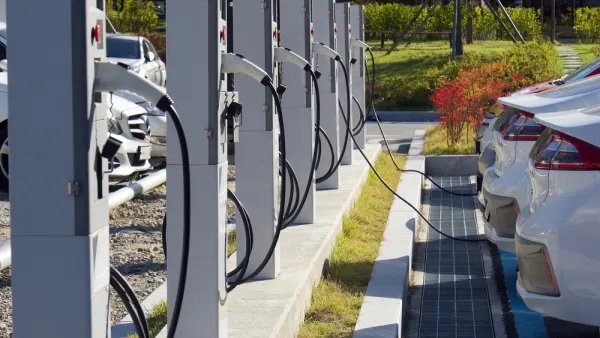
States File Lawsuit Over EV Charging Funds
A coalition of states sued the Trump administration over its suspension of funding for the National Electric Vehicle Infrastructure program.

April Must-Reads: Top 10 Articles From Last Month
A key federal housing assistance program is in peril, Maui tries to balance housing affordability with its tourism-based economy, and a landmark Virginia law could set a new standard for road safety.

Planetizen Federal Action Tracker
A weekly monitor of how Trump’s orders and actions are impacting planners and planning in America.

‘Going backwards:’ Baltimore mayor, students rally against state's transit funding plan
Maryland's proposed six-year plan provides no funding for Baltimore’s BMORE bus program and reduces its road maintenance funding.

Detroit to transform waterfront with $2.2 billion investment
Developers will convert about 18 acres of unused parking lot space into civic spaces.

'Fertilization president' to reward areas with high birthrates more transit funding
The Federal Transit Association plans to cover up to 10% more of a transit project's costs if the community’s birth rates meet or exceed national thresholds.

25 states, cities sue the EPA over erased power plant emissions limits
The coalition also intends to sue the EPA for not regulating emissions from gas-fired power plants.

Newsom vetoes giving CA tribes greater voice in water projects
In his veto letter, Newsom said the bill would add ‘uncertainty’ to the state’s fight to secure Californians’ water supplies.

FREE Course: Walkable City 1: Why Walkability?
After describing his path towards focusing on walkability as the essence of good planning, Jeff Speck marches through his five principal reasons for making more walkable places.
Reinventing Malls: Planning Alchemy—Turning Gray Fields Into Gold
The course focuses on the opportunities and imperatives that shape reinvention of mall sites.

City of Thousand Oaks
City of Wisconsin Rapids
Harvard University Graduate School of Design
The Architects Foundation
University of Cincinnati Online
Northern Illinois Transit Authority (NITA)
The Pocatello Development Authority
The Urban Renewal Agency of the City of Pocatello

