A federal commission cleared the way for the president's proposed 250-foot arch.


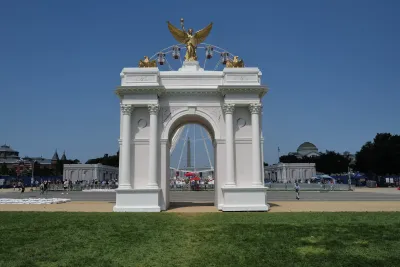
The National Capital Planning Commission, a federal body tasked with assessing the planning issues around monuments such as materials, placement and pedestrian safety, approved preliminary plans for President Donald Trump's proposed 250-foot arch, prompting questions about whether D.C. height limits apply to federal projects.
As Rachel Treisman explains for NPR, the commission "promised to revisit the height question" at its next meeting. Will Scharf, chair of the commission, said he doubts whether the 1910 Height of Buildings Act applies to federal construction, despite a long-held policy by the commission that upheld it. The Department of the Interior's Office of the Solicitor submitted a memo saying the act is "just a local zoning ordinance and does not apply to the United States.'"
According to the planning commission's general counsel and secretariat Meghan Hottel-Cox,, "If the HBA no longer applies to federal property in the District, it could fundamentally reshape the city's architectural fabric, the balance of local vs. federal authority, and the visual character of the nation's capital."
Washington D.C.'s height limits arose from concerns in the 1890s about tall buildings blocking light and air, as well as building safety. Congress passed the first HBA in 1899, revising it in 1910 to remove an exemption for federal buildings.
Read the full story: Trump's arch clears another hurdle, setting up a big debate: Do height limits apply?
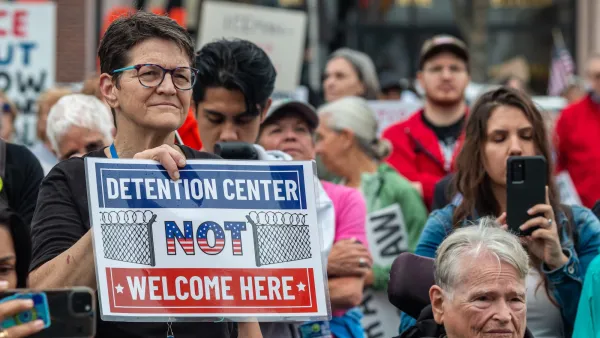
Land use as protest: How American cities are fighting federal immigration detention centers
Across the country, city officials are using zoning codes and land use law to limit where ICE detention facilities can be built.
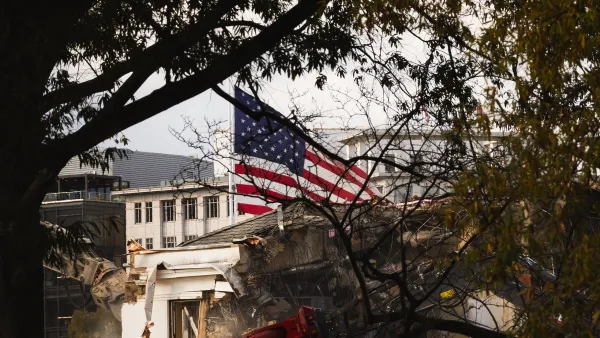
Trump Says White House Ballroom Exempt from Permitting, Zoning Rules
The President reportedly told teams working on the ballroom that the project doesn’t have to comply with regulations.
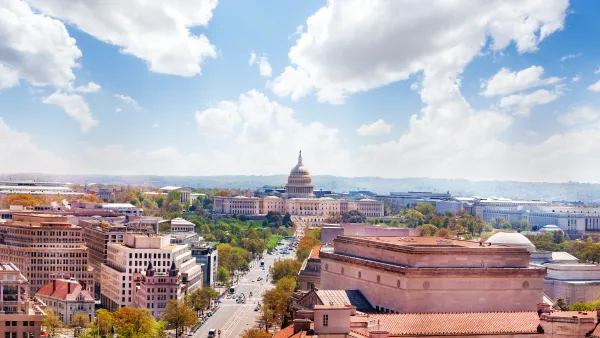
Is it Time to Revise D.C.’s Height Act?
The century-old rule has shaped the District’s iconic horizontal skyline, but some Council members say it need revision in light of the region’s growing housing crisis.

Planetizen Federal Action Tracker
A weekly monitor of how Trump’s orders and actions are impacting planners and planning in America.

Washington state to charge fee to drivers with fuel-efficient cars
Revenue from the fee will go towards supporting the state’s highways.

Trump to blast ‘hydrocarbon highway’ through ‘world’s longest art gallery’
Environmental and historic preservation groups are suing to stop the project.

Data centers need power – lower income, rural residents pay the price
In 2025, data centers paid only 38% of the energy infrastructure costs linked to their growth, with households, especially rural and low-income residents, bearing the remaining burden.

MBTA Green Line project moved to next phrase of CIG program
The modernization effort will cost $4.08 billion.

22-mile pedestrian and bike path to encircle Atlanta by 2030
The project will also support affordable housing.

FREE Course: Walkable City 1: Why Walkability?
After describing his path towards focusing on walkability as the essence of good planning, Jeff Speck marches through his five principal reasons for making more walkable places.
Reinventing Malls: Planning Alchemy—Turning Gray Fields Into Gold
The course focuses on the opportunities and imperatives that shape reinvention of mall sites.

City of Charlotte
City of Rosemead
Rutgers University, Edward J. Bloustein School of Planning and Public Policy
University of Michigan School for Environment and Sustainability (SEAS)
Hunter College, City University of New York (CUNY)
The Architects Foundation
University District Partnership