The judge said the administration did not offer “any plausible connection” between transportation projects and immigration enforcement.


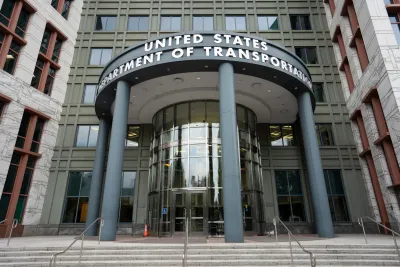
A federal judge in Rhode Island ruled that the Trump administration can’t tie federal transportation funding to a city or state’s immigration policies, seemingly negating a weapon the administration has been yielding against so-called sanctuary states and cities.
As Alex Nieves explains in Politico, “The decision represents another victory for Democrat-led states that have countered DOT’s attempts to disrupt transportation funding, including $5 billion for electric vehicle chargers that a judge in June ordered the Trump administration to unfreeze.”
In his preliminary injunction, Judge John McConnell wrote that the Trump administration did not cite “any plausible connection between cooperating with ICE enforcement and the congressionally approved purposes of the Department of Transportation.”
FULL STORY: Judge rules Trump administration can’t tie transportation funding to immigration

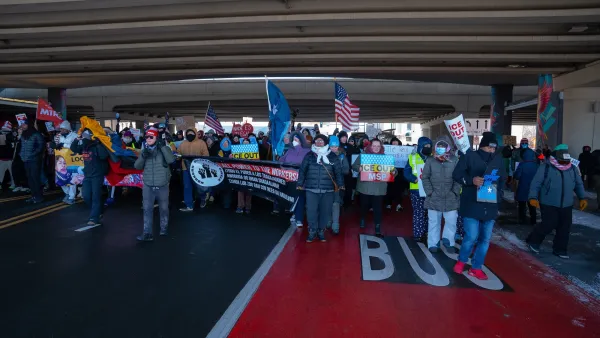
USDOT Ends Effort to Tie Transportation Funding to ICE Cooperation
The department ended its effort to challenge a court ruling barring it from withholding federal grants over immigration enforcement.

Judge Halts Trump Order Tying State Transportation Grants to Immigration Actions
Ruling applies to Colorado, which was among 20 plaintiff states.
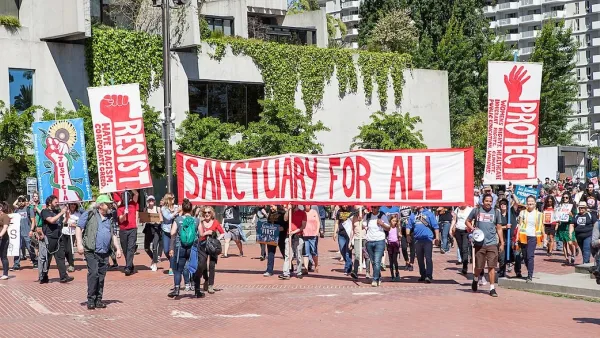
Duffy Threatens to Cut DOT Funds to “Sanctuary Cities”
“Follow the law or forfeit the funding” says US Secretary of Transportation.

Planetizen Federal Action Tracker
A weekly monitor of how Trump’s orders and actions are impacting planners and planning in America.

The state-sanctioned urbicide of Austin
People don’t kill cities. Freeways do.

US to reduce Colorado River water deliveries to Mexico
A new Colorado Treaty amendment reduces Mexico’s Colorado River water allocation by 250,000 acre feet.

Baltimore to break ground on $50 million Transit Priority Project
The project will bring faster bus trips, safer streets and better bike connections to Baltimore.

Airbnb launches $250 million 'last-dollar financing' housing accelerator, makes first investment in Austin
The company will put $6.4 million towards affordable housing development in Texas’ capital.

Guerilla urbanists are building DIY bus stop benches in Chicago
A before-and-after of one of the bus stops with a new bench. The new benches are not officially sanctioned or permitted, but the residents who placed them hope they will be the start of a network of DIY benches across the city.

FREE Course: Walkable City 1: Why Walkability?
After describing his path towards focusing on walkability as the essence of good planning, Jeff Speck marches through his five principal reasons for making more walkable places.
Reinventing Malls: Planning Alchemy—Turning Gray Fields Into Gold
The course focuses on the opportunities and imperatives that shape reinvention of mall sites.

Eagle County Government
Harvard University Graduate School of Design
Nashville Planning Department
The Architects Foundation
University of Cincinnati Online
The Pocatello Development Authority
The Urban Renewal Agency of the City of Pocatello
Journal of the American Planning Association