Leaving rail funding up to annual appropriations threatens to drastically limit its reliability and effectiveness.


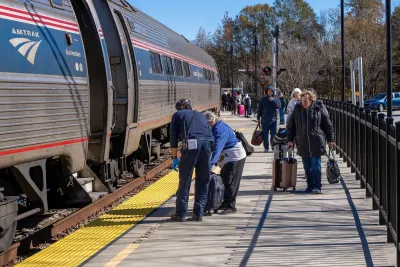
The National Rail Passengers Association is warning that the currently proposed draft of the BUILD America 250 Act would endanger funding for passenger rail and could ultimately lead to a drop of 80% in federal railway funding, writes Kea Wilson in Streetsblog USA.
According to Wilson, "Unlike the Bipartisan Infrastructure Law, which the new bill would theoretically replace when it expires on Sept. 30, BUILD America 250 includes no 'advanced appropriations' for any transportation program not secured by the Highway Trust fund — a $106 billion category which includes all funding for passenger rail." This means rail funding would have to be approved by Congress each year, unlike funds for highway programs.
"Given an annual appropriations process that is more likely to generate an extended government shutdown than pass a bill on time, we can say with a high degree of confidence: there won’t be enough funding," said Sean Jeans-Gail, the NRPA's vice president of government affairs and policy.
Read the full story: Why BUILD America 250 Would Be Uniquely Bad For Passenger Rail

Trump budget slashes passenger rail funding by 82%
The White House's proposed FY2027 budget makes drastic cuts to public transit and eliminates high-speed rail funding altogether.

Texas DOT report outlines options for commuter rail between Austin and San Antonio
Amtrak currently operates just one trip per day between the two cities.
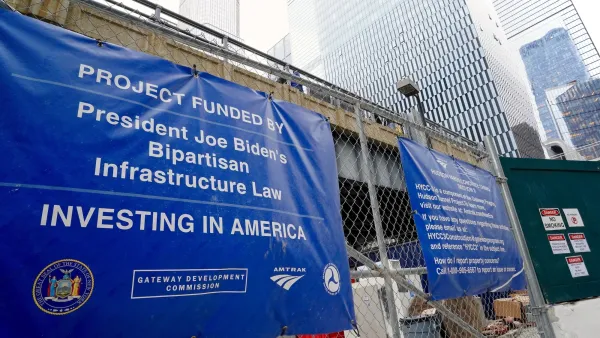
NYC-NJ Gateway Tunnel Project to Stop Work Next Week if DOT Doesn’t Release Funding
The federal government hasn’t released funding frozen during last October’s government shutdown.

Planetizen Federal Action Tracker
A weekly monitor of how Trump’s orders and actions are impacting planners and planning in America.

California plans to bury El Niño’s downpour
If the state plays its cards right, it may be able to store a billion acre-feet of El Niño’s water in aquifers.

Chicago breaks ground on $3 billion megadevelopment
The new neighborhood, titled Foundry Park, will one day host 3,700 residences.

Satanic Place Names
From streams and lakes to valleys and canyons, I mapped more than 1,000 places named after the Devil.

California High-Speed Rail Authority CEO resigns after $600,000 scandal
Under Ian Choudri, the authority used taxpayer dollars to fund first class flights and trips to nightclubs.

Want to study the Missouri River? Soon, you may need unanimous approval from 10 states
Legislation would require 10 governors’ permission to study or build projects moving water outside the basin.

FREE Course: Walkable City 1: Why Walkability?
After describing his path towards focusing on walkability as the essence of good planning, Jeff Speck marches through his five principal reasons for making more walkable places.
Reinventing Malls: Planning Alchemy—Turning Gray Fields Into Gold
The course focuses on the opportunities and imperatives that shape reinvention of mall sites.

City of Rosemead
Rutgers University, Edward J. Bloustein School of Planning and Public Policy
One Hundred Miles
Hunter College, City University of New York (CUNY)
The Architects Foundation
University of Cincinnati Online
City of Cambridge
Montrose County
The Pocatello Development Authority