The agency plans to repeal a key 2009 rule that underpins the government’s authority to regulate greenhouse gas emissions.


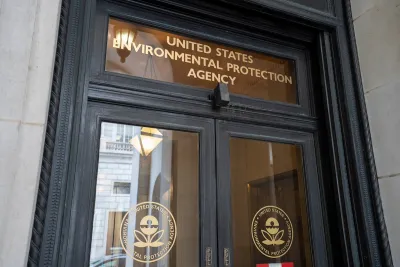
The Environmental Protection Agency (EPA) plans to revoke the 2009 declaration known as the ‘endangerment finding,’ a foundation of the government’s effort to fight climate change.
As Maxine Joselow and Lisa Friedman explain in the New York Times, the finding established that greenhouse gases pose a threat to public health. “The Obama and Biden administrations used that determination to set strict limits on greenhouse gas emissions from cars, power plants and other industrial sources of pollution.”
Without the endangerment finding, the E.P.A. would be left with no authority under the Clean Air Act to regulate the greenhouse gas emissions that are accumulating in the atmosphere from the burning of fossil fuels.
EPA administrator Lee Zeldin called the change “the largest deregulatory action in the history of the United States,” adding that the decision would eliminate limits on emissions for cars and trucks, among other regulations. In the United States, transportation emissions are the largest source of greenhouse gases.
The EPA cited a report from five scientists “known for their rejection of the overwhelming scientific consensus on climate change” that claims climate change models exaggerate warming and that carbon dioxide has overall positive effects because of its usefulness to plants.
FULL STORY: In Game-Changing Climate Rollback, E.P.A. Aims to Kill a Bedrock Scientific Finding

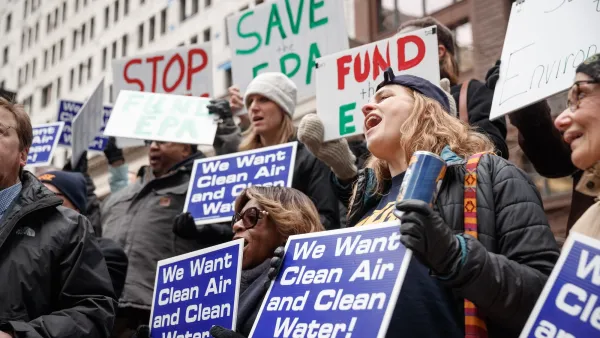
EPA Guts Emissions Regulations
The agency is eliminating the endangerment finding that underpins the agency’s authority to regulate greenhouse gas emissions.
Ways the EPA Can Still Fight Climate Change
Despite the Supreme Court’s recent decision to limit the EPA’s ability to regulate emissions from power plants, the agency still has a range of tools at its disposal for enforcing pollution controls and reducing harmful emissions.
House Moves to Rescind California’s Emissions Standards
The state has been allowed to set its own emissions goals, including a mandate to transition to electric or zero-emissions vehicles by 2035.

The state-sanctioned urbicide of Austin
People don’t kill cities. Freeways do.

US to reduce Colorado River water deliveries to Mexico
A new Colorado Treaty amendment reduces Mexico’s Colorado River water allocation by 250,000 acre feet.

New Jersey’s second-largest city bans standalone data centers
Jersey City will continue to allow co-location facilities, such as those meant for research institutions that store their own data.

Amtrak not solely to blame for New Jersey commuter rail's unreliability, report finds
A new study from the Garden State Initiative found that NJ Transit’s budget grew 20% across a 4 year period, but reliability declined significantly over the same period.

EPA erases limits on planet-warming pollution from power plants
Under Monday’s plan, power plants would still have some limits on how much mercury, arsenic and other contaminants they can emit.

Phoenix announces new on-demand transit service, more frequent RAPID buses
Both new services will launch in October, and are part of Phoenix's Project Effective Access Solutions for Easing Congestion.

FREE Course: Walkable City 1: Why Walkability?
After describing his path towards focusing on walkability as the essence of good planning, Jeff Speck marches through his five principal reasons for making more walkable places.
Reinventing Malls: Planning Alchemy—Turning Gray Fields Into Gold
The course focuses on the opportunities and imperatives that shape reinvention of mall sites.

Eagle County Government
Harvard University Graduate School of Design
Nashville Planning Department
The Architects Foundation
University of Cincinnati Online
The Pocatello Development Authority
The Urban Renewal Agency of the City of Pocatello
Journal of the American Planning Association