The state has been allowed to set its own emissions goals, including a mandate to transition to electric or zero-emissions vehicles by 2035.



The U.S. House of Representatives reversed exemptions that allowed California to set its own emissions standards and target higher reduction goals than other states.
As Damien Newton explains in Streetsblog USA, “Because California was regulating air quality issues decades before the federal government, it is the only state that can get a waiver from the Feds to set more stringent standards.”
The House took the action using the 1996 Congressional Review Act (CRA), which allows Congress a short window to review and revoke federal rules. Newton adds, “By using the CRA instead of simply having the Trump-led EPA revoke the waiver again, Republicans hope to end the back-and-forth over the waiver should the Democrats retake the White House.”
According to Newton, “If the Senate follows the House’s lead and California loses in court, it would be a disaster for the state’s plans to reduce Greenhouse Gas Emissions.” Because other states were allowed to match California’s standards, the decision will have impacts far beyond California itself.
FULL STORY: Congress Declares War on State’s Clean Air Efforts

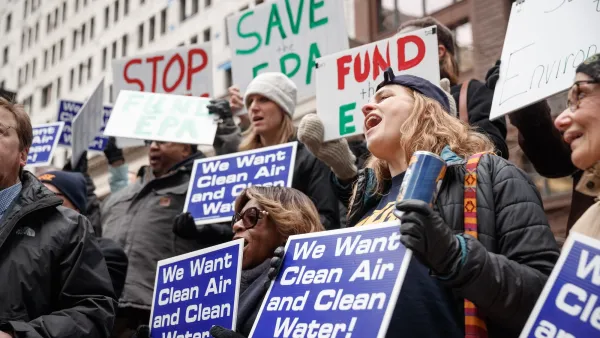
EPA Guts Emissions Regulations
The agency is eliminating the endangerment finding that underpins the agency’s authority to regulate greenhouse gas emissions.
EPA Plans “Largest Deregulatory Action” in History
The agency plans to repeal a key 2009 rule that underpins the government’s authority to regulate greenhouse gas emissions.
Trump's proposed budget slashes EPA funding by 52%
The budget also reduces funding for FEMA, climate resilience projects, and water infrastructure programs.

Planetizen Federal Action Tracker
A weekly monitor of how Trump’s orders and actions are impacting planners and planning in America.

The state-sanctioned urbicide of Austin
People don’t kill cities. Freeways do.

US to reduce Colorado River water deliveries to Mexico
A new Colorado Treaty amendment reduces Mexico’s Colorado River water allocation by 250,000 acre feet.

Baltimore to break ground on $50 million Transit Priority Project
The project will bring faster bus trips, safer streets and better bike connections to Baltimore.

Airbnb launches $250 million 'last-dollar financing' housing accelerator, makes first investment in Austin
The company will put $6.4 million towards affordable housing development in Texas’ capital.

Guerilla urbanists are building DIY bus stop benches in Chicago
A before-and-after of one of the bus stops with a new bench. The new benches are not officially sanctioned or permitted, but the residents who placed them hope they will be the start of a network of DIY benches across the city.

FREE Course: Walkable City 1: Why Walkability?
After describing his path towards focusing on walkability as the essence of good planning, Jeff Speck marches through his five principal reasons for making more walkable places.
Reinventing Malls: Planning Alchemy—Turning Gray Fields Into Gold
The course focuses on the opportunities and imperatives that shape reinvention of mall sites.

Eagle County Government
Harvard University Graduate School of Design
Nashville Planning Department
The Architects Foundation
University of Cincinnati Online
The Pocatello Development Authority
The Urban Renewal Agency of the City of Pocatello
Journal of the American Planning Association