For public land advocates, the Senate Republicans’ proposal to sell millions of acres of public land in the West is “the biggest fight of their careers.”


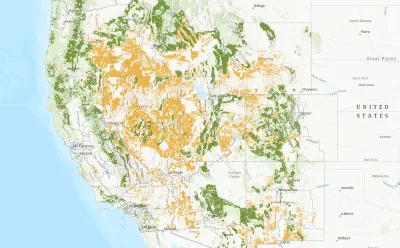
If a Senate Committee on Energy and Natural Resources proposal to sell hundreds of millions acres of public lands in the West goes through, it could cause irreparable damage to sensitive natural, historical, and cultural sites, warn groups from conservationists to hunters to indigenous communities.
As Andrew McKean explains in Outdoor Life, “The bill, in a section titled ‘Mandatory Disposal of Bureau of Land Management Land and National Forest Service System Land for Housing,’ requires the BLM and Forest Service to ‘select for disposal no less than 0.50 percent and not more than 0.75 percent’ of eligible land for sale. National parks, wildlife refuges, designated wilderness areas, national monuments, and historic sites would be exempt from sale.” A map created by The Wilderness Society illustrates the over 250 million acres eligible for sale under the proposal.
Although the bill purports to make more land available for affordable housing, critics point out that, while some strategic use of federal land could help, much of the land in question is far from existing cities and infrastructure and unsuitable for housing. The bill’s language includes an expansive “associated community needs” provision that could allow for “nearly any purpose,” according to an attorney who analyzed the text.”He says that could include AI data centers, ski areas, golf courses, or consolidation of large ranches.” Meanwhile, the administration has moved to open more public lands to mining, timber, and other extractive industries.
This isn’t a uniquely Western concern. “It doesn’t matter if you live in Bozeman or Baltimore, these lands belong to you,” said an unnamed legislative source who provided details for the story. Actions to defund, shrink, and eliminate national monuments and historic and cultural sites will harm ecosystems, erase key parts of the nation’s history, and make public lands less accessible to all Americans.
FULL STORY: More Details Emerge Around the Public Land Sale Bill — and It’s Worse Than You Think


Most Public Lands Are Safe — For Now
A proposal to sell off federally owned lands was removed from the Republican spending bill on procedural grounds.
Trump Administration Wants to Remove Conservation From Approved 'Uses' of Public Land
The Department of the Interior moved to officially rescind the Public Lands Rule passed in 2024, which elevates the conservation of public lands to the same level of protection as other uses.
DOJ Says Trump Has Power to Roll Back National Monuments
The opinion sheds light on how the administration may justify its effort to eliminate protected public lands.

Planetizen Federal Action Tracker
A weekly monitor of how Trump’s orders and actions are impacting planners and planning in America.

The state-sanctioned urbicide of Austin
People don’t kill cities. Freeways do.

US to reduce Colorado River water deliveries to Mexico
A new Colorado Treaty amendment reduces Mexico’s Colorado River water allocation by 250,000 acre feet.

5 New England states march closer to 800 megawatt wind energy project
Securing federal approval for the project may be complicated under the Trump administration, which has historically been hostile towards domestic wind power.

Baltimore to break ground on $50 million Transit Priority Project
The project will bring faster bus trips, safer streets and better bike connections to Baltimore.

Airbnb launches $250 million 'last-dollar financing' housing accelerator, makes first investment in Austin
The company will put $6.4 million towards affordable housing development in Texas’ capital.

FREE Course: Walkable City 1: Why Walkability?
After describing his path towards focusing on walkability as the essence of good planning, Jeff Speck marches through his five principal reasons for making more walkable places.
Reinventing Malls: Planning Alchemy—Turning Gray Fields Into Gold
The course focuses on the opportunities and imperatives that shape reinvention of mall sites.

Eagle County Government
Harvard University Graduate School of Design
Nashville Planning Department
The Architects Foundation
University of Cincinnati Online
The Pocatello Development Authority
The Urban Renewal Agency of the City of Pocatello
Journal of the American Planning Association