The MTA says it is committed to continuing work on the light rail project, but the pause signals a potential shift in federal funding for the east-west line.


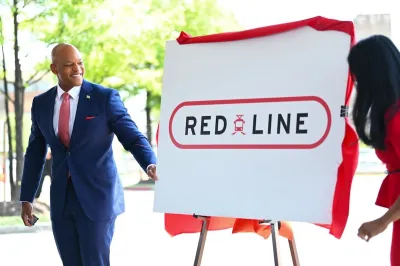
Federal and state officials have agreed to pause the federal review process for the proposed Red Line light rail in Baltimore, which could delay the completion of the project, reports Daniel Zawodny in The Banner.
According to Zawodny, “The proposed east-west light rail needs certain permits — including an approved environmental impact statement, or EIS, and one demonstrating compliance with the National Historic Preservation Act — to pass federal scrutiny and receive funding.”
Although the review process was paused in June, no announcement was made until last week, when a Red Line spokesperson noted the process was paused “due to uncertainty at the federal level and the need to reassess the project timelines.” The Maryland Transit Administration (MTA) says the pause will not delay any ongoing technical work, but the project would be difficult to complete if federal funding is revoked.
Read the full story: Permitting process for Baltimore’s Red Line paused by state and federal officials

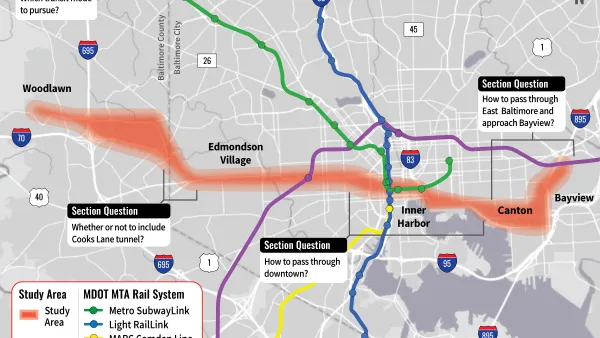
Details Start to Emerge for Revived Baltimore Red Line
The long-awaited east-west transit line is moving forward with support from a new governor, but still has a long road ahead.
Op-Ed: Maryland Governor Is No Friend to Transit
According to this editorial, Governor Larry Hogan's decision to halt a planned $2.9 billion light rail line betrays a politically-motivated preference for roads.
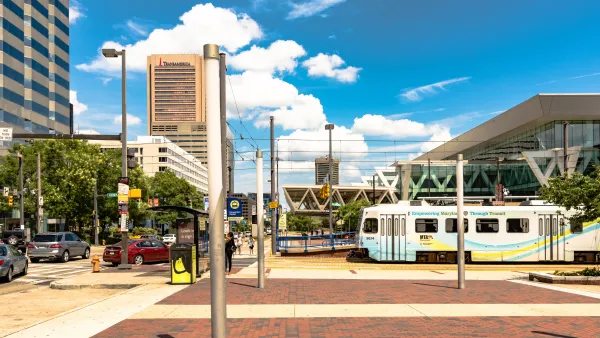
Light Rail It Is for Baltimore’s Red Line Project
The decision to go with light rail over bus rapid transit will be more expensive and take longer to complete, but proponents say it’s an investment in Baltimore’s economic future.

Planetizen Federal Action Tracker
A weekly monitor of how Trump’s orders and actions are impacting planners and planning in America.

California plans to bury El Niño’s downpour
If the state plays its cards right, it may be able to store a billion acre-feet of El Niño’s water in aquifers.

Chicago breaks ground on $3 billion megadevelopment
The new neighborhood, titled Foundry Park, will one day host 3,700 residences.

Satanic Place Names
From streams and lakes to valleys and canyons, I mapped more than 1,000 places named after the Devil.

California High-Speed Rail Authority CEO resigns after $600,000 scandal
Under Ian Choudri, the authority used taxpayer dollars to fund first class flights and trips to nightclubs.

Want to study the Missouri River? Soon, you may need unanimous approval from 10 states
Legislation would require 10 governors’ permission to study or build projects moving water outside the basin.

FREE Course: Walkable City 1: Why Walkability?
After describing his path towards focusing on walkability as the essence of good planning, Jeff Speck marches through his five principal reasons for making more walkable places.
Reinventing Malls: Planning Alchemy—Turning Gray Fields Into Gold
The course focuses on the opportunities and imperatives that shape reinvention of mall sites.

City of Rosemead
Rutgers University, Edward J. Bloustein School of Planning and Public Policy
One Hundred Miles
Hunter College, City University of New York (CUNY)
The Architects Foundation
University of Cincinnati Online
City of Cambridge
Montrose County
The Pocatello Development Authority