According to this editorial, Governor Larry Hogan's decision to halt a planned $2.9 billion light rail line betrays a politically-motivated preference for roads.


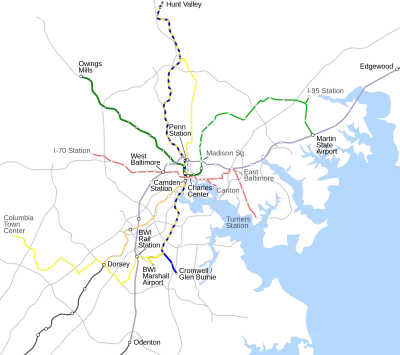
Maryland Governor Larry Hogan has decided against constructing the Baltimore Red Line, a rail project on the drawing boards for "a dozen or so" years, along with corresponding transit-oriented development projects. "The loss of the Red Line, the $2.9 billion, 14.1-mile east-west light rail line represented not only thousands of jobs but perhaps billions in development opportunities around the 19 planned stations between Woodlawn and Johns Hopkins Bayview."
The article claims Hogan is beholden to rural interests who favor roads over transit. "That Mr. Hogan now intends to cannibalize the Red Line to finance more road and bridge projects "in every county in the state" only adds insult to injury, underscoring the fact that most elected leaders in the Baltimore metropolitan area favored light rail [...]"
By rejecting the Red Line, Maryland will lose out on $900 million in federal funds designated to support the project. "[Hogan's] unilateral actions (held as a closely-guarded secret until Thursday's announcement) do not represent the behavior of a 'partner' or a 'friend' but of a politician beholden to rural and politically conservative suburban constituencies that care not a fig for Baltimore."
Read the full story: Hogan goes off the tracks
Civil Rights Activists Target Baltimore Red Line Cancellation
A complaint filed with the U.S. Department of Transportation alleges that Maryland Gov. Hogan's decision to cancel the long-planned Red Line rail project violates the Civil Rights Act.
Feds Pause Baltimore Red Line Permits
The MTA says it is committed to continuing work on the light rail project, but the pause signals a potential shift in federal funding for the east-west line.
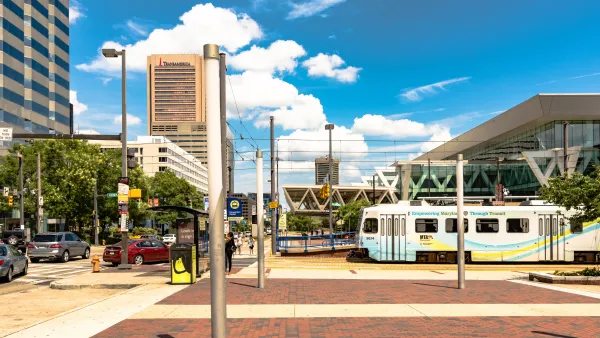
Light Rail It Is for Baltimore’s Red Line Project
The decision to go with light rail over bus rapid transit will be more expensive and take longer to complete, but proponents say it’s an investment in Baltimore’s economic future.

Planetizen Federal Action Tracker
A weekly monitor of how Trump’s orders and actions are impacting planners and planning in America.

Washington state to charge fee to drivers with fuel-efficient cars
Revenue from the fee will go towards supporting the state’s highways.

Illinois considers spending $1 billion in taxpayer money on data center
A quantum computing campus and data center are currently under construction in Chicago.

Senate passes bill overhauling permitting
The bill still needs to pass the House.

Did data centers change how voters cast their ballots?
Texas, Ohio, and Georgia all flipped party control. But in rural counties, the effect of local data centers was mixed.

Amtrak invests in eight new Airo trainsets
The new trainsets will begin serving passengers in 2031.

FREE Course: Walkable City 1: Why Walkability?
After describing his path towards focusing on walkability as the essence of good planning, Jeff Speck marches through his five principal reasons for making more walkable places.
Reinventing Malls: Planning Alchemy—Turning Gray Fields Into Gold
The course focuses on the opportunities and imperatives that shape reinvention of mall sites.


City of Charlotte
City of Rosemead
Rutgers University, Edward J. Bloustein School of Planning and Public Policy
University of Michigan School for Environment and Sustainability (SEAS)
Hunter College, City University of New York (CUNY)
The Architects Foundation
University District Partnership