At least 110 wind energy projects have not heard from the government since a federal judge ruled that the Trump administration's freeze on wind turbine clearances was likely illegal.


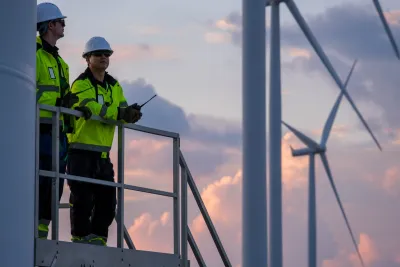
Nearly all wind energy projects in the United States are still on pause almost a month after a federal judge ruled that the Trump administration’s freeze on vertical height clearances for wind turbines was likely illegal. The administration has control over airspace higher than 200 feet, and therefore has control over wind projects on both private and public land, writes Jael Holzman for Heatmap.
On Sept. 17, the Trump administration provided its first update to the federal court since the ruling. Heatmap reports:
The administration claimed that “as a matter of policy” it had “resumed processing wind energy project applications,” but it only described a single instance where a company had heard from the military about moving forward. In addition, that company as well as all others affected by the freeze would still face a “new analytical methodology” for federal agencies reviewing height clearances for all projects, which appears to fly in the face of the ruling. The Justice Department did not provide any more detail about the methodology in its status update to the court.
According to the Department of Justice, at least 110 wind energy projects were in active discussion with the federal government before the injunction, and none have heard from officials since. Another 50 projects are awaiting initial meetings with the federal government.
Read the full story: Trump Keeps Wind Farms Waiting Despite Court Ruling
Despite Trump Administration Policies, Wind Power Still Growing
Technological improvements and market demand have buoyed the sector against the Trump adminsitration’s attacks.
Coal Miners Are Going Back to Work, Proclaims Trump Upon Signing Executive Order
Flanked by coal miners, President Trump signed an executive order on Tuesday that begins the roll back of his predecessor's signature environmental rule, the Clean Power Plan, and other environmental regulations to facilitate energy production.
Trump Administration Lawyering Up for Eminent Domain at the U.S.-Mexico Border
One of the nuggets of significance in the Trump Administration's budget draft indicates the president's seriousness about building a wall on the border between the United States and Mexico.

Planetizen Federal Action Tracker
A weekly monitor of how Trump’s orders and actions are impacting planners and planning in America.

California plans to bury El Niño’s downpour
If the state plays its cards right, it may be able to store a billion acre-feet of El Niño’s water in aquifers.

Desperate measures: Advocates weigh draining Lake Powell to fill Colorado River
Draining the reservoir could reduce evaporation losses by a couple hundred thousand acre-feet.

US buildings threatened, destroyed by fires set to triple by 2060
Researchers found a high fire risk for socioeconomically vulnerable neighborhoods in the American West.

LA residents may be allowed to paint their own crosswalks
Councilwoman Katy Yaroslavsky put out a motion instructing the Los Angeles Department of Public Transportation to study the feasibility of allowing volunteers to paint crosswalks.

Dallas moves to overhaul its zoning code
The city's zoning reform will allow more multi-family and mixed-use developments.

FREE Course: Walkable City 1: Why Walkability?
After describing his path towards focusing on walkability as the essence of good planning, Jeff Speck marches through his five principal reasons for making more walkable places.
Reinventing Malls: Planning Alchemy—Turning Gray Fields Into Gold
The course focuses on the opportunities and imperatives that shape reinvention of mall sites.

City of Rosemead
Rutgers University, Edward J. Bloustein School of Planning and Public Policy
One Hundred Miles
Hunter College, City University of New York (CUNY)
The Architects Foundation
University of Cincinnati Online
City of Cambridge
Montrose County
The Pocatello Development Authority