The council is tasked with creating a design guidebook to align with Trump’s preference for neoclassical architecture.


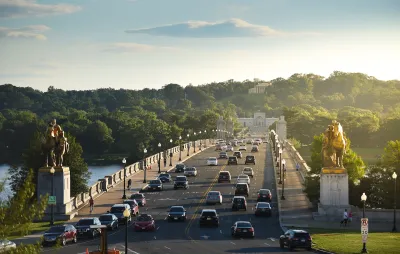
The U.S. Department of Transportation’s new Beautifying Transportation Infrastructure Council could dramatically reshape the look and design of American transportation infrastructure, writes Nate Berg in Fast Company.
According to Berg:
Though the council was created to serve an advisory role with no decision-making or funding authority, it currently has two major agenda items that could form the basis of a widespread makeover of American transportation infrastructure.
The council’s first task is a national design competition “seeking innovative thinking around transportation infrastructure design.” The second is creating a design guidebook with aesthetic recommendations for federal transportation projects tentatively titled “Beauty and Transportation.”
The announcement of the council states that its preferences will align with those laid out in President Trump’s “Making Federal Architecture Beautiful Again” executive order, which “defines the traditional and classical architecture of ancient Athens and Rome as the basis of a preferred architectural style for federal buildings.”
According to council chair and president of the National Civic Art Society Justin Shubow, USDOT has outlined design principles including that “transportation infrastructure should be designed to uplift and inspire the human spirit and lend prestige to the nation,” and that it “should foster a sense of place and inspire national and community pride in a way that builds upon the past.”
Read the full story: The DOT’s new beautification council could Trumpify U.S. transportation infrastructure


New USDOT safety strategy highlights enforcement, embraces autonomous cars
The new National Roadway Safety Strategy emphasizes safety technology and enforcement and promises to further crack down on immigrant truck drivers with illicitly obtained licenses.
USDOT will stop enforcing a key civil rights law
The agency will no longer enforce Title VI, eliminating disparate impact protections for federally protected groups.

USDOT Blocks Federal Funding for Traffic Cameras
Applicants to the Safe Streets and Roads for All grant program will not be allowed to use funds for automated traffic enforcement.

Planetizen Federal Action Tracker
A weekly monitor of how Trump’s orders and actions are impacting planners and planning in America.

California plans to bury El Niño’s downpour
If the state plays its cards right, it may be able to store a billion acre-feet of El Niño’s water in aquifers.

Chicago breaks ground on $3 billion megadevelopment
The new neighborhood, titled Foundry Park, will one day host 3,700 residences.

Satanic Place Names
From streams and lakes to valleys and canyons, I mapped more than 1,000 places named after the Devil.

California High-Speed Rail Authority CEO resigns after $600,000 scandal
Under Ian Choudri, the authority used taxpayer dollars to fund first class flights and trips to nightclubs.

Want to study the Missouri River? Soon, you may need unanimous approval from 10 states
Legislation would require 10 governors’ permission to study or build projects moving water outside the basin.

FREE Course: Walkable City 1: Why Walkability?
After describing his path towards focusing on walkability as the essence of good planning, Jeff Speck marches through his five principal reasons for making more walkable places.
Reinventing Malls: Planning Alchemy—Turning Gray Fields Into Gold
The course focuses on the opportunities and imperatives that shape reinvention of mall sites.

City of Rosemead
Rutgers University, Edward J. Bloustein School of Planning and Public Policy
One Hundred Miles
Hunter College, City University of New York (CUNY)
The Architects Foundation
University of Cincinnati Online
City of Cambridge
Montrose County
The Pocatello Development Authority