Two UC Berkeley economists evaluated whether to charge electric vehicles a mileage fee since they pay no fuel taxes. A study from the Mineta Institute evaluated the impact of new EV registration fees and increased fuel taxes in California.


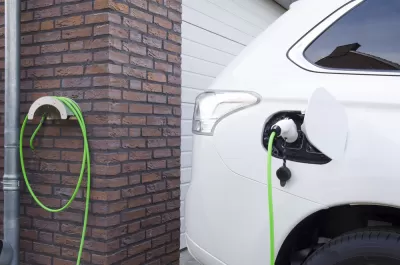
Two studies into the costs of electric vehicles were released in July. Laura Bliss, CityLab’s west coast bureau chief, reports on an economics study by the Energy Institute at BerkeleyHaas (source article), while Melanie Curry, editor of Streetsblog California, evaluates the findings of a Mineta Transportation Institute on the financial impact of zero-emission vehicles in California.
Last year saw a record 81 percent increase in electric vehicle (EV) sales, and those sales will likely increase as more electric models with greater range enter dealers' showrooms and more public EV charging infrastructure is installed to keep them powered. "But are all those Bolts, Leafs, and Teslas paying their fair share for the asphalt they drive on?" asks Bliss, noting that these vehicles pay no fuel taxes, the primary source of revenue for the Highway Trust Fund which will exhaust its current funding at the end of September 2020.
In a new working paper for the National Bureau of Economic Research [a non-profit, non-partisan organization dedicated to conducting economic research], Lucas Davis, a professor of business and technology and a director of U.C. Berkeley’s Energy Institute, and James Sallee, a professor in the school’s Department of Agricultural and Resource Economics, estimate that while the U.S. does indeed forgo millions in tax revenue thanks to EVs, instituting a special tax on electric vehicles might produce unwanted side effects. [Full report accessible as (PDF) via the Energy Institute].
How much funding is forgone in gas tax revenue, and how is it regressive?
Davis and Sallee estimate about $250 million a year, based on vehicle substitution trends and average miles driven. That’s a fairly modest hit, but per EV, it seems weightier: $318 annually, according to their estimates.
What’s more, Sallee and Davis estimate that two-thirds of those foregone resources comes from households that make more than $100,000 in annual income, since EVs tend to be more expensive to purchase than conventional cars and are disproportionately driven by more affluent people. This suggests that the under-taxation of zero-emissions cars has a “regressive” effect—it hurts poorer Americans more than rich folks.
The purpose of the study was to evaluate charging EVs what the researchers refer to as a "mileage tax," aka road usage charge, mileage-based user fee, or vehicle miles traveled fee. Only one state has such a fee – Oregon, which has been in operation since July 2015 for a limited number of vehicles, although many states have conducted pilot programs.
In the long run, however, a mileage fee for all vehicles is probably the best answer of all, the researchers conclude. Unlike the venerable gas tax, a mileage fee could vary by time and location, and it could be priced to account for more of the negative social impacts of driving.
Perhaps that’s the most useful takeaway of this paper. The gas tax—the baseline for how much driving “should” be taxed—is so vastly underpriced that trying to compute a fair way to layer additional fees on top of it becomes complicated, quickly.
While some experts suggest that statewide mileage fee for all vehicles is about a decade away, it may be more practical to require only electric vehicles to participate in a program, as UC Davis researchers advised the California legislature earlier this year.
What about EV registration fees?
Since October 2018, at least 21 state legislatures haven't waited for a mileage fee to ensure that electric vehicles, and even gas tax-paying hybrid vehicles in many states, contribute to road costs by requiring that they pay a special registration fee, according to the National Conference of State Legislatures. California joined that list in April 2017 with the passage of Senate Bill 1.
Beginning July 1, 2020, "owners of electric vehicles will begin paying a Road Improvement Fee of $100, an amount that was supposed to approach what the average gas car driver pays in gas taxes annually," writes Melanie Curry, editor of Streetsblog California. In addition, SB 1 subjected all light-duty vehicles to a new Transportation Improvement Fee, which took effect January 1, 2018, which ranges from $25 to $175, depending on the value of the vehicle.
Three researchers who have studied the ins and outs of gas taxes for years–Martin Wachs, professor emeritus at the UCLA Luskin Center, Hannah King of UCLA, and Asha Weinstein Agrawal Weinstein of the Mineta Institute–have just published a report estimating how much revenue that is likely to be.
The study is particularly significant in the sense that it is evaluated both increases to gas and diesel excise taxes, diesel sales taxes, and the two new registration fees (see Table 1 [pdf] on pg. 2), all of which are indexed to inflation, that are in the Road Repair and Accountability Act of 2017. California's gas and diesel excise tax increased by 12 cents and 20 cents per gallon, respectively, on Nov. 1, 2017. On July 1, the gas tax increased by another 5.6 cents, making California the state with the highest gas tax at 61.2 cents per gallon, per API. Inflation adjustments will occur annually.
But even with the highest fuel taxes in the country, indexed for inflation, fuel tax revenues will fall due to projected adoption of non-gas tax-paying vehicles.
Like the Berkeley study, the Mineta study looks at foregone gas (and diesel) tax due to increased sales of electric vehicles. Last year, plug-in vehicles accounted for 7.8 percent of light-duty vehicle sales. Former Gov. Jerry Brown signed an executive calling for 5 million zero-emission vehicles on the road by 2030.
The key finding of the study is that revenue from the two new registration fees will more than compensate for the loss of fuel tax revenue as the proportion of electric vehicles increase in the Golden State.
"The California Transportation Commission continues to explore other ways to raise transportation revenue, such [as] through road-user charges that drivers would pay per mile driven," concludes Curry.
But this study shows that even without such a system, there will be a continuous source of money to maintain and improve California’s highways, streets, and roads–and that it was a very good idea for the legislature to make sure S.B. 1 included a way for electric vehicles to contribute.
Related in Planetizen:
-
Mileage Fee or Annual Fee for Electric Vehicles? January 11, 2019
- Should Electric Vehicles Be Taxed or Subsidized? July 1, 2015
FULL STORY: Should Electric Vehicle Drivers Pay Per Mile?

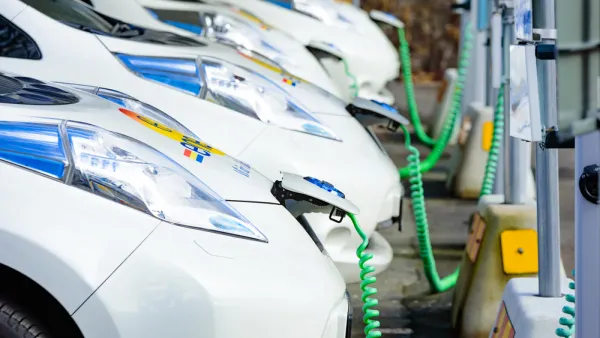
Consumer Group Accuses States of 'Punishing' Electric Vehicle Drivers
The advocacy division of Consumer Reports published a study to highlight the practice of what could soon be a majority of state governments: charging electric vehicle owners an additional registration fee to compensate for forgone fuel tax revenue.
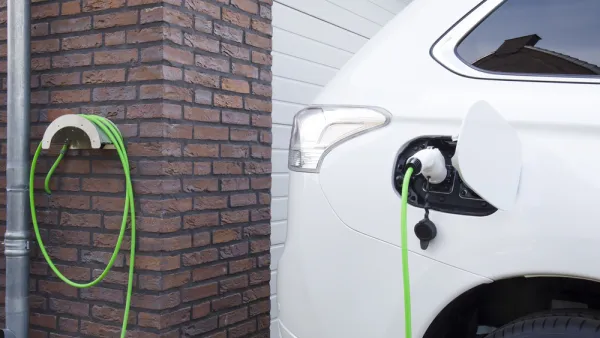
Mileage Fee or Annual Fee for Electric Vehicles?
What's the best way to ensure that electric vehicle drivers pay to maintain the roads they drive on, considering they don't pay fuel taxes? A new report from the UC Davis Institute of Transportation Studies was sent to the California legislature.
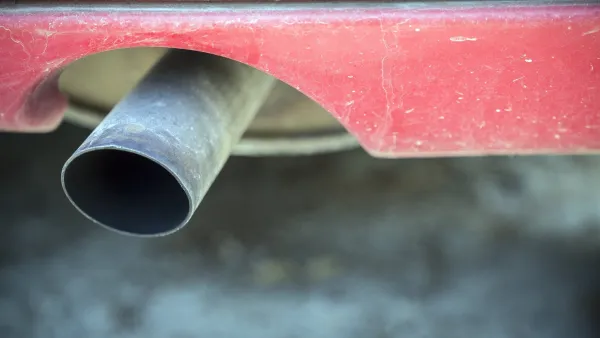
As EV Sales Soar, Transportation Emissions Continue to Increase
California has embraced electric vehicles like no other state, with success reflected in increased sales and registration data, yet transportation emissions have increased for the last four years, primarily from light-duty vehicles.

The state-sanctioned urbicide of Austin
People don’t kill cities. Freeways do.

US to reduce Colorado River water deliveries to Mexico
A new Colorado Treaty amendment reduces Mexico’s Colorado River water allocation by 250,000 acre feet.

New Jersey’s second-largest city bans standalone data centers
Jersey City will continue to allow co-location facilities, such as those meant for research institutions that store their own data.

Amtrak not solely to blame for New Jersey commuter rail's unreliability, report finds
A new study from the Garden State Initiative found that NJ Transit’s budget grew 20% across a 4 year period, but reliability declined significantly over the same period.

EPA erases limits on planet-warming pollution from power plants
Under Monday’s plan, power plants would still have some limits on how much mercury, arsenic and other contaminants they can emit.

Phoenix announces new on-demand transit service, more frequent RAPID buses
Both new services will launch in October, and are part of Phoenix's Project Effective Access Solutions for Easing Congestion.

FREE Course: Walkable City 1: Why Walkability?
After describing his path towards focusing on walkability as the essence of good planning, Jeff Speck marches through his five principal reasons for making more walkable places.
Reinventing Malls: Planning Alchemy—Turning Gray Fields Into Gold
The course focuses on the opportunities and imperatives that shape reinvention of mall sites.

Eagle County Government
Harvard University Graduate School of Design
Nashville Planning Department
The Architects Foundation
University of Cincinnati Online
The Pocatello Development Authority
The Urban Renewal Agency of the City of Pocatello
Journal of the American Planning Association