The Trump administration has canceled a nearly $1 billion grant assigned to the California high-speed rail project and is attempting to get the state to return the $2.5 billion it has already spent on the $77 billion project.


President Trump, like most Republicans, has never been a fan of high-speed rail and the California project, linking Northern and Southern California via the Central Valley, in particular.
On Feb. 12, Gov. Gavin Newsom (D), the successor to Gov. Jerry Brown (D), the state's long-time champion of high-speed rail, announced during his first state-of-the-state address that "there simply isn’t a path to get from Sacramento to San Diego, let alone from San Francisco to LA. I wish there were. However, we do have the capacity to complete a high-speed rail link between Merced and Bakersfield."
"Late Tuesday [Feb. 19], a Trump administration official pointed to Mr. Newsom’s remarks as an indication that the project was too costly and would never be constructed as planned,'" report Annie Karni and Jennifer Medina for The New York Times.
Given that acknowledgment, the official said, the administration had a responsibility to taxpayers to “cancel the financial support for this boondoggle.”
Also on Tuesday, the Federal Railroad Administration issued this statement canceling the one remaining grant it has yet to award to California and announced the administration's intent to recoup previously awarded grants:
The U.S. Department of Transportation announced today that the Federal Railroad Administration (FRA) intends to cancel $929 million in Federal grant funds yet to be paid for the California High-Speed Rail project envisioned to connect the L.A. Basin to the San Francisco Bay Area.
In addition, the Department announced it is actively exploring every legal option to seek the return from California of $2.5 billion in Federal funds FRA previously granted for this now-defunct project.
Suspicious timing
Both the Times and Gov. Newsom acknowledged that the Trump administration's actions to cancel and recoup the grants came one day after California filed a lawsuit with 15 other states challenging President Trump’s emergency declaration on the border on Feb. 15.
“It’s no coincidence that the administration’s threat comes 24 hours after California led 16 states in challenging the president’s farcical ‘national emergency,’” Mr. Newsom said in a statement. “This is clear political retribution by President Trump, and we won’t sit idly by. This is California’s money, and we are going to fight for it.”
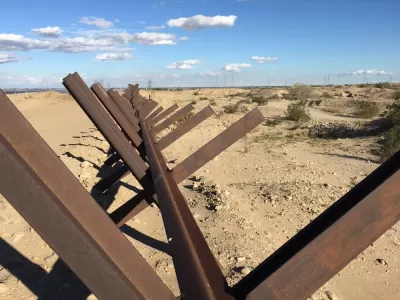
The president didn't even attempt to hide the relationship between the rail project and the border wall by linking the two in his tweet Tuesday morning.
Litigation likely
"It is unclear whether the federal government has the legal authority to withhold the grant from California, and state officials are likely to challenge the move in court," write Karni and Medina.
A 3-page letter [pdf] penned by Ronald L. Batory, Administrator of the Federal Railroad Administration, to Brian Kelly, CEO of the California High-Speed Rail Authority, indicating his intent "to de-obligate the full $928,620,000" grant appears formidable to this correspondent. He states that the Authority "has failed to provide FRA with timely and satisfactory reports."
Criticism was also targeted against the Authority in a state audit issued in November noting that their “flawed decision making and poor contract management have contributed to billions in cost overruns and delays.”
An analysis of Batory's letter by and
Related in Planetizen:
-
Gov. Gavin Newsom to Dramatically Downsize High-Speed Rail Project, February 13, 2019
FULL STORY: Trump Administration Wants California to Pay Back $2.5 Billion for High-Speed Rail


Campaign Launched to Halt State Reopenings and Start Over
During March and April, most states shut down all but essential services in order to "flatten the curve," and it largely worked. What happened afterward didn't. U.S. PIRG has organized a campaign to start the process over and do it right.
Yes, Trump Can Recoup the $3.5 Billion Awarded to California High-Speed Rail
The beleaguered project is still very much alive, despite some media claims to the contrary. As for the Trump administration's claim to two grants awarded to the now-$77 billion project, the state has a deadline to meet if it wants to keep them.
Trump Selects Elaine J. Chao, former Labor Secretary, as Transportation Secretary
Elaine Chao served all eight years as President George W. Bush's former Secretary of Labor and also under his father's administration as Deputy Secretary of Transportation. She is married to Senate majority leader Mitch McConnell (R-Ky.).

Planetizen Federal Action Tracker
A weekly monitor of how Trump’s orders and actions are impacting planners and planning in America.

The state-sanctioned urbicide of Austin
People don’t kill cities. Freeways do.

US to reduce Colorado River water deliveries to Mexico
A new Colorado Treaty amendment reduces Mexico’s Colorado River water allocation by 250,000 acre feet.

5 New England states march closer to 800 megawatt wind energy project
Securing federal approval for the project may be complicated under the Trump administration, which has historically been hostile towards domestic wind power.

Baltimore to break ground on $50 million Transit Priority Project
The project will bring faster bus trips, safer streets and better bike connections to Baltimore.

Airbnb launches $250 million 'last-dollar financing' housing accelerator, makes first investment in Austin
The company will put $6.4 million towards affordable housing development in Texas’ capital.

FREE Course: Walkable City 1: Why Walkability?
After describing his path towards focusing on walkability as the essence of good planning, Jeff Speck marches through his five principal reasons for making more walkable places.
Reinventing Malls: Planning Alchemy—Turning Gray Fields Into Gold
The course focuses on the opportunities and imperatives that shape reinvention of mall sites.

Eagle County Government
Harvard University Graduate School of Design
Nashville Planning Department
The Architects Foundation
University of Cincinnati Online
The Pocatello Development Authority
The Urban Renewal Agency of the City of Pocatello
Journal of the American Planning Association