The area bound by the 22-mile Ringbahn would still allow 12 uses of a private automobile per year per person, and several other exemptions.


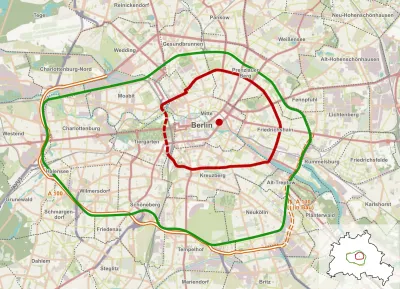
Berlin is one step closer to banning most cars in an area larger than Manhattan, reports Patrick Maynard in Streetsblog USA.
“A decision on Wednesday by the Berlin Constitutional Court allows a long-stalled initiative by the advocacy group Volksentscheid Berlin Autofrei ("Ballot Measure for an Auto-Free Berlin) to continue gathering signatures for a referendum to create a zone in the center of the German capital that would be free of almost all private automobiles.” If the group is successful, the car-free area would cover the entire area bounded by the city’s 22-mile ring road.
The ban would allow residents to use private automobiles 12 times per year, and would include exceptions for people with disabilities, delivery vans, garbage trucks, and other service vehicles.
FULL STORY: Berlin Moves Closer to Banning Cars From A Zone Bigger Than Manhattan

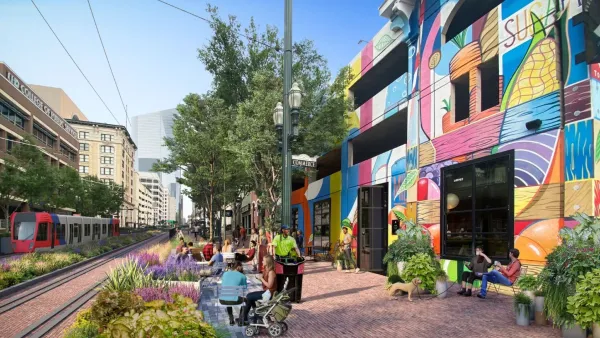
6 Streets Getting Pedestrian Makeovers in 2026
These U.S. cities are reducing or removing car traffic to make major streets more people-friendly.
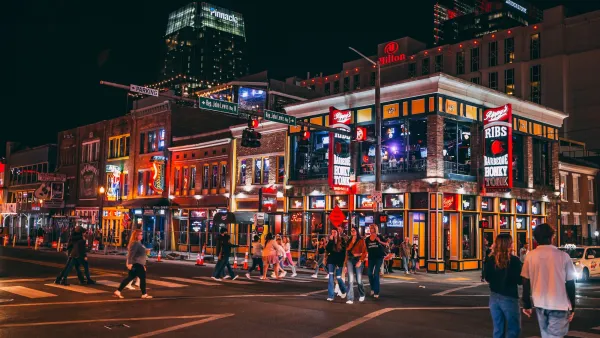
Tennessee DOT weighs making Nashville's Broadway car-free — sometimes
After a crash that killed one person and injured several others, state and city officials are in talks to consider options for closing the popular thoroughfare to cars during certain events.

After Culdesac's success in Tempe, Mesa approves new 1,000-unit 'car-light' development
Culdesac Mesa will take the same transit-oriented approach with a compact, walkable design and access to transit and shared mobility options.

Planetizen Federal Action Tracker
A weekly monitor of how Trump’s orders and actions are impacting planners and planning in America.

The state-sanctioned urbicide of Austin
People don’t kill cities. Freeways do.

US to reduce Colorado River water deliveries to Mexico
A new Colorado Treaty amendment reduces Mexico’s Colorado River water allocation by 250,000 acre feet.

5 New England states march closer to 800 megawatt wind energy project
Securing federal approval for the project may be complicated under the Trump administration, which has historically been hostile towards domestic wind power.

Baltimore to break ground on $50 million Transit Priority Project
The project will bring faster bus trips, safer streets and better bike connections to Baltimore.

Airbnb launches $250 million 'last-dollar financing' housing accelerator, makes first investment in Austin
The company will put $6.4 million towards affordable housing development in Texas’ capital.

FREE Course: Walkable City 1: Why Walkability?
After describing his path towards focusing on walkability as the essence of good planning, Jeff Speck marches through his five principal reasons for making more walkable places.
Reinventing Malls: Planning Alchemy—Turning Gray Fields Into Gold
The course focuses on the opportunities and imperatives that shape reinvention of mall sites.

.png)
Eagle County Government
Harvard University Graduate School of Design
Nashville Planning Department
The Architects Foundation
University of Cincinnati Online
The Pocatello Development Authority
The Urban Renewal Agency of the City of Pocatello
Journal of the American Planning Association