Sen. Scott Wiener introduced legislation to make state highways that run through villages, town, and cities, often acting as main streets, accommodate the safety needs of walkers, cyclists, and transit users when undergoing capital improvements.


It was just over a decade that Republican Gov. Arnold Schwarzenegger signed Sen. Mark Leno's (D-San Francisco) landmark legislation, Assembly Bill 1358, the Complete Streets Act, ensuring that all local streets and roads accommodate the needs of bicyclists, pedestrians and transit riders, as well as motorists.
State highways, the domain of the California Department of Transportation (Caltrans), was the subject of an internal policy document known as Deputy Directive 64 [pdf], "that explicitly embraces Complete Streets as the policy covering all phases of state highway projects, from planning to construction to maintenance and repair," according to a Complete Streets Fact Sheet prepared by the California Bicycle Coalition (CalBike). However, progress has been slow.
“For too long, Caltrans has talked about complete streets as a policy, but hasn’t actually delivered these improvements in its projects," said Sen. Scott Wiener [D-San Francisco) at a press conference held at Zuckerberg San Francisco General Hospital on Jan. 14.
"SB 127 ensures that as we rehabilitate state highways that run through the centers of our towns and cities, we prioritize active transportation uses like walking, bicycling, and riding public transportation.
"Streets designed for all residents create safer, healthier, and more inclusive communities. Ensuring everyone has access to safe streets also encourages alternate modes of transportation, which can help reduce vehicle miles traveled, and help us fight climate change.”
The bill "is stronger and more thorough than the Complete Streets bill Wiener introduced last year [SB 760] but let die when Prop 6 threatened to disrupt new gas tax revenue," reports Melanie Curry, editor of Streetsblog California.
According to the legislation, the bill would require Caltrans, by January 1, 2021, "when undertaking any capital improvement project on a state highway or a local street crossing a state highway that is funded through the State Highway Operation and Protection Program, to include new pedestrian and bicycle facilities, or improve existing facilities, as part of the project."
At the press conference, speakers in support of the legislation addressed traffic crashes that injured walkers and cyclists on 19th Ave. and Park Presidio Blvd., both part of State Route 1, maintained by Caltrans.
Dr. Rebecca Plavin, a trauma surgeon at the hospital, stated that her department treats about 4,000 patients annually for trauma, "and nearly half are injured in traffic collisions...and about half of those are pedestrians and cyclists."
Additionally, the bill would establish a Division of Active Transportation within Caltrans to oversee the existing Active Transportation Program and require that an undersecretary of the Transportation Agency be assigned to it.
SB 127 is sponsored by the California Bicycle Coalition, the Safe Routes to School National Partnership, California Walks, and the American Heart Association/American Stroke Association.
Read the full story: Bill Would Make State Highways–Which Are Often City Streets–Accommodate All Users

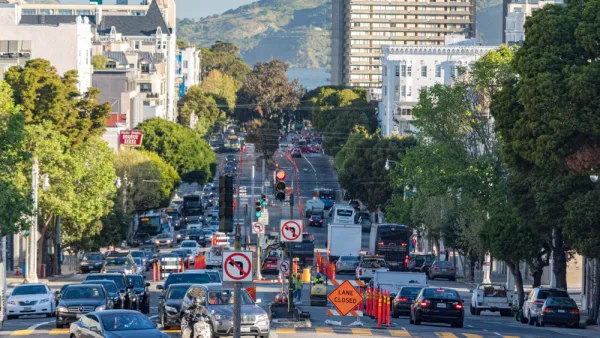
Governor's Veto Kills Complete Streets Requirements for Caltrans
California Governor Gavin Newsom over the weekend vetoed a bill that would have required the state's department of transportation to consider public transit as well as bike and pedestrian infrastructure when planning projects on state-owned roads.
San Francisco to Use Conservatorship for Some Mentally Ill Homeless People
Thanks to legislation by Sen. Scott Wiener passed last year, San Francisco will apply a new tool to force treatment on some homeless, mentally ill people who refuse it, but it's limited to five people annually. A new Wiener bill would expand it.
Bill Introduced to Allow California Cities to Pursue Congestion Pricing
Four cities could charge tolls for drivers to enter congested parts of their cities if an assembly bill introduced by Richard Bloom last month becomes law.

Planetizen Federal Action Tracker
A weekly monitor of how Trump’s orders and actions are impacting planners and planning in America.

California plans to bury El Niño’s downpour
If the state plays its cards right, it may be able to store a billion acre-feet of El Niño’s water in aquifers.

Chicago breaks ground on $3 billion megadevelopment
The new neighborhood, titled Foundry Park, will one day host 3,700 residences.

Satanic place names
From streams and lakes to valleys and canyons, I mapped more than 1,000 places named after the Devil.

California High-Speed Rail Authority CEO resigns after $600,000 scandal
Under Ian Choudri, the authority used taxpayer dollars to fund first class flights and trips to nightclubs.

Want to study the Missouri River? Soon, you may need unanimous approval from 10 states
Legislation would require 10 governors’ permission to study or build projects moving water outside the basin.

FREE Course: Walkable City 1: Why Walkability?
After describing his path towards focusing on walkability as the essence of good planning, Jeff Speck marches through his five principal reasons for making more walkable places.
Reinventing Malls: Planning Alchemy—Turning Gray Fields Into Gold
The course focuses on the opportunities and imperatives that shape reinvention of mall sites.

City of Rosemead
Rutgers University, Edward J. Bloustein School of Planning and Public Policy
One Hundred Miles
Hunter College, City University of New York (CUNY)
The Architects Foundation
University of Cincinnati Online
City of Cambridge
Montrose County
The Pocatello Development Authority