Road pricing terminology can be confusing, particularly since Californians see so little of it. For example, a Sacramento TV station calls proposed express lanes on Interstate 80 from Solano County to Sacramento a ‘tollway.’



Freeway express lanes, aka toll lanes that are often dynamically priced and generally allow carpools to use them at no cost or at a discount, exist adjacent to general purpose lanes and are now common in the Bay Area and Southern California. A proposed interstate highway improvement project for the Sacramento region has at least one local news source using a misnomer because it considers several road pricing alternatives.
“A new proposal by Caltrans would be the Sacramento region's first tollway from West Sacramento to Davis in both directions,” reports Michelle Bandur for KCRA Channel 3, Sacramento, on November 14.
[Dennis Keaton, a spokesperson for Caltrans] said they are proposing a tollway on the causeway, similar to the toll express lanes in the Bay area and Southern California.
“This isn't anything new to California," Keaton said. "It may be new to Solano County and Yolo County.”
The “Yolo 80 Corridor Improvements Project,” proposed by Caltrans, the state's department of transportation, is not a road pricing project. Rather, it's a managed lanes project consisting of basically seven ‘build alternatives,' with three involving pricing.
Related:
- “Caltrans Demotes Official Who Challenged Road Expansion Projects,” October 8, 2023 [this project is one of the two that the official questioned]
- “Widening I-80 from Davis to Sacramento: HOT Lane or HOV Lane?” June 5, 2018
Caltrans defines ‘managed lanes’ as “an operational practice utilized to address congestion by controlling traffic movement on the highway” that fall into three categories:
Express lane alternative
The Sacramento Bee used the correct road pricing terminology, and also reported on the larger geographic scope of the Caltrans project.
“Caltrans, the state of California’s highway authority, is seeking public input on a proposed $465 million express toll lane project for stretches of Interstate 80 and the Highway 50 portion of the Capital City Freeway,” reported Ryan Lillis on November 14.
The federal Department of Transportation issued an $86 million grant for the project in 2021. However, that funding will expire if construction isn’t approved by the end of September 2024, Caltrans officials said.
If construction is approved, Caltrans expects to begin work in October 2024 and finish about three years later. The agency is hosting two public meetings on the project: Nov. 28...in West Sacramento, and Dec. 13...in Davis.
Express lanes and HOT lanes
Caltrans distinguishes express lanes from high occupancy toll (HOT) lanes in the description of the alternatives for the project. The former would subject all motorists, regardless of the number of occupants, to the toll, which illustrates why the term, “express toll lane” may be used in lieu of express lanes in some states like Maryland.
[See the section titled, “HOT lanes not included,” in “Maryland's $9 Billion Project Would Be the Nation's Largest P3 for Highways,” September 29, 2017.]
The Caltrans HOT lane alternative, which are generally referred to as express lanes in the Bay Area and Southern California, would exempt carpools.
Environmental documents released
The project, particularly the road pricing alternatives, has received media attention this past week due to the recent releases of the draft environmental impact report [pdf] and Finding Of No Significant Impact [pdf] for the project. However, Caltrans has yet to select a 'managed lane' alternative.
As it stands now according to the environmental document [pdf] released November 9, Caltrans “would add managed lanes on I-80 and US-50 by a combination of lane conversion, restriping, and shoulder and median reconstruction with a concrete barrier.” Just what form those lanes take is yet to be determined.
As for the ‘tollways’ alternative, an email to the KCRA reporter sent November 15 went unanswered by publication.
Hat tip to AASHTO Daily Transportation Update, November 14.
FULL STORY: Caltrans proposes Sacramento region's 1st tollway to ease traffic troubles

Widening I-80 from Davis to Sacramento: HOT Lane or HOV Lane?
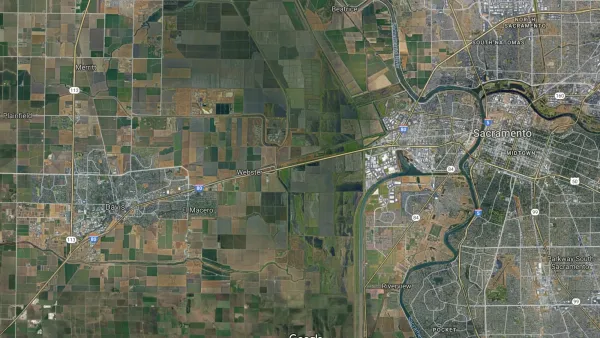
Caltrans is studying a plan to widen 16 miles of Interstate 80 through Solano and Yolo counties, over the Yolo Bypass. Initially, the plan called for a carpool lane, but uncertainty about funding makes a toll lane a possibility.
More Toll Lanes Coming to California Freeways
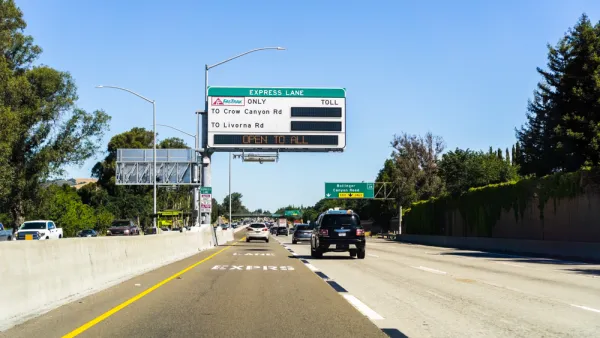
Solo drivers in the Golden State will have more options to escape traffic congestion on busy freeways – for a price, as transportation agencies increasing decide to convert existing carpool lanes to high-occupancy toll lanes and add new ones.

When Carpool Lanes Cause Mayhem
A newly widened Bay Area freeway serves as a reminder of the futility of HOV lanes. There are better ways to manage and mitigate traffic.

Planetizen Federal Action Tracker
A weekly monitor of how Trump’s orders and actions are impacting planners and planning in America.

The state-sanctioned urbicide of Austin
People don’t kill cities. Freeways do.

US to reduce Colorado River water deliveries to Mexico
A new Colorado Treaty amendment reduces Mexico’s Colorado River water allocation by 250,000 acre feet.

5 New England states march closer to 800 megawatt wind energy project
Securing federal approval for the project may be complicated under the Trump administration, which has historically been hostile towards domestic wind power.

Baltimore to break ground on $50 million Transit Priority Project
The project will bring faster bus trips, safer streets and better bike connections to Baltimore.

Airbnb launches $250 million 'last-dollar financing' housing accelerator, makes first investment in Austin
The company will put $6.4 million towards affordable housing development in Texas’ capital.

FREE Course: Walkable City 1: Why Walkability?
After describing his path towards focusing on walkability as the essence of good planning, Jeff Speck marches through his five principal reasons for making more walkable places.
Reinventing Malls: Planning Alchemy—Turning Gray Fields Into Gold
The course focuses on the opportunities and imperatives that shape reinvention of mall sites.

Eagle County Government
Harvard University Graduate School of Design
Nashville Planning Department
The Architects Foundation
University of Cincinnati Online
The Pocatello Development Authority
The Urban Renewal Agency of the City of Pocatello
Journal of the American Planning Association