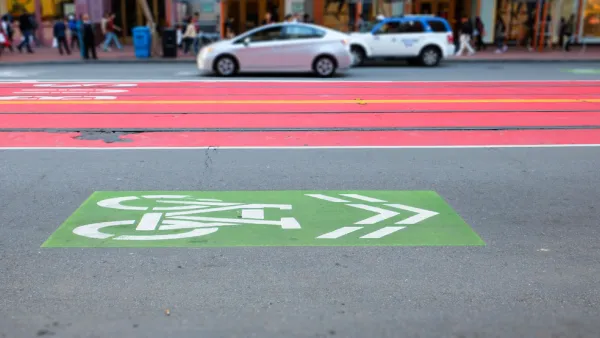
The SF Examiner reports on America's top-rated bike lane, as rated by People for Bikes. The protected contraflow lane runs from Market Street to Grove Street, all of two blocks; only one block in opposite direction is separated


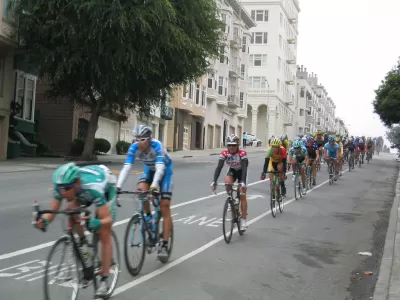
"The project, completed in May, is one of many funded through a $248 million voter-approved bond," writes Joe Fitzgerald Rodriguez for the Examiner. "Tyler Frisbee, the new policy director at the San Francisco Bicycle Coalition (SFBC), said safety improvements will soon proliferate "along the entire stretch of Polk Street."
I hope so—the street needs it! According to SFBC, it is considered "one of the top five most dangerous streets in San Francisco for people biking." That said, lower Polk, where it meets Market and Fell Streets, is truly a world apart from the rest of the corridor in terms of bike infrastructure, and it's easy to see why it impressed People for Bikes.
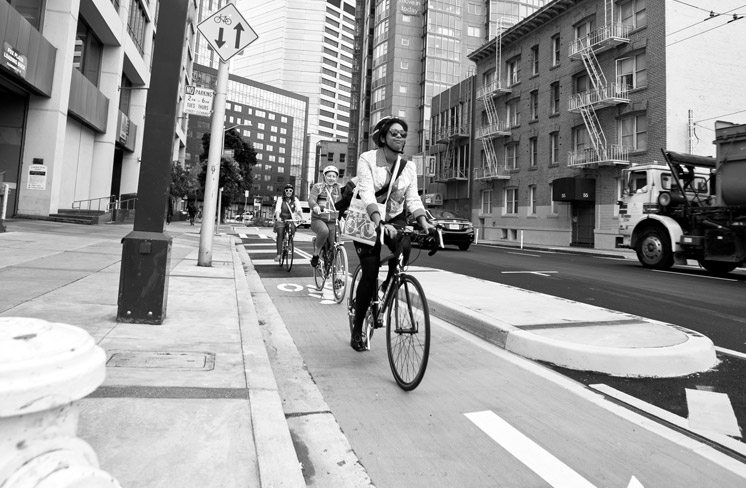
credit: San Francisco Bicycle Coalition
THE IMPORTANCE OF GOOD DESIGN: A beautiful, inviting design is what separates the Polk Street bikeway from the other handful of protected bikeways in the city. The bikeway itself is physically separated from car traffic with a curb and landscaped median filled with succulents. [SFBC]
As posted here earlier, People for Bikes determined the ten best bicycle lanes in the country. While the competition was tough, San Francisco's new contraflow lane scored highest. Michael Anderson, Green Lane Project staff writer for the organization, wrote, "San Francisco's legendarily cautious public process kept this project in the works for 15 years, but when it finally opened last spring, Streetsblog called it "the best segment of bicycle infrastructure in San Francisco."
According to the San Francisco Municipal Transportation Agency (SFMTA) May 1 press release, "The highlight of the project is a new separated northbound bike lane, also known as a contra-flow lane, because it allows people biking to safely travel against vehicle traffic on the one-way corridor."
Lower Polk, from just below City Hall at Grove Street, to Hayes Street, and then to where it terminates at Market and Fell Streets, is one-way, (see map), unlike the remainder of the street which runs to the Bay near Fisherman's Wharf. The protected bikes lanes run on both sides of the street, with the northbound lane running against traffic, hence the contra-flow name.
Streetsblog's Angie Schmitt noted in July that contra flow and buffered lanes are "only just now getting official recognition from powerful standard-setters inside the U.S. engineering establishments." [Also posted here.]
"Polk Street near Market Street was a stressful ride among traffic, with numerous bus routes and active loading zones, the SFMTA noted in a news release. Now the bike lane protects cyclists along its three blocks length," writes Rodriguez.
So, why is the new bike infrastructure limited to the lower three blocks? Community opposition—from merchants who viewed protected bike lanes as a threat to their businesses. As we posted here in March, 2013, "to the more than 300 vocal denizens of Polk Gulch who packed a standing-room-only neighborhood meeting last week, the proposal is a commerce killer, one that would create 'a freeway for bikes,' with little benefit to shops along the route."
Aaron Bialick of SF Streetsblog captured the problem in his April, 2013 piece. "The (SFMTA), it seems, has backed down from making bicycling on Polk safe enough for a broader range of San Franciscans, in order to placate merchants who have vociferously opposed removing a small percentage of parking to make room for safety improvements that could actually boost business on a street where 85 percent of people arrive without a car."
The new Polk Street bike infrastructure also includes bicycle traffic signals—at Market and Fell Streets, and at Hayes and Grove Streets for the contra flow lanes.
At Market and Fell Streets, there is an excellent confluence of cycle tracks due to the protected bike lanes on Market Street. However, first-time users may be baffled, as I was. Cyclists are directed to first cross Fell Street, obeying the new bike traffic signals, rather than cross directly into or across Market Street. And just as for motorists on Fell Street, left turns onto Market are prohibited.
Hat tip to AASHTO Daily Transportation Update.
Read the full story: SF bike lane wins national recognition

It Takes a Fatality to Remove On-Street Parking
On March 8, 30-year-old Tess Rothstein of Berkeley was riding a rented Ford GoBike in San Francisco's SoMa district when a car door suddenly opened, forcing her outside the narrow white line of the conventional bike lane into the path of a truck.
Streamlining Protected Bike Lanes, San Francisco Style
Cutting the board of the San Francisco Municipal Transportation Agency out of the approvals process for implementing bike lanes in San Francisco could shave three months off the delivery schedule.
Protected Bike Lane Plan Shelved in San Francisco
Bike advocates say a protected bike lane near the downtown Caltrain station can't wait. The San Francisco Municipal Transportation Agency (SFMTA) says the project will have to wait.

Planetizen Federal Action Tracker
A weekly monitor of how Trump’s orders and actions are impacting planners and planning in America.

Amtrak, CN end decades-long dispute with eight-year agreement
The new operating agreement establishes an updated framework for the companies to work together, including processes to resolve disputes.

Judges permit Denver to divert 77,000 acre feet from the Colorado River for reservoir expansion
Overuse and climate change have caused the Colorado River’s water levels to plummet.

How ‘post-disaster gentrification’ alters neighborhoods after natural calamities
After hurricanes, fires or other calamities, the original residents of a community are often replaced by younger, wealthier residents.

Maryland local governments examine if they should have more power to raise property taxes
Maryland’s housing market is out of reach for the majority of moderate-income residents.

Northwest rail fans eager for Sept. 30 debut of Amtrak’s Airo fleet
Get ready for that new train smell and more seats. But they won’t go faster or run more frequently on the Cascades route in Washington and Oregon.

FREE Course: Walkable City 1: Why Walkability?
After describing his path towards focusing on walkability as the essence of good planning, Jeff Speck marches through his five principal reasons for making more walkable places.
Reinventing Malls: Planning Alchemy—Turning Gray Fields Into Gold
The course focuses on the opportunities and imperatives that shape reinvention of mall sites.

Harvard University Graduate School of Design
KFH Group Inc.
Greater Baltimore Committee
The Architects Foundation
University of Cincinnati Online
The Pocatello Development Authority
The Urban Renewal Agency of the City of Pocatello