The Energy Department's loan office, known for a bad loan to the solar panel startup Solyndra in 2011, will loan $504 million to a company that will use renewable energy to create 'green hydrogen' and store it in salt caverns in Utah.


To use a term familiar to President Joe Biden, the loan office of the U.S. Department of Energy (DOE) ‘is back.’
“The Energy Department granted its first clean energy loan guarantee out of its Loan Programs Office since 2014, the department announced Wednesday,” wrote POLITICO energy reporter Matthew Choi on June 9. “The $504.4 million loan guarantee will go toward the Advanced Clean Energy Storage project in Utah, set to be the world’s largest clean hydrogen storage facility.”
The office, led by Jigar Shah, has been the target of Republican criticism ever since solar firm Solyndra received over $500 million in DOE loans only to go bankrupt in 2011. The office was largely quiet during the Trump administration, but Shah told reporters that Wednesday’s “announcement shows we're back in a big way.”
Solyndra's bankruptcy was noted in a 2013 post about the departure of Nobel laureate Steven Chu as President Barack Obama's first secretary of energy:
But Chu will also be remembered for “the 2011 collapse of the solar panel manufacturer Solyndra, which received a half-billion-dollar federal loan in 2009, [and] prompted GOP-led Capitol Hill hearings and an avalanche of election-season attacks.”
Clean energy + storage
“Accelerating the commercial deployment of clean hydrogen as a zero-emission, long-term energy storage solution is the first step in harnessing its potential to decarbonize our economy, create good paying clean energy jobs and enable more renewables to be added to the grid.” said U.S. Secretary of Energy Jennifer M. Granholm in the June 9 department press release, the source article for this post.
To meet President Biden’s goals to achieve a clean grid by 2035 and reach net zero emissions economy wide by 2050, long duration energy storage technologies — including hydrogen — will play a critical role. Clean energy from hydrogen can be produced using renewables, such as solar and wind, before being stored for later use for power generation or as a dispatchable fuel or feedstock to decarbonize the industrial and transportation sectors.
Clean hydrogen, often referred to as green hydrogen, uses electrolysis, with the power generated from renewable sources, to separate hydrogen from water. Almost all hydrogen today is made from natural gas using a process known as steam methane reformation or from the gasification of coal.
Boon for Utah
“I’m pleased to see DOE support Utah’s efforts to become a world leader in hydrogen,” said U.S. Senator Mitt Romney (R-Utah) in the DOE press release.
“This is not only a win for Millard County and Utah, but it is also an important step toward developing new energy technologies as we utilize an ‘all of the above’ approach to meet our energy demands.”
“Utah has a wealth of natural resources that make it an ideal location for clean energy innovation,” Rep. John Curtis (R-Utah), who launched the Conservative Climate Caucus, said in a statement, reported Choi for POLITICO.
“Hydrogen can, and should, play a large role in powering our society and I am appreciative of Secretary Granholm supporting this important project.”
Earlier announcement
The June 8 press release noted that the loan office in April had “announced a conditional commitment for a loan guarantee for Advanced Clean Energy Storage, which will be the first of this kind to a clean hydrogen company.”
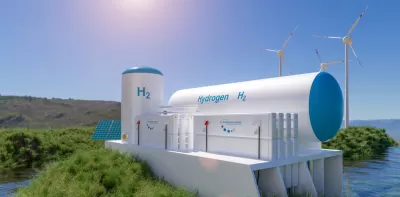
The facility in Delta, Utah, will combine 220 megawatts of alkaline electrolysis with two massive 4.5 million barrel salt caverns to store clean hydrogen.
Advanced Clean Energy Storage will capture excess renewable energy when it is most abundant, store it as hydrogen, then deploy it as fuel for the Intermountain Power Agency’s (IPA) IPP Renewed Project — a hydrogen-capable gas turbine combined cycle power plant that intends to incrementally be fueled by 100% clean hydrogen by 2045.
See two related posts on the Intermountain Power Project:
- Green Hydrogen, Plus Storage, Key to Los Angeles' Plan for Carbon-Free Electricity, December 22, 2019
- Shuttering a Large Coal Plant: A Tale of Two States, July 23, 2019
Infrastructure Investment and Jobs Act connection
ACES Delta, the joint venture between Mitsubishi Power Americas and the real estate company, Magnum Development that will build and operate the hydrogen facility, refers to it as an energy storage hub or hydrogen hub.
Two days before the Energy Department announced the loan to ACES Delta, it announced the launch of a new program to fund at least four hydrogen hubs, a component of the Infrastructure Investment and Jobs Act (IIJA) that it administers.
The U.S. Department of Energy (DOE) today [June 6] released a Notice of Intent (NOI) to fund the Bipartisan Infrastructure Law’s [IIJA] $8 billion program to develop regional clean hydrogen hubs (H2Hubs) across America.
H2Hubs will create networks of hydrogen producers, consumers, and local connective infrastructure to accelerate the use of hydrogen as a clean energy carrier. The production, processing, delivery, storage, and end-use of clean hydrogen, including innovative uses in the industrial sector, is crucial to DOE’s strategy for achieving President Biden’s goal of a 100% clean electrical grid by 2035 and net-zero carbon emissions by 2050.
Additional reading on the loan to the ACES Delta project: “DOE unveils $500M loan for massive ‘clean hydrogen’ project,” 04/27/2022, E&E News.
Planetizen posts on other programs funded by the IIJA and administered by the DOE include:
- Extending the Life of California's Largest Power Plant, May 31, 2022
- $6 Billion to Keep Uncompetitive Nuclear Plants Alive, May 11, 2022
- Bill Gates' Nuclear Power Company Takes Giant Step in Cowboy State, November 24, 2021
H.R.3684, the Infrastructure Investment and Jobs Act, passed Congress on November 5, 2021 and was signed by President Biden ten days later.
FULL STORY: DOE Announces First Loan Guarantee for a Clean Energy Project in Nearly a Decade

Two New Clean Energy Programs Funded by the Bipartisan Infrastructure Law Unveiled
The U.S. Department of Energy announced two new programs last month that are funded by the $1.2 trillion Infrastructure Investment and Jobs Act: $7 billion to create regional ‘hydrogen hubs’ and $4.9 billion to ‘manage and store carbon pollution.’
First Federal Funding for Hydrogen Hubs Awarded to California and Pacific Northwest
The U.S. Department of Energy announced on July 17 that the first grant to build the nation's seven proposed 'hydrogen hubs' would go to California. The ultimate goal is to decarbonize transportation fuels used in port operations.
$6 Billion to Keep Uncompetitive Nuclear Plants Alive
The Infrastructure Investment and Jobs Act includes $6 billion to create a credit program to extend the life of existing nuclear power plants, the largest source of carbon-free energy in the nation. The first deadline to bid for credits is May 19.

The state-sanctioned urbicide of Austin
People don’t kill cities. Freeways do.

US to reduce Colorado River water deliveries to Mexico
A new Colorado Treaty amendment reduces Mexico’s Colorado River water allocation by 250,000 acre feet.

New Jersey’s second-largest city bans standalone data centers
Jersey City will continue to allow co-location facilities, such as those meant for research institutions that store their own data.

Amtrak not solely to blame for New Jersey commuter rail's unreliability, report finds
A new study from the Garden State Initiative found that NJ Transit’s budget grew 20% across a 4 year period, but reliability declined significantly over the same period.

EPA erases limits on planet-warming pollution from power plants
Under Monday’s plan, power plants would still have some limits on how much mercury, arsenic and other contaminants they can emit.

Phoenix announces new on-demand transit service, more frequent RAPID buses
Both new services will launch in October, and are part of Phoenix's Project Effective Access Solutions for Easing Congestion.

FREE Course: Walkable City 1: Why Walkability?
After describing his path towards focusing on walkability as the essence of good planning, Jeff Speck marches through his five principal reasons for making more walkable places.
Reinventing Malls: Planning Alchemy—Turning Gray Fields Into Gold
The course focuses on the opportunities and imperatives that shape reinvention of mall sites.

Eagle County Government
Harvard University Graduate School of Design
Nashville Planning Department
The Architects Foundation
University of Cincinnati Online
The Pocatello Development Authority
The Urban Renewal Agency of the City of Pocatello
Journal of the American Planning Association