A Wyoming coal power plant will be transformed by a company backed by Microsoft co-founder Bill Gates to run on nuclear power. With the signing of the bipartisan infrastructure act, $1.5 billion will help produce zero-emission power by 2028


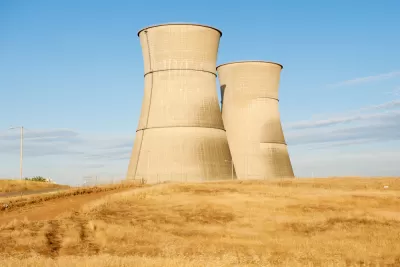
"TerraPower, a start-up co-founded by Bill Gates to revolutionize designs for nuclear reactors, has chosen Kemmerer, Wyoming, as the preferred location for its first demonstration reactor," writes Catherine Clifford, a climate and technology reporter for CNBC on Nov. 17. "It aims to build the plant in the frontier-era coal town by 2028."
Once built, the plant will provide a baseload of 345 megawatts, with the potential to expand its capacity to 500 megawatts.
It will cost about $4 billion to build the plant, with half of that money coming from TerraPower and the other half from the U.S. Department of Energy’s Advanced Reactor Demonstration Program.]
[Related post on TerraPower: Can Bill Gates Provide America's Next 800 Years of Electricity? September 26, 2013: "For Bill Gates's next act, the Microsoft founder is trying to turn atomic trash into treasure."]
Infrastructure Investment and Jobs Act
“Just yesterday, President Biden signed the Bipartisan Infrastructure Deal and today DOE is already putting it to work with more than $1.5 billion heading to Wyoming,” said Secretary of Energy Jennifer M. Granholm in TerraPower's press release on Nov. 16.
"The U.S. Department of Energy is extremely excited about this project and plans to invest nearly $2 billion to support the licensing, construction and demonstration of this first-of-a-kind reactor by 2028," wrote Alice Caponiti, a deputy assistant secretary in the energy department's Office of Nuclear Energy.
Not a conventional nuclear reactor
"The Kemmerer plant will be the first to use an advanced nuclear design called Natrium, developed by TerraPower with GE-Hitachi," adds Clifford.
Natrium plants use liquid sodium as a cooling agent instead of water. Sodium has a higher boiling point and can absorb more heat than water, which means high pressure does not build up inside the reactor, reducing the risk of an explosion.
Natrium plants can also store heat in tanks of molten salt, conserving the energy for later use like a battery and enabling the plant to bump its capacity up from 345 to 500 megawatts for five hours.
In addition to improvements in safety, reduction in costs over conventional nuclear plants, and storing energy, "Natrium plants produce less waste, a problematic and dangerous byproduct of nuclear fission," notes Clifford.
Nuclear demonstration plants headed to Pacific Northwest
"Along with Natrium, two other advanced reactors are also expected to operate in the Northwest region," adds Caponiti with DOE's Office of Nuclear Energy.
X-energy announced its plans to site its Xe-100 reactor in the state of Washington and NuScale plans to operate its first advanced small modular light water reactor system at Idaho National Laboratory—making this region the new hub of nuclear innovation.
[Related post: The Next Generation of Nuclear Power Could Come Closer to Home, December 10, 2020]
“The Infrastructure Investment and Jobs Act sends a strong message that the U.S. will support the Advanced Reactor Demonstrations to their full and successful completion,” said Darren Gale, X-energy Vice President and ARDP Program Manager, in X-energy's press release on Nov. 15. “This support ensures the success of our reactor and fuel technology at commercial scale”.
Critics get last word
Nuclear power remains controversial within the energy and science communities. Cliffords explored the opposition from the latter in an earlier and more comprehensive piece for CNBC.
On March 18, for instance, the Union of Concerned Scientists (UCS), a non-profit group of 250 scientists and related professionals, issued a 140-page rebuke of “advanced nuclear” reactor designs.
“It doesn’t make sense to us for either government or industry to devote a lot of resources to pursuing high-risk, low-reward technologies – or technologies that could be even worse than what we have now,” Edwin Lyman, Director of Nuclear Power Safety at the Union of Concerned Scientists in Washington, DC, tells CNBC Make It.
Instead, more federal government spending to improve conventional reactors is a better tactic, according to the UCS.
Additional reading on TerraPower's nuclear plant to be built in Kemmerer, Wyoming:
- Inside Climate News: Bill Gates’ Vision for Next-Generation Nuclear Power in Wyoming Coal Country, Nov. 17, 2021
- Rawlins Times (via Wyoming News Exchange): TerraPower chooses Kemmerer for nuclear reactor, Nov. 20, 2021
And on DOE's commitment to advancing nuclear power:
-
Office of Nuclear Energy: It’s Time for the United States to Demonstrate Advanced Reactors, Oct. 14, 2020
Additional related posts:
- Can Steel Go Green? [More on Bill Gates and energy investments], September 4, 2019
- Bill Gates's Coalition of Rich Investors Buying In to Energy Storage, June 15, 2018
- DOE Clears Way for First Nuclear Construction in 30 Years, February 19, 2014
Hat tip to Eric Gilbertson.
FULL STORY: Bill Gates’ TerraPower aims to build its first advanced nuclear reactor in a coal town in Wyoming

$6 Billion to Keep Uncompetitive Nuclear Plants Alive
The Infrastructure Investment and Jobs Act includes $6 billion to create a credit program to extend the life of existing nuclear power plants, the largest source of carbon-free energy in the nation. The first deadline to bid for credits is May 19.
Georgia Makes Clean Energy History in U.S.
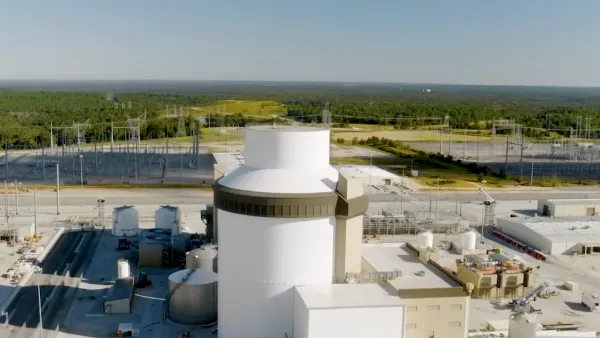
The first newly constructed nuclear power plant to generate electricity in the U.S. in over 30 years began operation in Waynesboro, Georgia on July 31.

Legislature Extends $1.4 Billion Lifeline to California's Last Operating Nuclear Power Plant
A bipartisan bill, fiercely opposed by many in the environmental community, would keep the Diablo Canyon Power Plant operating beyond 2025. The bill received overwhelming approval after it was amended to shorten the duration of the extension.

Planetizen Federal Action Tracker
A weekly monitor of how Trump’s orders and actions are impacting planners and planning in America.

The state-sanctioned urbicide of Austin
People don’t kill cities. Freeways do.

US to reduce Colorado River water deliveries to Mexico
A new Colorado Treaty amendment reduces Mexico’s Colorado River water allocation by 250,000 acre feet.

5 New England states march closer to 800 megawatt wind energy project
Securing federal approval for the project may be complicated under the Trump administration, which has historically been hostile towards domestic wind power.

Baltimore to break ground on $50 million Transit Priority Project
The project will bring faster bus trips, safer streets and better bike connections to Baltimore.

Airbnb launches $250 million 'last-dollar financing' housing accelerator, makes first investment in Austin
The company will put $6.4 million towards affordable housing development in Texas’ capital.

FREE Course: Walkable City 1: Why Walkability?
After describing his path towards focusing on walkability as the essence of good planning, Jeff Speck marches through his five principal reasons for making more walkable places.
Reinventing Malls: Planning Alchemy—Turning Gray Fields Into Gold
The course focuses on the opportunities and imperatives that shape reinvention of mall sites.

Eagle County Government
Harvard University Graduate School of Design
Nashville Planning Department
The Architects Foundation
University of Cincinnati Online
The Pocatello Development Authority
The Urban Renewal Agency of the City of Pocatello
Journal of the American Planning Association