A report produced by the county authority that built and operates the I-580 Express Lanes in the Bay Area declares them a success. Operating speeds are faster and congestion is reduced. About 11 percent of the freeway traffic uses the toll lanes.


"The Bay Area’s newest express lanes — on Interstate 580 through the Tri-Valley region of Alameda County — are just a year old, but drivers are already pouring into them, eager to pay for a quicker commute," reports Michael Cabanatuan for the San Francisco Chronicle.
Since the combination express and carpool lanes opened in February 2016 on I-580, along the main route between the Bay Area and the Central Valley, more than 7.6 million drivers have taken advantage of them, according to a report released Thursday [March 16] by the Alameda County Transportation Commission, which operates the lanes.
The report is in the form of a 2-page infographic (pdf) of data compiled by ACTC on the "first year in review," identifying the users:
- Approximately 30,000 trips are taken in the Express Lanes each day
- 6 percent of the corridor’s solo drivers choose to use the Express Lanes as toll-paying customers instead of the general purpose lanes, reducing congestion in the general purpose lanes
- 38 percent of current Express Lane users are using the lanes toll-free.
Tolls
"By paying an average toll of $1.62 westbound and $2.13 eastbound, drivers get to drive about 10 mph faster than those in the other lanes," writes Cabanatuan. Depending on direction, motorists on the express lanes are either paying, on average, roughly the same as a local adult AC Transit fare, $2.10, or 23 percent less.
However, peak hour fares jump to the maximum rate of $9 (see infographic), which will create a problem unless the eastbound "cap" is increased to match the westbound maximum of $13.
As Herbie Huff, research associate at UCLA's Lewis Center for Regional Policy Studies and Institute for Transportation Studies, opined in her recent Los Angeles Times op-ed, dynamic tolling is key to fighting congestion. Since 62 percent of express lane traffic is tolled, increasing the toll is instrumental to keeping traffic moving during the peak hour.
But congestion pricing is not a silver bullet, warns John Goodwin, a spokesman for the Metropolitan Transportation Commission, the Bay Area's metropolitan planning organization.
“I’m not going to tell anyone they will eliminate congestion. They won’t,” said Goodwin of MTC, which is planning the regional network and will operate the new [I-680] lane. “But they will make the roadway operate more efficiently. We will see reduced congestion at the beginning and end of the peak of the commute, but at the peak of the peak, there will still be congestion. It’s not a silver bullet. But it will help.”
Listen to the one-minute KCBS report on the ACTC findings.
FULL STORY: A year later, I-580 pay-to-use lanes are a success, report says

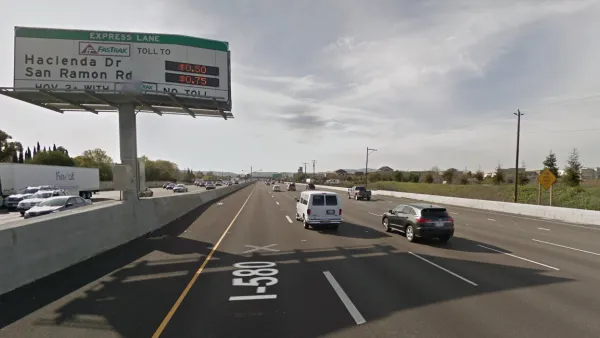
Bay Area Express Lanes Turn a Profit
Not all of them, just the I-580 lanes. One of the reasons is that most users are actually paying, unlike the other two express lanes where a majority of users are clean-air vehicles or carpools, neither of which pay.
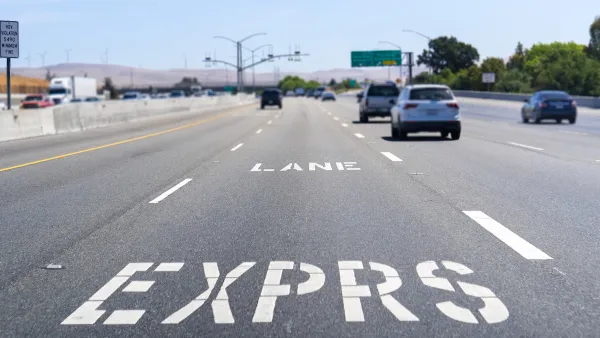
Congestion Pricing in the San Francisco Bay Area
Planners call them “express lanes,” but make no mistake, they are congestion pricing in action, and they're successful. The Bay Area network of what the Federal Highway Administration calls “high-occupancy toll (HOT) lanes” is growing.
Bay Area's Newest Express Lanes Opened Monday
Due to the high level of existing congestion, the Metropolitan Transportation Commission warns motorists that the new I-680 Contra Costa Express Lanes will offer relief just before and after the peak commute hour.

Planetizen Federal Action Tracker
A weekly monitor of how Trump’s orders and actions are impacting planners and planning in America.

The state-sanctioned urbicide of Austin
People don’t kill cities. Freeways do.

US to reduce Colorado River water deliveries to Mexico
A new Colorado Treaty amendment reduces Mexico’s Colorado River water allocation by 250,000 acre feet.

Mamdani overhauls NYC's Vision Zero plan with 100 new policy goals
The overhaul aims to reduce traffic deaths and make streets safer for pedestrians, cyclists and drivers through lower speed limits, new safety infrastructure and more.

Amtrak not solely to blame for New Jersey commuter rail's unreliability, report finds
A new study from the Garden State Initiative found that NJ Transit’s budget grew 20% across a 4 year period, but reliability declined significantly over the same period.

EPA erases limits on planet-warming pollution from power plants
Under Monday’s plan, power plants would still have some limits on how much mercury, arsenic and other contaminants they can emit.

FREE Course: Walkable City 1: Why Walkability?
After describing his path towards focusing on walkability as the essence of good planning, Jeff Speck marches through his five principal reasons for making more walkable places.
Reinventing Malls: Planning Alchemy—Turning Gray Fields Into Gold
The course focuses on the opportunities and imperatives that shape reinvention of mall sites.

Eagle County Government
Harvard University Graduate School of Design
Nashville Planning Department
The Architects Foundation
University of Cincinnati Online
The Pocatello Development Authority
The Urban Renewal Agency of the City of Pocatello
Journal of the American Planning Association