At best, it will take seven years to build the Amtrak Gateway tunnels, the replacement of Access to the Region's Core. If one of the existing two aging tunnels has to be shut to make repairs before the project is completed, commute nightmare ensues.


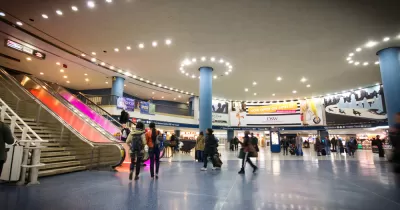
"Amtrak officials are in a race against time to avoid a commuting nightmare if one of the existing 100-year old tunnels has to be closed for major repairs before new (Hudson River) tunnels are built," writes Larry Higgs of NJ Advance Media for NJ.com on the calamity facing NJ Transit commuter and Amtrak's Northeast Corridor passengers accessing New York's Penn Station from New Jersey.
Train traffic would slow to a trickle, from an average of 24 to 6 trains per hour if one of the existing tunnels had to be closed. About 400 NJ Transit commuter trains a day travel through the existing tunnels, said (Amtrak president Joseph Boardman during an interview with the Star Ledger editorial board).
As we noted last month, the need to close one of the tunnels for repairs was hastened after "Amtrak released a report (in September) finding that 'salt left behind by Hurricane Sandy’s floodwaters continues to weaken the tunnels’ concrete and corrode its cast iron and steel'." The findings also impact LIRR commuters accessing Penn Station.
Cost for the Amtrak Gateway "and several allied projects to New York could cost an estimated $16 billion and under the most optimistic scenario could take up to a decade to build," writes Higgins. And the cost won't be borne only by the region's commuters. "The regional economy could lose $100 million a day in economic activity, due to a shut down, Boardman said."
An estimated 50 and 80 percent [sic] of the Gateway tunnel project funding should come from the federal government, with the remainder to be divided between New Jersey, New York and Amtrak, Boardman said. The Gateway Project [PDF] includes two new tunnels under the Hudson, adding two new tracks along the corridor in New Jersey south of Newark, and construction an [sic] annex [aka Moynihan Station] to New York's Penn Station to handle additional trains.
Last month, Higgins wrote, "To do the major repair work, one tube of the two [existing] Hudson River tunnels would have to be shut down for a year, which would have severe impact on the 450 trains a day which use the tunnels. Anthony Coscia, chairman of Amtrak's board of directors, said that can only happen if the Gateway Tunnel project is built first, which would allow Amtrak to take one of the old tunnels out of service without reducing the number of trains it and NJ Transit run.
Read the full story: Build $16B Hudson tunnel project or economy could lose $100M a day, Amtrak says


Planetizen Federal Action Tracker
A weekly monitor of how Trump’s orders and actions are impacting planners and planning in America.

Amtrak, CN end decades-long dispute with eight-year agreement
The new operating agreement establishes an updated framework for the companies to work together, including processes to resolve disputes.

Northwest rail fans eager for Sept. 30 debut of Amtrak’s Airo fleet
Get ready for that new train smell and more seats. But they won’t go faster or run more frequently on the Cascades route in Washington and Oregon.

St. Louis Metro to test if single-car trains can reduce operating costs, maintain rider satisfaction
The pilot program will run from October to spring 2027, and begin with one single-car train operating on Metrolink’s Red and Blue lines.

Pennsylvania is building data centers in abandoned mines
Housing data centers in mines provides an alternative to destroying local forests and may spare residents from data centers’ noise and air pollution.

If Corpus Christi can’t revive desalination plant project, it may owe Texas $235 million
Earlier this month, city officials declined to pursue developing the plant for the second time in a year.

FREE Course: Walkable City 1: Why Walkability?
After describing his path towards focusing on walkability as the essence of good planning, Jeff Speck marches through his five principal reasons for making more walkable places.
Reinventing Malls: Planning Alchemy—Turning Gray Fields Into Gold
The course focuses on the opportunities and imperatives that shape reinvention of mall sites.

City of Thousand Oaks
City of Wisconsin Rapids
Harvard University Graduate School of Design
The Architects Foundation
University of Cincinnati Online
The Pocatello Development Authority
The Urban Renewal Agency of the City of Pocatello