The federal government has an opportunity to make a generational investment in the country's infrastructure that could fundamentally shift the way we live and move around cities.



Thomas Day describes how, with a clear vision, the Infrastructure Investment and Jobs Act (IIJA) could be an opportunity to invest in large-scale projects that shift development toward "hyperdense," transit-oriented cities. But while Robert Moses-style redevelopment on a large scale may no longer be possible, experts like Vishaan Chakrabarti, architect and professor at the University of California, Berkeley, argue that leaving too much power in the hands of competing local interests would squander a "generational opportunity" to redesign urban landscapes with a broad, unified vision.
According to Chakrabarti, the 1956 Federal Highway Act kindled a reassessment of how Americans live—a reassessment that could happen again with a similarly massive and directed infrastructure investment.
Ongoing debates over freeway removal or expansion proposals and rail projects indicate that policymakers and the public remain divided on what the future of transportation should be. But Chakrabarti believes that policymakers should move to aggressively encourage high-density development that would both ease the housing crisis and reduce carbon emissions and energy use.
Day suggests that in order to facilitate quicker and more assertive development of high-density, transit-oriented infrastructure projects, federal agencies should direct funding to projects that meet their goals and empower regional agencies to make decisions that balance local concerns and opposition with regional benefits.
Read the full story: The Opportunity to Create the Hyperdense Cities We Need

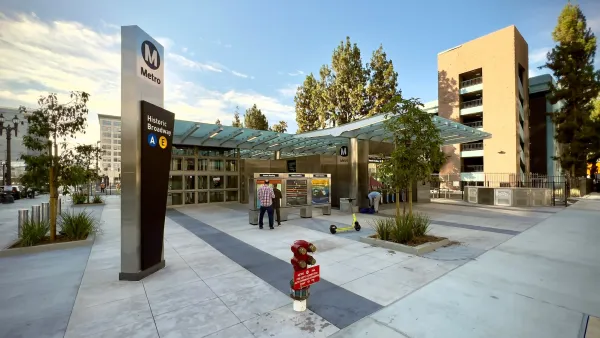
LA Delays State TOD Law to 2030 With its Own, Lower-density Plan
SB 79 allows cities to delay its implementation if they come up with alternate plans to boost density while retaining local control near transit.

How SB 827 'Cleaved the California Environmental Movement'
Even before the bill was defeated, it exposed a major generational divide between anti-development environmentalists and their pro-density, pro-housing heirs.
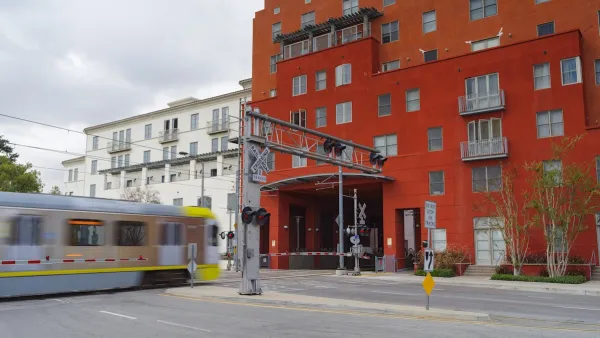
New California Law Allows 9-Story Buildings Near Transit
Gov. Newsom signed a low that overrides local zoning laws in the state’s biggest counties to allow for larger buildings near rail or rapid bus stations.

Planetizen Federal Action Tracker
A weekly monitor of how Trump’s orders and actions are impacting planners and planning in America.

Northwest rail fans eager for Sept. 30 debut of Amtrak’s Airo fleet
Get ready for that new train smell and more seats. But they won’t go faster or run more frequently on the Cascades route in Washington and Oregon.
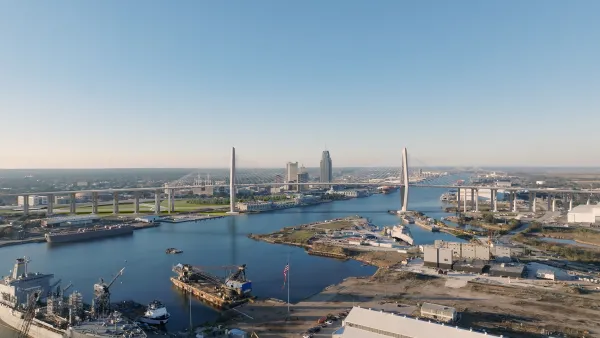
Alabama scores up to $2.5 billion federal loan for largest infrastructure project in state’s history
The Mobile River Bridge and Bayway Project aims to ease congestion at Alabama’s worst bottleneck.

Novel study finds extreme state-by-state disparity in housing construction timelines
The first comprehensive working paper on U.S. construction timelines also found that the permitting process for multi-family projects has slowed nationwide.

California may destroy its beaches trying to save homes from El Niño
Boulders and seawalls can protect homes from waves, but ultimately destroy sandy beaches.

California high-speed rail accomplishes only one legislative goal in 2026
The majority of the agency's failed pitches were never developed into written proposals.

FREE Course: Walkable City 1: Why Walkability?
After describing his path towards focusing on walkability as the essence of good planning, Jeff Speck marches through his five principal reasons for making more walkable places.
Reinventing Malls: Planning Alchemy—Turning Gray Fields Into Gold
The course focuses on the opportunities and imperatives that shape reinvention of mall sites.

City of Thousand Oaks
City of Wisconsin Rapids
Harvard University Graduate School of Design
The Architects Foundation
University of Cincinnati Online
Northern Illinois Transit Authority (NITA)
The Pocatello Development Authority
The Urban Renewal Agency of the City of Pocatello