The court rejected an argument that the MBTA Communities law, which requires zoning for multifamily housing, is an “unfunded mandate.”


A judge ruled against a group of Massachusetts towns that sought to block the state’s MBTA Communities law, a housing policy that requires cities to zone for multifamily housing development near MBTA transit stations.
As Jennifer Smith explains in CommonWealth Beacon, the plaintiffs in the suit argued that the law amounts to an “unfunded mandate” that does not provide a funding mechanism to offset the cost of added strain on local infrastructure. “More broadly, they claimed, the state imposed improper compliance requirements through the law as a condition to receive significant grant funding.”
In the decision, the judge wrote that the towns did not provide enough evidence of the added cost for local infrastructure that would be incurred by new development. “There was only ‘speculation’ about possible direct costs, he concluded, noting that the filing and affidavits submitted include words like ‘may,’ ‘expect,’ ‘possibly,’ ‘anticipate,’ and ‘estimated.’” The judge also pointed out that the law does not require new housing, merely “encourages” it, and that the state offers grants that can help cities with infrastructure costs.
FULL STORY: MBTA Communities law is not an unfunded mandate, judge rules

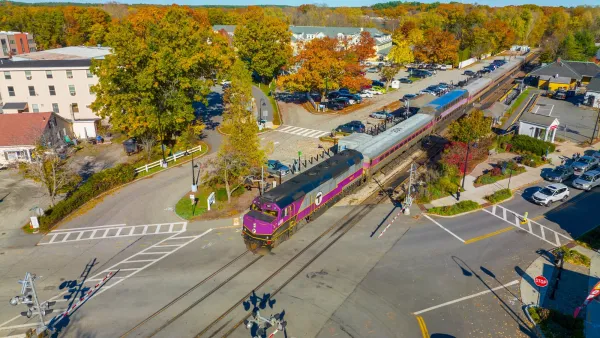
Report: MBTA Communities Act has Created Just 7,000 New Housing Units
The Massachusetts law requires cities to rezone appropriate neighborhoods for denser housing.
Poll: 2/3 of Virginians Don’t Trust Local Governments to Address Housing Crisis
Three-quarters of residents say the state needs to do more to address housing supply and affordability.
Opinion: California’s SB 79 Would Improve Housing Affordability and Transit Access
A proposed bill would legalize transit-oriented development statewide.

Planetizen Federal Action Tracker
A weekly monitor of how Trump’s orders and actions are impacting planners and planning in America.

The state-sanctioned urbicide of Austin
People don’t kill cities. Freeways do.

US to reduce Colorado River water deliveries to Mexico
A new Colorado Treaty amendment reduces Mexico’s Colorado River water allocation by 250,000 acre feet.

Baltimore to break ground on $50 million Transit Priority Project
The project will bring faster bus trips, safer streets and better bike connections to Baltimore.

Airbnb launches $250 million 'last-dollar financing' housing accelerator, makes first investment in Austin
The company will put $6.4 million towards affordable housing development in Texas’ capital.

Guerilla urbanists are building DIY bus stop benches in Chicago
A before-and-after of one of the bus stops with a new bench. The new benches are not officially sanctioned or permitted, but the residents who placed them hope they will be the start of a network of DIY benches across the city.

FREE Course: Walkable City 1: Why Walkability?
After describing his path towards focusing on walkability as the essence of good planning, Jeff Speck marches through his five principal reasons for making more walkable places.
Reinventing Malls: Planning Alchemy—Turning Gray Fields Into Gold
The course focuses on the opportunities and imperatives that shape reinvention of mall sites.

Eagle County Government
Harvard University Graduate School of Design
Nashville Planning Department
The Architects Foundation
University of Cincinnati Online
The Pocatello Development Authority
The Urban Renewal Agency of the City of Pocatello
Journal of the American Planning Association