Los Angeles County has released the draft 2025 OurCounty Sustainability Plan — shaped by community input — and is inviting public feedback through August 22 to help guide the County’s path toward a more sustainable, equitable, and resilient future.



The Los Angeles County Chief Sustainability Office (CSO) has released the draft 2025 OurCounty Sustainability Plan. Building on the original 2019 Plan, this update reflects the voices of thousands of residents and other stakeholders who participated through community workshops, individual meetings, and a countywide survey. The draft Plan advances ambitious goals around climate resilience, equity, biodiversity, housing, and more — grounded in what communities across the County said matters most.
OurCounty outlines what local governments and partners can do to enhance the well-being of every community in the County while reducing damage to the natural environment and adapting to the changing climate, particularly focusing on those communities that have been disproportionately burdened by environmental pollution. This plan envisions streets and parks that are accessible, safe, and welcoming to everyone; air, water, and soil that are clean and healthy; affordable housing that enables all residents to thrive in place; climate ready communities that are informed and prepared with infrastructure that supports them today and in a changing climate; and a just economy that runs on renewable energy instead of fossil fuels.
The public is invited to review and comment on the draft Plan now through Friday, August 22. To help stakeholders better understand the Plan’s content and how to engage, the CSO will host a public webinar on Thursday, August 7 at 10:00 a.m. (register here). Feedback can be submitted using this form, or by emailing: [email protected]. Please visit the project website to learn more.
FULL STORY: 2025 OurCounty Plan


A Sustainable Future for LA: Updating the OurCounty Plan
Los Angeles County is updating its Sustainability Plan to refine its vision for climate action, environmental justice, and community well-being, with residents encouraged to participate by taking the OurCounty 2025 Update Community Survey.

From Planning to Action: How LA County Is Rethinking Climate Resilience
Chief Sustainability Officer Rita Kampalath outlines the County’s shift from planning to implementation in its climate resilience efforts, emphasizing cross-departmental coordination, updated recovery strategies, and the need for flexible funding.
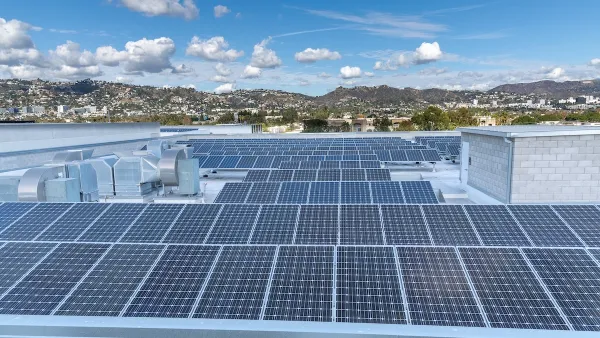
How Los Angeles County is Advancing Sustainability
A recently released report by the Chief Sustainability Office (CSO) shows that L.A. County is making progress on meeting the goals of the OurCounty Sustainability Plan.

Planetizen Federal Action Tracker
A weekly monitor of how Trump’s orders and actions are impacting planners and planning in America.

The state-sanctioned urbicide of Austin
People don’t kill cities. Freeways do.

US to reduce Colorado River water deliveries to Mexico
A new Colorado Treaty amendment reduces Mexico’s Colorado River water allocation by 250,000 acre feet.

Airbnb launches $250 million 'last-dollar financing' housing accelerator, makes first investment in Austin
The company will put $6.4 million towards affordable housing development in Texas’ capital.

Guerilla urbanists are building DIY bus stop benches in Chicago
A before-and-after of one of the bus stops with a new bench. The new benches are not officially sanctioned or permitted, but the residents who placed them hope they will be the start of a network of DIY benches across the city.

Mamdani overhauls NYC's Vision Zero plan with 100 new policy goals
The overhaul aims to reduce traffic deaths and make streets safer for pedestrians, cyclists and drivers through lower speed limits, new safety infrastructure and more.

FREE Course: Walkable City 1: Why Walkability?
After describing his path towards focusing on walkability as the essence of good planning, Jeff Speck marches through his five principal reasons for making more walkable places.
Reinventing Malls: Planning Alchemy—Turning Gray Fields Into Gold
The course focuses on the opportunities and imperatives that shape reinvention of mall sites.

Eagle County Government
Harvard University Graduate School of Design
Nashville Planning Department
The Architects Foundation
University of Cincinnati Online
The Pocatello Development Authority
The Urban Renewal Agency of the City of Pocatello
Journal of the American Planning Association