After several years, Sen. Jim Beall's persistent efforts to address the state's $130 billion road and bridge shortfall finally passed the legislature, but Assemblyman Travis Allen hopes to repeal the 12-cent tax hike through the initiative process.


Republican Assemblyman Travis Allen from Huntington Beach launched a grassroots campaign on May 5 to repeal the Road Repair and Accountability Act of 2017, aka SB 1, a 12 cents-per-gallon gas tax increase passed by the legislature on April 6 that takes effect November 1. His website asks for $5 donations and volunteers to gather petitions to qualify the initiative for the November 2018 ballot.
Sacramento Bee reporters Christopher Cadelago and Jim Miller explain why the repeal effort will not delay the gas tax increase, as one would expect in a voter referendum in California.
Allen is proposing an initiative, which means the earliest the tax could be repealed is after the November 2018 election.
Referendums, which allow the law in question to be halted until voters pass judgment on the repeal, cannot be used to repeal tax levies or measures that lawmakers passed with an urgency clause, such as the gas tax increase.
California voters decided a referendum on banning single-use plastic bags last November. The bill to ban the bags became law in September 2014 and was scheduled to take effect in July 2015, but was placed on-hold because the referendum qualified for the ballot. Voters narrowly upheld the ban.
"Allen can begin to gather signatures once the state attorney general issues a title and summary for his repeal," add Cadelago and Miller.
“While we were unable to stop it in the Legislature,” Allen said, “I realized that through the initiative system, the people of California can have a voice in Sacramento.”
The "we" whom Allen refers to are Republican legislators. Only one Republican, Sen. Anthony Cannella, from Ceres, Stanislaus County, voted for SB 1 after making a deal for a $400 million extension of ACE commuter rail into his district, and a $100 million parkway to UC Merced, enabling the the bill to pass with a two-thirds supermajority.
"[Assemblyman Allen] said he has gotten an outpouring of support for the effort, but odds are long for initiatives that don’t have backing from billionaires or monied interest groups," reports Katy Murphy for The Mercury News. Initiatives in the Golden State rarely qualify without the use of paid signature-gatherers.
For example, an initiative to limit the size of revenue bonds, Proposition 53, qualified for the ballot last year as it was financed by a wealthy Stockton farmer. The initiative was believed to have targeted high-speed rail and the Delta water tunnels. It was narrowly defeated, with 50.58 percent voting no.
On the other hand, a grassroots Massachusetts effort in 2014 qualified an initiative to repeal the automatic inflation adjustment that was included in a three cents per-gallon state gas tax increase in 2013. The initiative won with 53 percent of the vote.
"Under California law, the Attorney General has 65 days [from May 4] to write a title and summary of the initiative for the November 2018 ballot, and the initiative's proponents have 150 days to gather 365,880 valid CA signatures to qualify the Repeal for the November 2018 ballot," according to PR Newswire.
Read the full story: Initiative filed to repeal California gas tax increase
California Gas Tax Repeal Update: And Then There Was One
One of two initiatives to repeal last November's 12-cents per gallon gas tax increase failed to attract enough signatures by the Jan. 8 deadline. However, the other initiative has major backing and will likely appear on the Nov. 6 ballot.
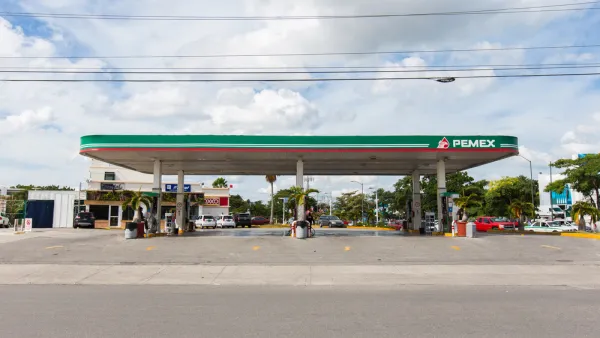
California Gas Tax Repeal Wins Significant Judicial Victory
The effort to repeal tax and fee increases resulting from the state's first successful gas tax legislation in 28* years received great news from a Sacramento superior court judge who tossed the attorney general's misleading title for their measure.
Voter Backlash Expected From Gas Tax Hike
There's a reason it can take decades to increase gas taxes — and many California legislators may soon found out why in November 2018, if not earlier. On November 1 of this year, state gas taxes will increase 12 cents per gallon.

Planetizen Federal Action Tracker
A weekly monitor of how Trump’s orders and actions are impacting planners and planning in America.

California plans to bury El Niño’s downpour
If the state plays its cards right, it may be able to store a billion acre-feet of El Niño’s water in aquifers.

Desperate measures: Advocates weigh draining Lake Powell to fill Colorado River
Draining the reservoir could reduce evaporation losses by a couple hundred thousand acre-feet.

US buildings threatened, destroyed by fires set to triple by 2060
Researchers found a high fire risk for socioeconomically vulnerable neighborhoods in the American West.

LA residents may be allowed to paint their own crosswalks
Councilwoman Katy Yaroslavsky put out a motion instructing the Los Angeles Department of Public Transportation to study the feasibility of allowing volunteers to paint crosswalks.

Dallas moves to overhaul its zoning code
The city's zoning reform will allow more multi-family and mixed-use developments.

FREE Course: Walkable City 1: Why Walkability?
After describing his path towards focusing on walkability as the essence of good planning, Jeff Speck marches through his five principal reasons for making more walkable places.
Reinventing Malls: Planning Alchemy—Turning Gray Fields Into Gold
The course focuses on the opportunities and imperatives that shape reinvention of mall sites.

City of Rosemead
Rutgers University, Edward J. Bloustein School of Planning and Public Policy
One Hundred Miles
Hunter College, City University of New York (CUNY)
The Architects Foundation
University of Cincinnati Online
City of Cambridge
Montrose County
The Pocatello Development Authority