A legal battle is looming between the nation's two most powerful environmental regulators after the California Air Resources Board on Friday defied President Trump by approving vehicle fuel efficiency standards that Trump has promised to ease.


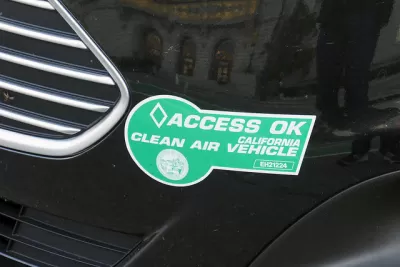
The unanimous vote on March 24 by the CARB board members to retain the high standards already approved on January 12 by the U.S. Environmental Protection Agency under the Obama Administration "is the boldest indication yet of California’s plan to stand up to President Trump’s agenda," writes Hiroko Tabuchi for The New York Times.
The president, appearing in Detroit on March 15, had announced that his administration will reevaluate the results announced in January at the conclusion of the midterm review process.
To roll back the mileage standards that call for attaining 54.5 mpg by year 2025, it "will take more than a year of legal and regulatory reviews by the E.P.A. and the Transportation Department," reported Coral Davenport and Bill Vlasic for The New York Times on the Detroit event.
The Trump administration will then propose its replacement fuel-economy standards by April of next year, according to a senior White House official.
Focus of conflict: the waiver
"But California can write its own standards because of a longstanding waiver granted under the Clean Air Act, giving the state — the country’s biggest auto market — major sway over the auto industry," explains Tabuchi.
Twelve other states, including New York and Pennsylvania, as well as Washington, D.C., follow California’s standards, a coalition that covers more than 130 million residents and more than a third of the vehicle market in the United States.
Now, the question is how — or whether — the Trump administration will handle California’s dissent. The administration could choose to revoke California’s waiver, at which point experts expect the state would sue.
EPA Administrator Scott Pruitt appeared as a guest on the last ten minutes of ABC News chief anchor George Stephanopoulos' Sunday show on March 26. Showing the headline of Ms. Tabuchi's article in The Times in Saturday's paper, Stephanopoulos asked Pruitt directly whether he will deny use of the waiver that allows California to set stricter emissions standards.
Pruitt evaded a direct answer but referenced the growing demand for sport utility vehicles. Passenger vehicles that are classified as light trucks, composed of sport utility vehicles, pickups and minivans, accounted for almost 61 percent of all auto sales last year, according to a January post.
"We ought to focus on fuel efficiency for cars that people really want to buy," he said. "This process of building cars that no one purchases in order to meet these standards that were previously set is counter helpful to the environment because people don't want to buy the new cars; they keep older cars."
Stephanopoulos pressed him again. "But will you let California go forward?"
"That's something we are going to be evaluating through April 2018," Pruitt responded, referring to the final date of the midterm evaluation process.
Administrator Pruitt went on to talk to Stephanopoulos about the Clean Power Plan rule. Expect a new presidential executive order on Tuesday announcing the beginning of its rollback.
Discussions on rolling back emissions standards and the Clean Power Plan are related to meeting the United States' commitment to the goals set by the Paris Climate Agreement (COP 21) in December 2015 thanks to Stephanopoulos' questioning.
Correspondent's notes:
- See CARB Agenda #17-3-8, Friday March 24: Public Meeting to Consider the Advanced Clean Cars Midterm Review (pdf) for more information and staff presentation
- On Thursday, CARB approved the Nation's Toughest Methane Emissions Rule
====================================
Related posts this year in Planetizen:
-
Uncertain Future for Electric Vehicles if Fuel Efficiency Standards Relaxed, March 8, 2017, NPR
The U.S. EPA has signaled that it will withdraw an earlier decision to maintain the 54.5 miles per gallon target. Should that happen, a major casualty will be electric vehicles, according to one prominent EV advocate interviewed on NPR.
- Legal Loophole Will Allow Rollback of Fuel Efficiency Standards, March 7, 2017, The New York Times
On Tuesday, the Trump administration anticipates unraveling two signature Obama environmental regulations: fuel efficiency standards for model year 2022-2025 light-duty vehicles and beginning the undoing of the Clean Power Plan.
- EPA Nominee Scott Pruitt Could Weaken California's Efforts to Fight Climate Change, January 24, 2017, Los Angeles Times
Oklahoma Attorney General Scott Pruitt suggested that as administrator of the Environmental Protection Agency he might not allow California to set its own stricter motor vehicle emissions standards.
- EPA Rejects Automakers' Bid to Reduce Fuel Economy Standards in Midterm Review, January 18, 2017, The Washington Post
The U.S. Environmental Protection Agency ruled that existing technology allows for increased efficiency in model years 2022 to 2025. The 2012 rule to achieve 54.5 mpg by 2025 required a 'midterm evaluation' to see if the final target was achievable.
FULL STORY: California Upholds Auto Emissions Standards, Setting Up Face-Off With Trump


Rollback of Fuel Efficiency Standards Announced by EPA
EPA Administrator Scott Pruitt announced Monday that his agency is siding with auto manufacturers and relaxing greenhouse gas emission standards for new cars and light trucks.
April 1 Showdown Between U.S. EPA and California Looms
At stake are greenhouse gas emission standards for 2022-25 model year passenger vehicles. Relaxing these standards would likely doom efforts to reduce these emissions 40 percent below 1990 levels by 2030 as required by 2016 state legislation.
California Earning Clean Air Despite the U.S. Environmental Protection Agency
While premature to claim victory, a report from the San Francisco Chronicle suggests that the California Air Resources Board will prevail in a looming showdown with the U.S. EPA over whether to allow the state to set vehicle emission standards.

The state-sanctioned urbicide of Austin
People don’t kill cities. Freeways do.

US to reduce Colorado River water deliveries to Mexico
A new Colorado Treaty amendment reduces Mexico’s Colorado River water allocation by 250,000 acre feet.

New Jersey’s second-largest city bans standalone data centers
Jersey City will continue to allow co-location facilities, such as those meant for research institutions that store their own data.

Amtrak not solely to blame for New Jersey commuter rail's unreliability, report finds
A new study from the Garden State Initiative found that NJ Transit’s budget grew 20% across a 4 year period, but reliability declined significantly over the same period.

EPA erases limits on planet-warming pollution from power plants
Under Monday’s plan, power plants would still have some limits on how much mercury, arsenic and other contaminants they can emit.

Phoenix announces new on-demand transit service, more frequent RAPID buses
Both new services will launch in October, and are part of Phoenix's Project Effective Access Solutions for Easing Congestion.

FREE Course: Walkable City 1: Why Walkability?
After describing his path towards focusing on walkability as the essence of good planning, Jeff Speck marches through his five principal reasons for making more walkable places.
Reinventing Malls: Planning Alchemy—Turning Gray Fields Into Gold
The course focuses on the opportunities and imperatives that shape reinvention of mall sites.

Eagle County Government
Harvard University Graduate School of Design
Nashville Planning Department
The Architects Foundation
University of Cincinnati Online
The Pocatello Development Authority
The Urban Renewal Agency of the City of Pocatello
Journal of the American Planning Association