While premature to claim victory, a report from the San Francisco Chronicle suggests that the California Air Resources Board will prevail in a looming showdown with the U.S. EPA over whether to allow the state to set vehicle emission standards.


"The Trump administration may be quietly conceding defeat to California on car tailpipe emissions, the biggest battleground in the state’s showdown with President Trump over climate change," reports Carolyn Lochhead, Washington correspondent for the San Francisco Chronicle.
Environmental Protection Agency chief Scott Pruitt backed away last month from his threats to challenge California’s unique legal authority, known as a waiver, to set aggressive limits on vehicle emissions, including greenhouse gases.
Although Pruitt left the door open to a future challenge, experts said he is running out of time to stop California from dictating national pollution standards on cars, the nation’s primary source of greenhouse gas emissions.
At stake is the continuation of the California Air Resources Board's Advanced Clean Cars Program, "a cornerstone of the state’s efforts to reduce greenhouse gases," reported the Chronicle's Melody Gutierrez in late March after board members voted to retain its commitment to reduced air and greenhouse pollution, including support for "more than 4 million zero-emission vehicles in California by 2030," according to CARB. [Also posted here].
In March, President Trump announced his intention to roll back the President Obama's strict fuel efficiency standards of the midterm review, while California had affirmed the January decision reached by the EPA under President Obama. In January, then EPA Administrator-nominee Pruitt had left open the possibility of withdrawing the waiver, granted under the Clean Air Act, enabling California to pursue more rigorous emission standards.
In addition to California, 12 other states have adopted the state's more rigorous vehicle emission standards, accounting for about a third of the U.S. auto market.
Lochhead acknowledges recent events that are in synch with California's regulations that are moving the American auto market to produce more electric vehicles (EVs). Rolling back fuel efficiency standards would set back efforts to increase EV adoption.
Last week’s decisions by Chinese-owned Volvo to put electric engines in all its new cars, and by France to phase out gasoline and diesel cars by 2040, only strengthened California’s hand.
FULL STORY: Trump administration may let California keep emissions standards

Trump Administration Proposes to Freeze Fuel Economy Standards at 2020 Level
On Thursday, the U.S. DOT and U.S. EPA announced one of the Trump administration's most consequential rollbacks of environmental and efficiency regulations that will have a detrimental effect on climate change, air pollution, and oil consumption.
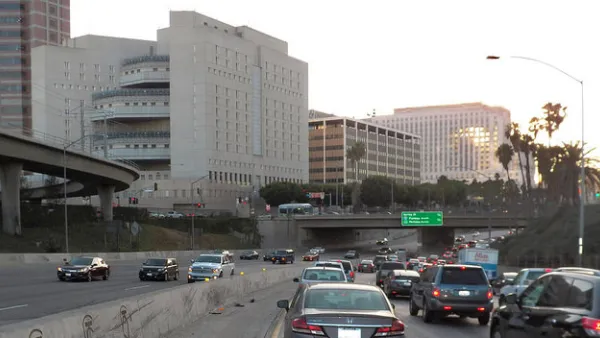
White House Ends Talks with California Over Fuel Efficiency Standards
Ending the talks means litigation will have to settle the conflict over the two standards: California and 12 other states continue to use the Obama-era standard of 36 mpg by 2025, while the administration's rule freezes standards at 2020, or 29 mpg.
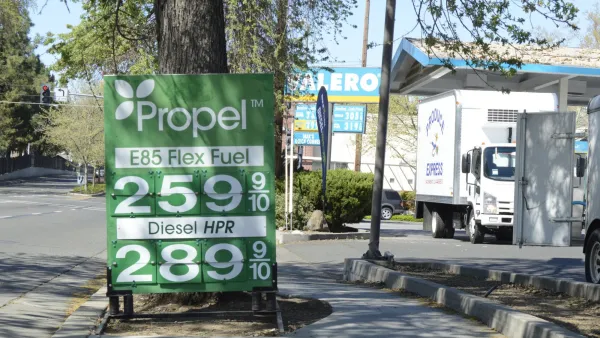
California and Auto Industry Agree on Vehicle Emissions Standards
Normally having the California Air Resources Board and the auto industry in agreement on emissions standards would be enough, but the Trump administration wants to ensure that California plays no role in setting standards.

The state-sanctioned urbicide of Austin
People don’t kill cities. Freeways do.

US to reduce Colorado River water deliveries to Mexico
A new Colorado Treaty amendment reduces Mexico’s Colorado River water allocation by 250,000 acre feet.

New Jersey’s second-largest city bans standalone data centers
Jersey City will continue to allow co-location facilities, such as those meant for research institutions that store their own data.

Amtrak not solely to blame for New Jersey commuter rail's unreliability, report finds
A new study from the Garden State Initiative found that NJ Transit’s budget grew 20% across a 4 year period, but reliability declined significantly over the same period.

EPA erases limits on planet-warming pollution from power plants
Under Monday’s plan, power plants would still have some limits on how much mercury, arsenic and other contaminants they can emit.

Phoenix announces new on-demand transit service, more frequent RAPID buses
Both new services will launch in October, and are part of Phoenix's Project Effective Access Solutions for Easing Congestion.

FREE Course: Walkable City 1: Why Walkability?
After describing his path towards focusing on walkability as the essence of good planning, Jeff Speck marches through his five principal reasons for making more walkable places.
Reinventing Malls: Planning Alchemy—Turning Gray Fields Into Gold
The course focuses on the opportunities and imperatives that shape reinvention of mall sites.

Eagle County Government
Harvard University Graduate School of Design
Nashville Planning Department
The Architects Foundation
University of Cincinnati Online
The Pocatello Development Authority
The Urban Renewal Agency of the City of Pocatello
Journal of the American Planning Association