Athlyn Cathcart-Keays of The Guardian-Cities chronicles the advancement of the international urban car-free movement as well as auto regulations that focus on air pollution. The most recent city to join the growing list is Oslo, Norway


"When Oslo revealed plans to ban all private vehicles from the centre by 2019, it joined a lengthening list of cities seeking to shift the focus away from cars and towards greener, citizen-focused mobility solutions," writes Cathcart-Keays, a freelance journalist writing on urbanism and sustainability who currently works on the The Guardian's Cities coverage. The Oslo plan was also described here by Erling Fossen, a Planetizen blogger and dedicated Oslopolitan.
Helsinki has ambitious plans to make its “mobility on demand” service so good that nobody will want to drive a car in the centre by 2025, while Paris’s car-free days have successfully reduced high pollution. New cities – such as the Great City on the outskirts of Chengdu, China, and Masdar near Abu Dhabi – plan to focus on mass transit or electric cars as alternatives to gas-guzzling private cars.
Air pollution mitigation
There is a strong relationship with with auto bans, or partial bans, to be more precise, and clean air. Take Paris - just last month it won the right to introduce auto restrictions in advance of the COP21 talks to be held in that city, writes The Guardian's Kim Willsher.
The mayor of Paris, Anne Hidalgo, has won a long-running battle with the French government to introduce emergency traffic bans in the city when air pollution spikes.
The move to speed up the introduction of alternate driving days for cars with odd and even number registration plates was announced after pollution spiked in the French capital on (Nov. 2).
The same restriction was enacted in Beijing on Dec. 7 as a result of the city's first "red alert" due to unhealthy levels of air pollution. But Paris has also gone beyond driving restrictions to combat pollution and initiated car bans in entire districts, as described by Planetizen blogger Josh Stephens and here by Managing Editor James Brasuell.
Greenhouse gas emission reduction
"The Norwegian capital’s announcement came last month as part of a wider political initiative by the newly elected leftist municipal government to halve the city’s emissions by 2020," writes Cathcart-Keays. "On top of implementing a no-car zone within the city’s central ring road, Oslo plans a number of other proposals, including building at least 40 miles of new bike lanes, introducing rush-hour charges (on top of existing congestion fees) and removing parking spaces."
Cathcart-Keays goes on to describe the Parisian plans, with emphasis on banning diesel cars, as well as those in other cities including Brussels, Dublin, Hamburg, Madrid, Milan, even Davis, Calif., thought it's "not a typical American city; it’s in thrall to the bicycle," writes Carlton Reid for The Guardian-Cities.
Hat tip to Metro Transportation Library.
FULL STORY: Will we ever get a truly car-free city?

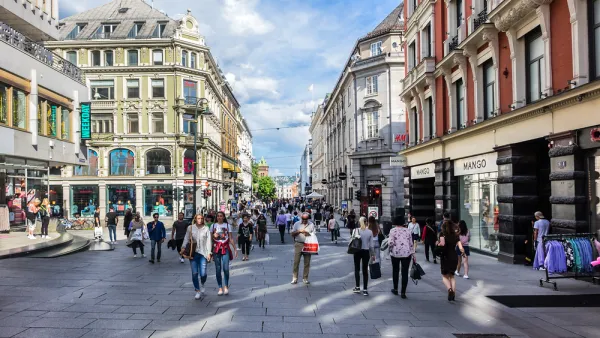
Watch: The Car-Free City Becomes Reality
The latest City Beautiful video shows off the fruits of car-free initiatives in European cities.
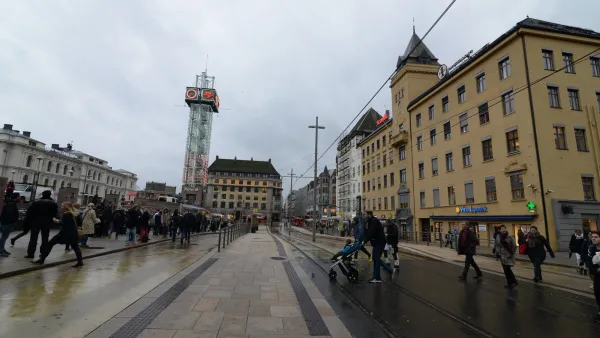
In Oslo, Streets for People, Not Cars
New measures will greatly reduce vehicle traffic in the city center as Oslo moves to put pedestrians, cyclists, and air quality before cars.

These Streets Were Made for Walking
Many streets and cities are designed for vehicles instead of for pedestrians. But policies and programs in cities around the world, and even in the United States, might be signaling a shift in priorities.

The state-sanctioned urbicide of Austin
People don’t kill cities. Freeways do.

US to reduce Colorado River water deliveries to Mexico
A new Colorado Treaty amendment reduces Mexico’s Colorado River water allocation by 250,000 acre feet.

New Jersey’s second-largest city bans standalone data centers
Jersey City will continue to allow co-location facilities, such as those meant for research institutions that store their own data.

Amtrak not solely to blame for New Jersey commuter rail's unreliability, report finds
A new study from the Garden State Initiative found that NJ Transit’s budget grew 20% across a 4 year period, but reliability declined significantly over the same period.

EPA erases limits on planet-warming pollution from power plants
Under Monday’s plan, power plants would still have some limits on how much mercury, arsenic and other contaminants they can emit.

Phoenix announces new on-demand transit service, more frequent RAPID buses
Both new services will launch in October, and are part of Phoenix's Project Effective Access Solutions for Easing Congestion.

FREE Course: Walkable City 1: Why Walkability?
After describing his path towards focusing on walkability as the essence of good planning, Jeff Speck marches through his five principal reasons for making more walkable places.
Reinventing Malls: Planning Alchemy—Turning Gray Fields Into Gold
The course focuses on the opportunities and imperatives that shape reinvention of mall sites.

Eagle County Government
Harvard University Graduate School of Design
Nashville Planning Department
The Architects Foundation
University of Cincinnati Online
The Pocatello Development Authority
The Urban Renewal Agency of the City of Pocatello
Journal of the American Planning Association