In perhaps the most aggressive move in the young history of tactical urbanism, the City of Light will clear not just one street or neighborhood, but rather an entire district of cars for 'Une Journée Sans Voiture' September 27.


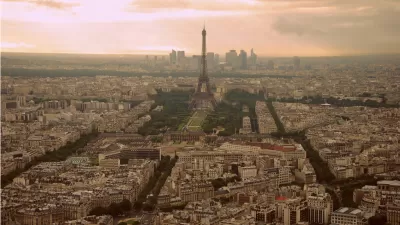
Bogota has its Ciclovia and Los Angeles has its CicLAvia, among many other cities that sponsor temporary car-free events. But few, if any cities, have attempted to clear as many cars from as many streets as Paris will September 27. An attempt to reduce pollution and increase pedestrianism in the one of the world's most walkable cities, "Une Journée Sans Voiture" is part of European Mobility Week, which promotes active transportation across the Continent.
"As Mayor Anne Hidalgo announced in March: 'Paris will be completely transformed for a day. This is an opportunity for Parisians and tourists to enjoy the city without noise, pollution and therefore without stress.'"
"The areas without traffic include the 1st, 2nd, 3th, 4th, 5th, 6th, 7th, 10thand 11th arrondissements (neighborhoods), the Champs Élysées, Place Stalingrad, Place de la Republique, the Left Bank, the Place de la Bastille, the area around the Eiffel Tower and the Bois de Vincennes and Boulogne."
"Our city has to establish an exemplary signal responding to global issues,” the non-profit environmental group Paris Sans Voiture says, supporting the initiative. “But it also has to respond to local issues after record peaks of pollution and climate challenges that are more than ever at the heart of everyday life. The car-free day, by its magnitude, will also leave a lasting mark on the collective imagination: Everyone can project a city more livable, adopt sustainable behaviors, particularly in terms of mobility and the sharing of public spaces."
FULL STORY: Paris Will Stop All Traffic, Literally, For One Day in September

Car-Free Movement Gaining Steam in Europe and Elsewhere
Athlyn Cathcart-Keays of The Guardian-Cities chronicles the advancement of the international urban car-free movement as well as auto regulations that focus on air pollution. The most recent city to join the growing list is Oslo, Norway
On the Re-Orientation of Los Angeles
Aaron Paley, the man who brought Ciclovia to the United States, wants Los Angeles to be a model for the transition from auto-dependent to car-optional.
CicLAvia Rides into South Los Angeles
CicLAvia, the Los Angeles open streets event, heads to South Los Angeles for the first time today. Sahra Sulaiman explains the communities preparedness leading up to this historic event.

The state-sanctioned urbicide of Austin
People don’t kill cities. Freeways do.

US to reduce Colorado River water deliveries to Mexico
A new Colorado Treaty amendment reduces Mexico’s Colorado River water allocation by 250,000 acre feet.

New Jersey’s second-largest city bans standalone data centers
Jersey City will continue to allow co-location facilities, such as those meant for research institutions that store their own data.

Amtrak not solely to blame for New Jersey commuter rail's unreliability, report finds
A new study from the Garden State Initiative found that NJ Transit’s budget grew 20% across a 4 year period, but reliability declined significantly over the same period.

EPA erases limits on planet-warming pollution from power plants
Under Monday’s plan, power plants would still have some limits on how much mercury, arsenic and other contaminants they can emit.

Phoenix announces new on-demand transit service, more frequent RAPID buses
Both new services will launch in October, and are part of Phoenix's Project Effective Access Solutions for Easing Congestion.

FREE Course: Walkable City 1: Why Walkability?
After describing his path towards focusing on walkability as the essence of good planning, Jeff Speck marches through his five principal reasons for making more walkable places.
Reinventing Malls: Planning Alchemy—Turning Gray Fields Into Gold
The course focuses on the opportunities and imperatives that shape reinvention of mall sites.

Eagle County Government
Harvard University Graduate School of Design
Nashville Planning Department
The Architects Foundation
University of Cincinnati Online
The Pocatello Development Authority
The Urban Renewal Agency of the City of Pocatello
Journal of the American Planning Association