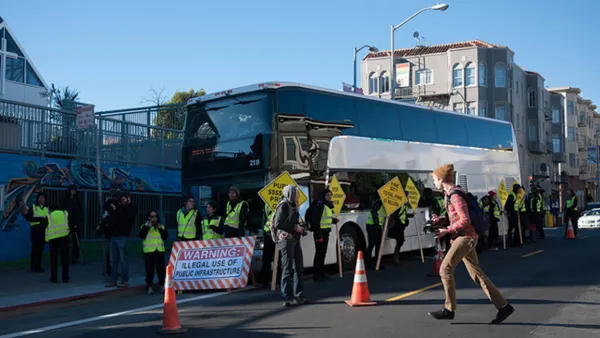
They're hated by many, blamed for the city's gentrification, but are an integral part of regional transportation, enabling tech employees to work on the Peninsula and South Bay while living in the city. A city-approved pilot may become permanent.


Last year, San Francisco and the San Francisco Municipal Transportation Agency (SFMTA) approved an 18-month pilot program allowing the so-called Google buses (or employee "tech buses or shuttles," as they are operated by other companies, including Yahoo and Genentech) to pay to use specified stops, including Muni stops.

While the pilot ends on January 31, 2016, Joe Fitzgerald Rodriguez reveals that the city may already be planning on making them permanent, which greatly upsets opponents of the buses as they have California Environmental Quality Act (CEQA) litigation pending.
“Make permanent the 18-month commuter shuttle pilot program,” reads filings at the Planning Commission, which show an air quality study now in planning stages.
The tech bus opponents, or "anti-shuttle advocates," as Rodriguez also calls them, "who sued the SFMTA, The City and tech companies over the program said the development comes as a surprise because the outcome of a lawsuit to compel environmental studies of the program have not been settled," writes Rodriguez.
Opponents of the shuttle program also contend the program will accelerate displacement of area residents, which is a legal environmental concern under the California Environmental Quality Act [CEQA] and may be subject to study.
[For a thorough examination of the displacement issue and tech workers in a regional context, see Kim-Mai Cutler's 2014 piece in TechCrunch posted here.]
Studies by the S.F.-based Anti-Eviction Mapping Project show rents rise considerably in apartments around commuter shuttle stops, which they argue leads to evictions of residents.
Of course, the same argument could be targeted at other forms of transit. As S.F. Planning Commissioner Dennis Richards stated in Rodriguez's article on Tuesday about San Francisco Supervisor Scott Wiener's expansive subway plan:
Wiener’s plan also dovetails with current long term housing planning, Richards said, which may ease housing pressure off The City’s urban core (downtown, South of Market, and The Mission).
“You don’t see (housing) moratoriums in the Sunset, do you?” he said. “Just the Mission, which is right on a BART line.”
While displacement caused by escalating rents is a top issue for San Franciscans, particularly in The Mission, blaming tech workers appears to be on the downswing, as noted by low turnout at some of their recent demonstrations.
Correspondent's note: Rather that call the Peninsula and the South Bay "Silicon Valley," I labeled them geographically because San Francisco is also considered part of Silicon Valley, by some definitions.
Read the full story: Controversial tech shuttles on road to becoming part of The City’s transit ecosystem

The Downside of Removing Tech Buses from Neighborhoods
A new study has shown that moving tech shuttle stops from neighborhoods to conform to a new "hub plan" would result in a drop in bus ridership, with most former riders resorting to driving their own vehicles to their Silicon Valley workplaces.
Google Bus Opponents Argue Need for CEQA Study in San Francisco Superior Court
On Friday, tech bus opponents took their case to court, arguing that the San Francisco Municipal Transportation Agency must comply with the California Environmental Quality Act due to impacts including air quality and community displacement.
Tech Bus Opponents in S.F. go to Court to Halt Buses using CEQA
Having lost their CEQA appeal with the San Francisco Board of Supervisors, the "tech bus" opponents are taking their case to the court, arguing that environmental impacts from the large, luxury private buses using public bus stops must be addressed.

Planetizen Federal Action Tracker
A weekly monitor of how Trump’s orders and actions are impacting planners and planning in America.

‘Going backwards:’ Baltimore mayor, students rally against state's transit funding plan
Maryland's proposed six-year plan provides no funding for Baltimore’s BMORE bus program and reduces its road maintenance funding.

Detroit to transform waterfront with $2.2 billion investment
Developers will convert about 18 acres of unused parking lot space into civic spaces.

U.S.-Iran war may have ‘devastating’ impact on cost to warm homes
Vermont and Maine residents may see a 76% increase in the cost of warming their homes this winter.

Senate bill would ‘overhaul’ environmental permitting laws
Under the proposed act, government agencies would also not be able to suspend or rescind permits after granting them.

Exemption applications for NYC’s pied-à-terre tax see 55% success rate
The city sent nearly 40% of its initial pied-à-terre tax warnings erroneously.

FREE Course: Walkable City 1: Why Walkability?
After describing his path towards focusing on walkability as the essence of good planning, Jeff Speck marches through his five principal reasons for making more walkable places.
Reinventing Malls: Planning Alchemy—Turning Gray Fields Into Gold
The course focuses on the opportunities and imperatives that shape reinvention of mall sites.

One Hundred Miles
County of Mendocino
planning NEXT
The Architects Foundation
University of Cincinnati Online
Montrose County
Northern Illinois Transit Authority (NITA)
The Pocatello Development Authority