Once again, chronic delays on New Jersey Transit's rail lines in and out of Manhattan serve as a reminder of Gov. Christie's ill fated decision to cancel replacement of the two aging Hudson River tunnels to Penn Station.


Just two weeks after The New York Times architectural critic, Michael Kimmelman wrote a featured article on the need to rebuild the 100-year-old Hudson River rail tunnels, known as Amtrak's Gateway Program, and warning of their vulnerability and high priority for replacement, Benjamin Mueller writes about just such an incident, though not confined to one day.
For the third day in a row, electrical problems in century-old rail tunnels under the Hudson River on Wednesday stymied the commutes of tens of thousands of New Jersey Transit riders, illustrating again the shortcomings of the region’s languishing infrastructure system.
"The delays... created chaos during the morning rush hour," writes Mueller. "The deterioration of the tunnel walls accelerated after Hurricane Sandy, as seawater and salt that inundated the tunnels ate away at concrete bench walls where the signal and power cables are held."
Power was shut down to both tubes of the Hudson River Tunnel around 5:45 a.m. [Wednesday] after a switch that controls a high-voltage cable malfunctioned, said Craig Schulz, a spokesman for Amtrak, which owns the tunnel.
Different problems with the same overhead catenary system also snarled New Jersey Transit commuting on Monday night and Tuesday morning. Both heat and brittle electrical systems could have played a role, but transportation experts said the problems pointed to broad failures to invest in repairs and build systems that could accommodate everyday glitches.
For New Jersey rail commuters going to Manhattan, the cancellation of the Access to the Region's Core (ARC) project by Gov. Chris Christie on October 7, 2010 followed by the devastation caused by Hurricane Sandy in late October two years later came as a one-two punch.
Transit advocates said that this week’s breakdowns, far from being an anomaly, laid bare the paralyzing effects of disruptions that could become common in the absence of quick action.
Mueller revisits the Christie's cancellation of ARC, writing that he "ordered that $3 billion from the Port Authority of New York and New Jersey set aside for the plan be redirected to other projects in New Jersey. Critics charged that his actions were politically motivated and allowed him to keep a campaign promise not to raise the gasoline tax."
Despite an independent federal report saying he exaggerated the costs, Mr. Christie defended the decision by saying he worried that the project would have unduly burdened taxpayers.
Amtrak, who is paid by New Jersey Transit to maintain the tunnels, issued a statement saying, “We apologize to all who are affected by these delays.”
The agency, which is in the process of upgrading signal and catenary systems on a 23-mile section of railroad from Trenton to New Brunswick, said such delays “stem from long-term underinvestment in the Northeast Corridor.”
In his July 8 piece that appeared The Arts section of The Times, Kimmelman starts with the Hudson tunnel problems, but like so many other ARC critics, delves into the problems associated with Penn Station, "the nation's busiest and most disgusting transit hub, not to mention a potential fire trap...But new tunnels aren't enough...The old tunnel plan, quashed by Governor Christie, skirted Penn Station, which posed problems."
Kimmelman goes on to describe plans for enlarging Penn Station, moving Madison Square Garden, and comparison to the new, soon-to-be-opened World Trade Center Transportation Hub, dubbed "the World’s Most Expensive Train Station."
Penn Station may be no Grand Central Station, but what's delaying commuters in and out of Manhattan is not a substandard terminal but decaying, century-old Hudson River tunnels.
Read the full story: On Day 3 of Delays, New Jersey Transit’s Shortfalls Are Painfully Clear

Formidable Barriers Threaten Penn Station Renovation
Last month N.Y. Gov. Andrew Cuomo proposed that Empire Station replace Penn Station, but many challenging parts, e.g., the Hudson River Tunnels, moving Madison Square Garden, could derail it. A related piece delves into the prior ARC tunnel project.
Northeast Rail Corridor Woes Extend Far Beyond Hudson River Tunnels
While Amtrak's century-old Hudson River rail tunnels may capture the public's attention, particularly when they are closed, infrastructure problems on the Northeast Corridor also plague the line from Rhode Island to Washington, D.C.
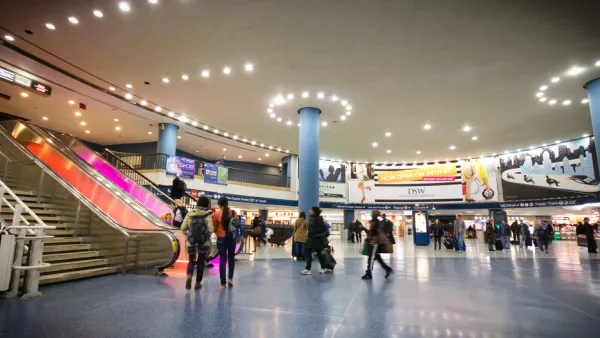
Commute Nightmare Awaits Amtrak and New Jersey Transit Passengers
At best, it will take seven years to build the Amtrak Gateway tunnels, the replacement of Access to the Region's Core. If one of the existing two aging tunnels has to be shut to make repairs before the project is completed, commute nightmare ensues.

Planetizen Federal Action Tracker
A weekly monitor of how Trump’s orders and actions are impacting planners and planning in America.

Data reveals that NYC’s bet on congestion pricing has paid off
After almost two years of the program, reports show positive impacts on traffic and air quality and no disruptions to parking.

HUD modernizes 50-year-old manufactured housing framework
The Next Generation Manufactured Housing Action Plan establishes new energy-efficiency standards for manufactured homes, and new guidelines for anchoring them.

Chicago city vehicles are on the hunt for illegally-parked cars
Cameras on the vehicles can automatically issue tickets to drivers who park their cars in bus or bike lanes.

Small single-family homes are illegal in most of MA. Voters can change that
Most land zoned for single-family housing in Massachusetts requires at least 40,000 square feet of land per house.

Public steps inside U.S.’s first battery-powered train
Metra’s groundbreaking train feature modern seats and a futuristic battery car.

FREE Course: Walkable City 1: Why Walkability?
After describing his path towards focusing on walkability as the essence of good planning, Jeff Speck marches through his five principal reasons for making more walkable places.
Reinventing Malls: Planning Alchemy—Turning Gray Fields Into Gold
The course focuses on the opportunities and imperatives that shape reinvention of mall sites.

One Hundred Miles
County of Mendocino
planning NEXT
The Architects Foundation
University of Cincinnati Online
Montrose County
Northern Illinois Transit Authority (NITA)
The Pocatello Development Authority