A survey by HNTB Corp. found that 79 percent of respondents would support tolling currently untolled roads, including highways, if the revenue was used to improve traveling conditions on the tolled road.


A survey conducted by HNTB Corp., "an employee-owned infrastructure solutions firm," found that 79 percent of U.S. residents "would support the addition of a toll on a non-tolled surface transportation facility if it resulted in a safer, congestion-free and more reliable trip," writes Keith Laing of The Hill.
It's a win-win, advocates argue. In addition to improving roads through better upkeep and reduced congestion, it would also reduce the $16 billion annual Highway Trust Fund shortfall (if tolls applied on federal highways.)
However, the anti-tolling Alliance for Toll-Free Interstates (ATFI) disputed the support for expanding tolling in the U.S. was as high as the HNTB poll found, pointing to other surveys that have painted a more muddled picture of public opinion on the topic.
It would appear that advocates face an uphill battle, notwithstanding the president's support for inclusion of tolling interstates in his Grow America plan. Tolling was not included in Sen. Barbara Boxer's stalled MAP-21 Reauthorization Act in order to keep it noncontentious.
Contradicting the HNTB poll was a May 7 poll showing overwhelming opposition to tolling interstate highways.
A new Rasmussen Reports national telephone survey finds that just 22% of American Adults favor putting tolls on Interstate highways for infrastructure maintenance. Three times as many (65%) are opposed to turning the nation’s Interstates into toll roads, something that has been banned since 1956 when the highway system was created.
Rasmussen did not compare toll increases to gas tax increases though, which is what an academic poll in Wisconsin did (posted here). While tolls were viewed more favorably than hiking gas taxes, it was suggested that respondents may have opted for tolls because they could avoid driving on a tolled road - while increased gas taxes would be inescapable.
Read the full story: Poll: 79 percent supports tolling to pay for highways
Transportation Reauthorization Bill Breezes Past First Committee
Receiving a resounding vote of confidence from the Environment and Public Works Committee, the $265 billion, six-year MAP-21 reauthorization bill advanced on its path to keep federal transportation payments going to states through the summer.
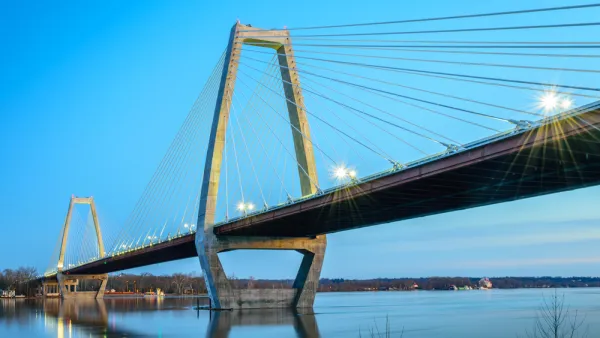
Indiana Advances Interstate Tolling Plans
The Hoosier State is on a roll, infrastructure speaking. Having passed its largest highway investment package last year based on a 10-cents per gallon gas tax hike, it initiated a study to determine the revenue potential for tolling interstates.
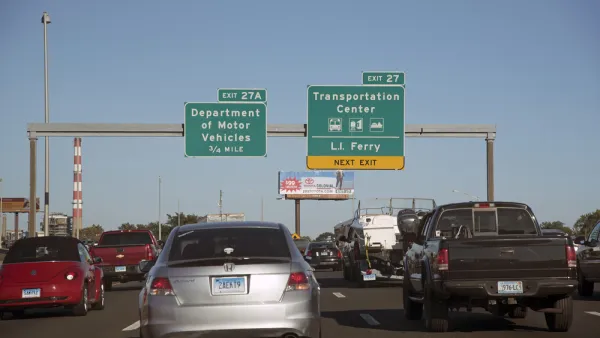
Bill to Toll Connecticut Interstates and Parkways Advances
A bill backed by Gov. Malloy that directs the Department of Transporation to prepare a plan to toll three interstates and two state parkways narrowly passed two legislative committees largely along party lines. It now advances to the full House.

Planetizen Federal Action Tracker
A weekly monitor of how Trump’s orders and actions are impacting planners and planning in America.

California plans to bury El Niño’s downpour
If the state plays its cards right, it may be able to store a billion acre-feet of El Niño’s water in aquifers.

Desperate measures: Advocates weigh draining Lake Powell to fill Colorado River
Draining the reservoir could reduce evaporation losses by a couple hundred thousand acre-feet.

Housing is the top priority of Seattle’s sole new councilmember
Jenks campaigned on building 1,000 new units of affordable housing.

New tax cuts may slash $1.5 billion in funding for Miami transit, public parks
Amendment 3 will save Miami-Dade homeowners $2,700 in 2028.

Arizona, Wisconsin, Pennsylvania hope to finally advance climate goals post-midterms
The three states have spent years under Republican or divided control.

FREE Course: Walkable City 1: Why Walkability?
After describing his path towards focusing on walkability as the essence of good planning, Jeff Speck marches through his five principal reasons for making more walkable places.
Reinventing Malls: Planning Alchemy—Turning Gray Fields Into Gold
The course focuses on the opportunities and imperatives that shape reinvention of mall sites.

City of Rosemead
Rutgers University, Edward J. Bloustein School of Planning and Public Policy
One Hundred Miles
University of Michigan School for Environment and Sustainability (SEAS)
Hunter College, City University of New York (CUNY)
The Architects Foundation
City of Cambridge
Montrose County
The Pocatello Development Authority