Although its unclear just how much influence the Department of Transportation's surface transportation authorization bill, called GROW AMERICA, will have (if any at all), the bill makes apparent a sea change with regard to tolling of the interstates.


"With pressure mounting to avert a transportation funding crisis this summer, the Obama administration Tuesday opened the door for states to collect tolls on interstate highways to raise revenue for roadway repairs," report Ashley Halsey III. "The proposal, contained in a four-year, $302 billion White House transportation bill, would reverse a long-standing federal prohibition on most interstate tolling."
The detail of the GROW AMERICA transportation reauthorization bill proposed by the Department of Transportation follows up on earlier hints by Transportation Secretary Foxx that the Obama Administration would be amenable to such changes.
Curtis Tate provides more coverage of the possibility that the federal government could end the longstanding prohibition of tolling on interstate highways, including opposition to the idea from "trucking industry and motorist groups."
Tanya Snyder also followed up on Streetsblog's initial coverage of the GROW AMERICA proposal with more details of what the proposal would or would not do. The latter is much more likely, however, according to Snyder: "President Obama’s funding plan — although it may align with that of the head tax man in the Republican House — has already been dismissed as a political non-starter."
Read the full story: White House opens door to tolls on interstate highways, removing long-standing prohibition
A Transportation Redline that Obama is Required to Keep
If Congress can't agree how to fund the Highway Trust Fund shortfall, Transportation Secretary Anthony Foxx warned state DOTs that he will be unable to reimburse them for funds already spent. The redline is the $4 billion mark projected to come July.
Secretary Foxx Talks Funding (and Possibly Tolling)
A recent article by Yonah Freemark details the policy agenda of Transportation Secretary Anthony Foxx, the former mayor of Charlotte and successor of well-regarded Transportation Secretary Ray La Hood.
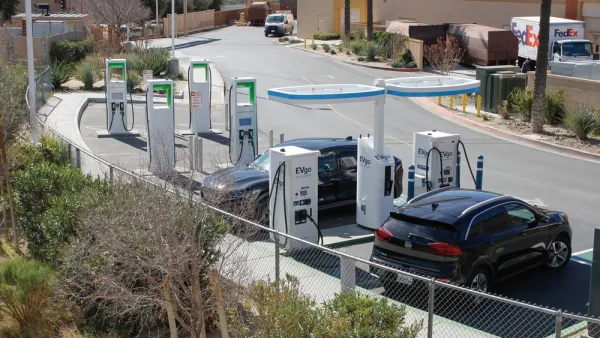
Electric Driving Is the Future; Now Is the Time to Price It
EVs are great, but they’re not perfect. Let’s end their free ride.

Planetizen Federal Action Tracker
A weekly monitor of how Trump’s orders and actions are impacting planners and planning in America.

California plans to bury El Niño’s downpour
If the state plays its cards right, it may be able to store a billion acre-feet of El Niño’s water in aquifers.

Desperate measures: Advocates weigh draining Lake Powell to fill Colorado River
Draining the reservoir could reduce evaporation losses by a couple hundred thousand acre-feet.

Los Angeles just elected an urban planner as its mayor
Transportation analysts are optimistic that Raman will be more aggressive in addressing transit issues than Bass.

Mamdani’s pied-à-terre tax survives legal challenge
A panel of judges found that the plaintiffs failed to demonstrate injury as a result of New York City's implementation of the tax.

Eastern Nebraska is running out of electricity
Data centers and electrification are straining eastern Nebraska’s grid, throttling economic development.

FREE Course: Walkable City 1: Why Walkability?
After describing his path towards focusing on walkability as the essence of good planning, Jeff Speck marches through his five principal reasons for making more walkable places.
Reinventing Malls: Planning Alchemy—Turning Gray Fields Into Gold
The course focuses on the opportunities and imperatives that shape reinvention of mall sites.

City of Rosemead
Rutgers University, Edward J. Bloustein School of Planning and Public Policy
One Hundred Miles
University of Michigan School for Environment and Sustainability (SEAS)
Hunter College, City University of New York (CUNY)
The Architects Foundation
City of Cambridge
Montrose County
The Pocatello Development Authority