Reviewing changes in bulk will make it easier for the Municipal Transportation Agency to remove parking around bus stops in San Francisco.


“San Francisco will kick off 2023 by removing hundreds of parking spaces across the city that obstruct riders from boarding [Municipal Transportation Agency (Muni)] buses — a process that is planned for completion within 18 months,” reports Ricardo Cano for the San Francisco Chronicle.
The changes are required by an ordinance approved by the San Francisco Board of Supervisors, intended to improve the safety and speed of bus boarding around the city. In October, Muni officials estimated that bringing bus stops into conformity with the new regulations would take seven years to complete.
“The reason for the initial, years-long timeline had to do with the bureaucratic process that requires the agency to hold a public hearing for each flag stop where parking will be removed,” explains Cano. The timeline has been shortened dramatically because “the transportation agency has committed to analyzing affected stops ‘in much bigger batches’ as opposed to one-by-one.”
In further evidence of the complicated politics of planning in San Francisco, the ordinance that is paving way for improved bus boarding was proposed by Supervisor Dean Preston, a familiar and favorite target of YIMBY advocates in the city and region.
Read the full story: S.F. will remove parking spaces obstructing Muni bus stops sooner than expected. Here’s when it will start

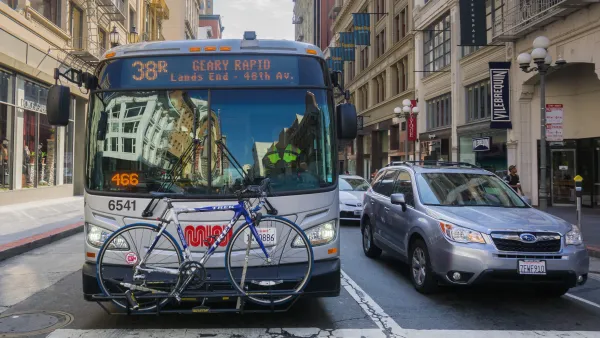
Strategies for Speeding Up Bus Service
A new report will highlight solutions for making bus service faster, more reliable, and thus more attractive to riders.

San Francisco Seeks Public Input on Post-Pandemic Muni Service
The SFMTA is considering a "high-access network" that would let people reach more destinations and increase frequency on some Muni lines.
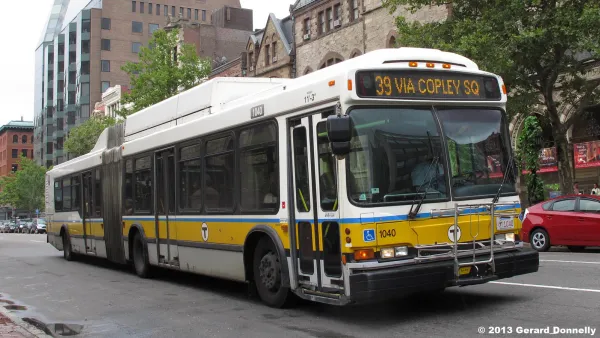
Around the Country, Cities Face Bus Driver Shortages
Cities like St. Louis, Denver, and Minneapolis have have fewer bus drivers than the transit system requires. The shortages are effecting the quality of service.

Planetizen Federal Action Tracker
A weekly monitor of how Trump’s orders and actions are impacting planners and planning in America.

The state-sanctioned urbicide of Austin
People don’t kill cities. Freeways do.

US to reduce Colorado River water deliveries to Mexico
A new Colorado Treaty amendment reduces Mexico’s Colorado River water allocation by 250,000 acre feet.

NYC cools commuters with city's first rain garden above a bus stop
New York City officials say the plants in the rain garden can absorb 16 gallons of rainwater during heavy storms.

Brightline West’s future may rely on $6 billion federal loan
The company has until Nov. 2 to make a $400 million equity investment into its proposed high-speed rail line.

LA Metro’s ultimatum: no extra buses for LA28 if federal funding isn’t imminently secured
If Metro does not provide additional buses, LA28 organizers will have to find a new way to manage Olympic traffic. LA28’s budget does not include a line item for transit.

FREE Course: Walkable City 1: Why Walkability?
After describing his path towards focusing on walkability as the essence of good planning, Jeff Speck marches through his five principal reasons for making more walkable places.
Reinventing Malls: Planning Alchemy—Turning Gray Fields Into Gold
The course focuses on the opportunities and imperatives that shape reinvention of mall sites.


Eagle County Government
Harvard University Graduate School of Design
Nashville Planning Department
The Architects Foundation
University of Cincinnati Online
The Pocatello Development Authority
The Urban Renewal Agency of the City of Pocatello
Journal of the American Planning Association