A new report will highlight solutions for making bus service faster, more reliable, and thus more attractive to riders.


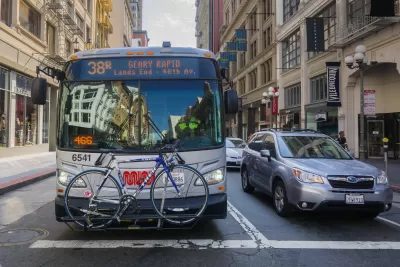
“SPUR, the San Francisco Bay Area Planning and Urban Research Association, is preparing a report on strategies to accelerate transit and transit projects, both literally on the ground and in policy and planning,” reports Melanie Curry for Streetsblog California.
“While the report focuses on Bay Area transit agencies, the strategies they are developing are universally applicable and adaptable to transit in any city,” Curry explains. Suggested strategies include “adding bus lanes, queue jump lanes, bus boarding bulbs, transit signal priority, and traffic control prioritizing buses.” These changes, some of which are challenging while others are low-hanging fruit, can have a powerful impact on the effectiveness of transit service and riders’ experience.
Improving and speeding up bus service can make transit more reliable and thus a better alternative to driving for more people. “It can also decrease costs for transit agencies, helping them run efficiently and offer superior service. Increased reliability can also make a bus network more viable and easier to coordinate, making buses even more useful for riders.”
Read the full story: How Can Buses Be Sped Up?

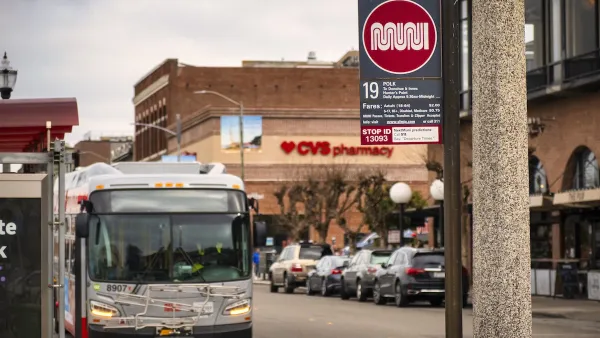
San Francisco Muni Sees Highest Ridership Since Start of Pandemic
The SFMTA is improving service at off-peak hours and on weekends to accommodate new travel patterns that rely less on weekday commuters. Ridership has increased accordingly.
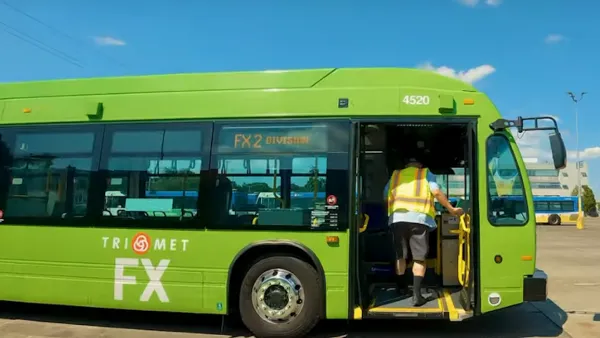
Portland ‘BRT Light’ Line Shows Promise
Despite not having fully dedicated bus lanes, Portland’s new ‘light’ bus rapid transit line is significantly reducing travel times.
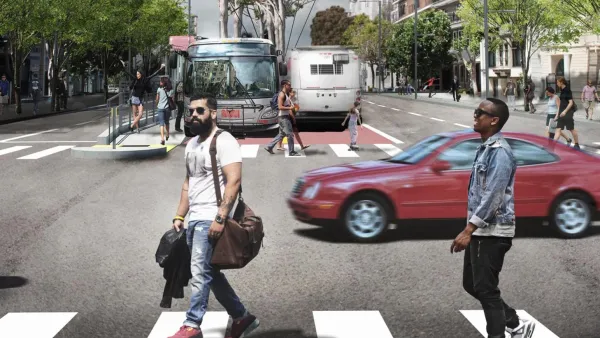
San Francisco's First BRT Line Closer to Opening
The Van Ness Avenue Bus Rapid Transit project will bring the first dedicated BRT corridor to San Francisco, nearly two decades after voters approved the project.

Planetizen Federal Action Tracker
A weekly monitor of how Trump’s orders and actions are impacting planners and planning in America.

The state-sanctioned urbicide of Austin
People don’t kill cities. Freeways do.

US to reduce Colorado River water deliveries to Mexico
A new Colorado Treaty amendment reduces Mexico’s Colorado River water allocation by 250,000 acre feet.

Brightline West’s future may rely on $6 billion federal loan
The company has until Nov. 2 to make a $400 million equity investment into its proposed high-speed rail line.

LA Metro’s ultimatum: no extra buses for LA28 if federal funding isn’t imminently secured
If Metro does not provide additional buses, LA28 organizers will have to find a new way to manage Olympic traffic. LA28’s budget does not include a line item for transit.

Colorado’s Largest Data Center Could Rise Next to Homes — Without a Public Hearing
The proposed campus would consume 11 times the power of Denver International Airport; as it has across the country, opposition mounts.

FREE Course: Walkable City 1: Why Walkability?
After describing his path towards focusing on walkability as the essence of good planning, Jeff Speck marches through his five principal reasons for making more walkable places.
Reinventing Malls: Planning Alchemy—Turning Gray Fields Into Gold
The course focuses on the opportunities and imperatives that shape reinvention of mall sites.

Eagle County Government
Harvard University Graduate School of Design
Nashville Planning Department
The Architects Foundation
University of Cincinnati Online
The Pocatello Development Authority
The Urban Renewal Agency of the City of Pocatello
Journal of the American Planning Association