Data from cities across the country show that bike helmet laws are enforced more aggressively in communities of color.


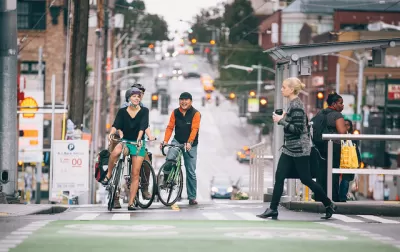
After body camera footage showing officers mocking and ultimately ticketing a bicyclist who was injured by a hit-and-run driver in Seattle surfaced, bike and pedestrian advocates in the city are calling for a reckoning with the unintended consequences of Seattle's bike helmet law. Since 2017, 43% of the city's helmet citations "have gone to people who are homeless," prompting questions about the law's uneven application, writes Adina Solomon in The Guardian.
Seattle isn't the only city where data shows bike helmet laws get unequally and unfairly applied:
"Black cyclists are disproportionately stopped in New Orleans, Washington DC and Oakland, California, and law enforcement policies have often overlooked inequity in their system. In Dallas, police have used helmet laws to stop and question cyclists in neighbourhoods of colour, according to a 2014 analysis by the Dallas Morning News. And a 2016 study by the Department of Justice found that Black people accounted for 73% of bicycle stops in Tampa, Florida, while only making up 26% of the population."
According to Charles T. Brown, CEO of urban planning firm Equitable Cities and adjunct professor of planning and public policy at Rutgers University, the laws are "being used as a pretext to stop individuals suspected of more serious drug and weapon charges." Tiffani McCoy, advocacy director for Real Change, agrees. "This is one law that we now know for certain is used as a way to criminalize poverty and in a racially motivated way," she says.
"But there are measures beyond helmet laws and policing that can help ensure the safety of all cyclists," writes Solomon. Since Seattle lowered vehicle speed limits to 25mph on many of its streets in December 2019, case studies show a 20% to 40% drop in collisions, and advocates believe that other measures such as "proper lighting for nighttime riding, protected bike lanes and recreational trail networks that connect to key destinations" can have a meaningful impact on reducing crashes and improving safety for people on bikes. "Before there is law, there should be investment and bicycle infrastructure in the communities that need the investments the most," said Brown.
FULL STORY: How US helmet laws are used against cyclists of colour and homeless people

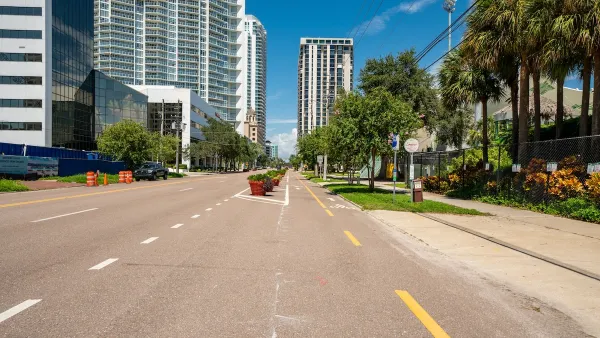
St. Petersburg’s Bike Infrastructure Efforts Pay Off
New bike infrastructure is encouraging more people to take to the streets on two wheels, but advocates say safety challenges remain.

San Francisco Reveals New Bike Plan
The draft plan targets improvements on 385 road segments.
Bike Resolutions for the New Year
A list of ways people can enhance their biking experience, appreciate the joy of cycling, and support safer bike infrastructure.

Planetizen Federal Action Tracker
A weekly monitor of how Trump’s orders and actions are impacting planners and planning in America.

The state-sanctioned urbicide of Austin
People don’t kill cities. Freeways do.

US to reduce Colorado River water deliveries to Mexico
A new Colorado Treaty amendment reduces Mexico’s Colorado River water allocation by 250,000 acre feet.

5 New England states march closer to 800 megawatt wind energy project
Securing federal approval for the project may be complicated under the Trump administration, which has historically been hostile towards domestic wind power.

Baltimore to break ground on $50 million Transit Priority Project
The project will bring faster bus trips, safer streets and better bike connections to Baltimore.

Airbnb launches $250 million 'last-dollar financing' housing accelerator, makes first investment in Austin
The company will put $6.4 million towards affordable housing development in Texas’ capital.

FREE Course: Walkable City 1: Why Walkability?
After describing his path towards focusing on walkability as the essence of good planning, Jeff Speck marches through his five principal reasons for making more walkable places.
Reinventing Malls: Planning Alchemy—Turning Gray Fields Into Gold
The course focuses on the opportunities and imperatives that shape reinvention of mall sites.

Eagle County Government
Harvard University Graduate School of Design
Nashville Planning Department
The Architects Foundation
University of Cincinnati Online
The Pocatello Development Authority
The Urban Renewal Agency of the City of Pocatello
Journal of the American Planning Association