A feature article revisits the gentrification and displacement discussion, especially as it pertains to racial and economic demographics, in one of the nation's most troubled and challenging housing markets.


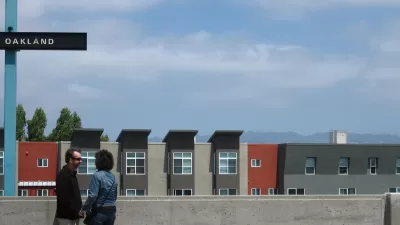
"According to the Bay Area Equity Atlas, a website that tracks the metrics of inequality around the region, 54 percent of low-income households of color are either in neighborhoods that are currently gentrifying or that
are at risk of gentrification," reports Kiley Russell.
"That number is even higher for some communities, with 66 percent of the Bay Area’s low-income African American households either experiencing gentrification or facing the risk of gentrification," according to Russell.
"Also, 55 percent of the region’s low-income Latino households are facing the same pressures, as are 48 percent of low-income Asian or Pacific Islander households and 50 percent of the Bay Area’s low-income Native American households," adds Russell.
The Bay Area Equity Atlas is the work of the San Francisco Foundation, PolicyLink, and the USC Program for Environmental and Regional Equity. PolicyLink Managing Director Sarah Treuhaft wrote to promote the release of the Atlas in June. "The Bay Area Equity Atlas is a comprehensive data resource to track the state of equity across the region and inform solutions for inclusive prosperity," writes Teurhaft. "Data that is disaggregated by race, nativity, geography, and more is critical to charting a more equitable future."
Russell's article provides more context for the debate surrounding gentrification in the United States and the Bay Area, fueled in part by a study released recently by the Federal Reserve Bank of Philadelphia that focused on what it described as benefits of gentrification.
Specific to the Bay Area's example, however, Russell also cites the work of the Urban Displacement Project and the California Housing Partnership in revealing the massive demographic shift of low-income and people of color leaving cities like San Francisco and Oakland for cities farther east in the region, like Pittsburg and other parts of Contra Costa County.
The article also includes a discussion about proposed policy solutions for the housing crisis, and its numerous consequences, such as the gentrification and displacement described in the article.
FULL STORY: Bay Area gentrification displacing communities of color

Op-Ed: Only Half of San Francisco is Changing
Using a mid 20th-century painting as his point of reference, Benjamin Schneider points out that the vast, disruptive changes we often associate with San Francisco are only affecting the city's eastern side.
Bay Area Displacement Spreads to Sacramento
A new study finds evidence that the ripple effect from the San Francisco Bay Area's housing affordability crisis has reached all the way to Sacramento.
Where Will Gentrification Happen Next?
This map tool hows gentrification-related statistics by Bay Area neighborhood, helping communities guess where the heaviest gentrification will occur.

Planetizen Federal Action Tracker
A weekly monitor of how Trump’s orders and actions are impacting planners and planning in America.

The state-sanctioned urbicide of Austin
People don’t kill cities. Freeways do.

US to reduce Colorado River water deliveries to Mexico
A new Colorado Treaty amendment reduces Mexico’s Colorado River water allocation by 250,000 acre feet.

5 New England states march closer to 800 megawatt wind energy project
Securing federal approval for the project may be complicated under the Trump administration, which has historically been hostile towards domestic wind power.

Baltimore to break ground on $50 million Transit Priority Project
The project will bring faster bus trips, safer streets and better bike connections to Baltimore.

Airbnb launches $250 million 'last-dollar financing' housing accelerator, makes first investment in Austin
The company will put $6.4 million towards affordable housing development in Texas’ capital.

FREE Course: Walkable City 1: Why Walkability?
After describing his path towards focusing on walkability as the essence of good planning, Jeff Speck marches through his five principal reasons for making more walkable places.
Reinventing Malls: Planning Alchemy—Turning Gray Fields Into Gold
The course focuses on the opportunities and imperatives that shape reinvention of mall sites.

Eagle County Government
Harvard University Graduate School of Design
Nashville Planning Department
The Architects Foundation
University of Cincinnati Online
The Pocatello Development Authority
The Urban Renewal Agency of the City of Pocatello
Journal of the American Planning Association