The founder of New Urbanism takes his autonomous vehicle skepticism, and ideas for other solutions to congestion, to the pages of the New York Times.



"Peter Calthorpe thinks Silicon Valley has it all wrong," writes John Markoff for the New York Times. "He rejects the ideas of tech industry visionaries who say personal autonomous vehicles will soon be the solution to urban problems like traffic congestion."
Calthorpe, famous in planning circles as one of the founders of New Urbanism, is adding his voice to a growing chorus of skepticism on the likelihood that self-driving cars are capable of delivering some of the benefits promised by boosters of the technology.
“One thing is certain: Zero- or single-occupant vehicles,” even ones that can drive themselves, “are a bad thing,” he and the transportation planner Jerry Walters wrote in an article last year in Urban Land, an urban planning journal. “They cause congestion, eat up energy, exacerbate sprawl and emit more carbon per passenger-mile.”
Instead of a self-driving car status quo that merely exacerbates the current auto-congested status quo, Calthorpe is promoting ideas, explained in more detail in the article, that evolve the concept of transit oriented development.
FULL STORY: Urban Planning Guru Says Driverless Cars Won’t Fix Congestion

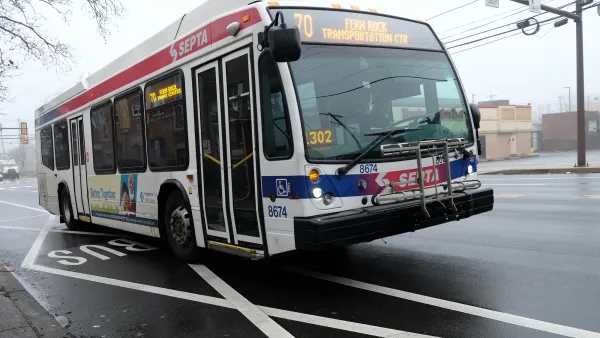
Pennsylvania lawmaker wants to ban fully self-driving buses
State Rep. Ben Waxman's proposed bill would require autonomous buses to have a licensed driver on board.

MIT study confirms robotaxis don't reduce traffic
Waymo data reveals that the cars spend close to half of their time 'deadheading' — driving around with no passengers.

Study: Self-driving Cars Could Raise VMT by 6%, Increasing Congestion
The study contradicts early predictions that AVs would reduce driving miles.

Planetizen Federal Action Tracker
A weekly monitor of how Trump’s orders and actions are impacting planners and planning in America.

The state-sanctioned urbicide of Austin
People don’t kill cities. Freeways do.

US to reduce Colorado River water deliveries to Mexico
A new Colorado Treaty amendment reduces Mexico’s Colorado River water allocation by 250,000 acre feet.

5 New England states march closer to 800 megawatt wind energy project
Securing federal approval for the project may be complicated under the Trump administration, which has historically been hostile towards domestic wind power.

Baltimore to break ground on $50 million Transit Priority Project
The project will bring faster bus trips, safer streets and better bike connections to Baltimore.

Airbnb launches $250 million 'last-dollar financing' housing accelerator, makes first investment in Austin
The company will put $6.4 million towards affordable housing development in Texas’ capital.

FREE Course: Walkable City 1: Why Walkability?
After describing his path towards focusing on walkability as the essence of good planning, Jeff Speck marches through his five principal reasons for making more walkable places.
Reinventing Malls: Planning Alchemy—Turning Gray Fields Into Gold
The course focuses on the opportunities and imperatives that shape reinvention of mall sites.

Eagle County Government
Harvard University Graduate School of Design
Nashville Planning Department
The Architects Foundation
University of Cincinnati Online
The Pocatello Development Authority
The Urban Renewal Agency of the City of Pocatello
Journal of the American Planning Association