President Trump is 'enraged' that automakers would agree with California in support of maintaining the Obama-era fuel efficiency standards, reports the Times. Mercedes-Benz is apparently preparing to join Ford, Honda, BMW, and VW in the private deal.


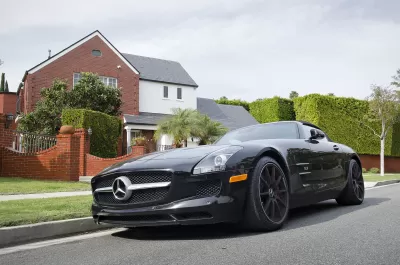
Last month, the White House was startled by a private deal between California and four automakers: Ford Motor Company, Honda, BMW of North America, and Volkswagen Group of America, to support an alternative to the administration's plan to freeze auto emissions/fuel efficiency standards at 2020 levels. Consequently, it "has mounted an effort to prevent any more companies from joining California," report Coral Davenport and
In an effort to ensure that other automakers don't join the aforementioned four, "Toyota, Fiat Chrysler and General Motors were all summoned by a senior Trump adviser to a White House meeting last month where he pressed them to stand by the president’s own initiative, according to four people familiar with the talks," add Davenport and Tabuchi.
However, those efforts don't appear to be succeeding. Mercedes-Benz appears ready to join the four, "according to two people familiar with the German company’s plans," they report, and "a sixth prominent automaker — one of the three summoned last month to the White House — intends to disregard the Trump proposal and stick to the current, stricter federal emissions standards for at least the next four years, according to executives at the company."
“Many companies have told us — more than one or two — that they would sign up to the agreement as soon as they felt free to do so,” said Mary Nichols, the top clean air official in California.
Why don't automakers support Trump's plan?
Under the framework agreement on clean emission standards worked out last month with the California Air Resources Board, the four companies, which represent about 30 percent of the U.S. auto market, have agreed to produce fleets averaging nearly 50 mpg by model year 2026, one year later than the target set under the Obama administration.
By comparison, the Safer Affordable Fuel-Efficient Vehicles Rule for Model Years 2021-2026, expected to be finalized this summer, only calls for fuel efficiency averaging 36 mpg. Trump tweeted that under his plan, vehicles would average $3,000 less in price.
But automakers "fear that the aggressive rollbacks will spark a legal battle between California and the federal government that could upend their business by splitting the United States into two car markets, one with stricter emissions standards than the other," write Davenport and Tabuchi.
Hat tip to InsideClimate News.
FULL STORY: Trump’s Rollback of Auto Pollution Rules Shows Signs of Disarray

GM, Toyota, and Fiat Chrysler Back Trump on Weaker Auto Emissions Rule
The auto industry is divided on whether to back stronger emissions standard adopted by California and 13 other states. Three major automakers and three auto industry groups sided with Trump on Monday in a court battle over 'one national standard.'
Who's Advocating Rolling Back Fuel Economy Standards?
Conventional thinking is that the auto industry, wanting to sell more fuel-gulping SUVs, are pushing for weaker fuel economy standards, but Hiroko Tabuchi, climate reporter for The New York Times, exposes Big Oil's stealth campaign.
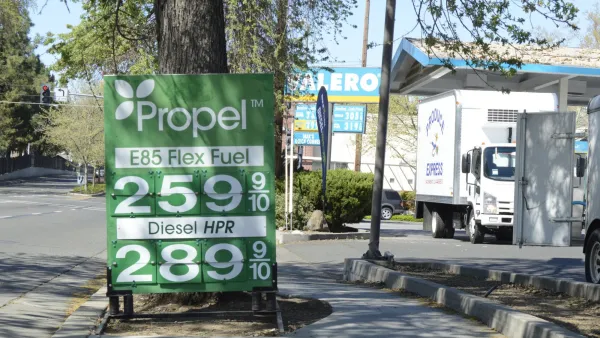
California and Auto Industry Agree on Vehicle Emissions Standards
Normally having the California Air Resources Board and the auto industry in agreement on emissions standards would be enough, but the Trump administration wants to ensure that California plays no role in setting standards.

Planetizen Federal Action Tracker
A weekly monitor of how Trump’s orders and actions are impacting planners and planning in America.

The state-sanctioned urbicide of Austin
People don’t kill cities. Freeways do.

US to reduce Colorado River water deliveries to Mexico
A new Colorado Treaty amendment reduces Mexico’s Colorado River water allocation by 250,000 acre feet.

5 New England states march closer to 800 megawatt wind energy project
Securing federal approval for the project may be complicated under the Trump administration, which has historically been hostile towards domestic wind power.

Baltimore to break ground on $50 million Transit Priority Project
The project will bring faster bus trips, safer streets and better bike connections to Baltimore.

Airbnb launches $250 million 'last-dollar financing' housing accelerator, makes first investment in Austin
The company will put $6.4 million towards affordable housing development in Texas’ capital.

FREE Course: Walkable City 1: Why Walkability?
After describing his path towards focusing on walkability as the essence of good planning, Jeff Speck marches through his five principal reasons for making more walkable places.
Reinventing Malls: Planning Alchemy—Turning Gray Fields Into Gold
The course focuses on the opportunities and imperatives that shape reinvention of mall sites.

Eagle County Government
Harvard University Graduate School of Design
Nashville Planning Department
The Architects Foundation
University of Cincinnati Online
The Pocatello Development Authority
The Urban Renewal Agency of the City of Pocatello
Journal of the American Planning Association