The California High Speed Rail Project is a political pawn in a contentious back and forth between the Golden State and the Trump administration.


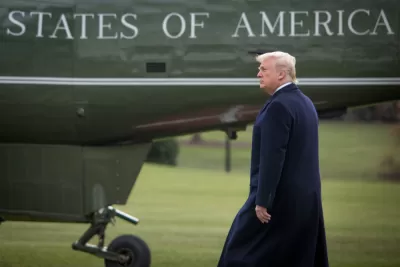
"The Trump administration made good Thursday on its threat to cancel nearly $1 billion in federal funds for California’s high-speed rail project, saying the state has “abandoned” its original plan for San Francisco-to-Los Angeles service in favor of a truncated line in the Central Valley," report Tal Kopan and John Wildermuth.
The Trump administration is making good on a threat to rescind the funding after California Governor Gavin Newsom spoke in his first state-of-state address about the need to reconsider the plan for the massive project. Gov. Newsom suggested focusing on the initial phase of the project between Bakersfield and Merced, the Federal Railroad Administration said that $928.6 million awarded to the project was dependent on the construction of the full, San Francisco to Los Angeles route.
"What’s more, it added, construction delays mean the state hasn’t complied with conditions for federal funding 'and has failed to make reasonable progress on the project,'" according to Kopan and Wildermuth.
California High Speed Rail Authority officials are quoted in the article saying the Trump administration decision will not kill the project. "The system has $9 billion from Proposition 1A, which voters approved in 2008; $2.55 billion in federal money that’s already been spent; and $500 million to $750 million a year in state cap-and-trade funds from air quality protection efforts," according to the article.
A separate article by Ralph Vartabedian and Stuart Leavenworth on the Trump administration's actions notes that in addition to rescinding the $929-million grant for project construction, the Federal Railroad Administration could still decide to force the state to reimburse "$2.5 billion in another grant that the state already has spent."
FULL STORY: Trump administration cancels California’s high-speed rail funding

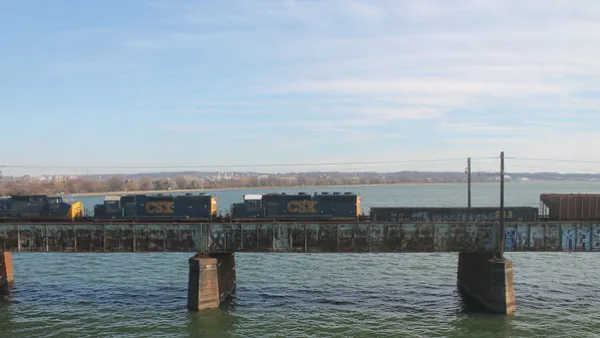
Virginia Passenger Rail Sets Ridership Records, Seeks More Wins
Virginia’s commitment to intercity rail is paying off in record ridership numbers, but more work will be necessary to achieve the state’s ambitions for passenger rail.
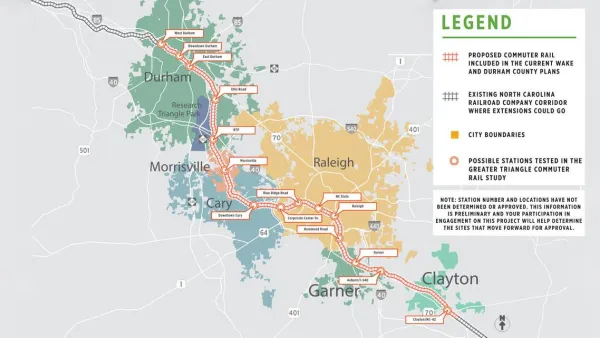
FTA Rejects North Carolina Commuter Rail Funding
As commuter patterns shift, so too do the transit funding preferences of the federal government.
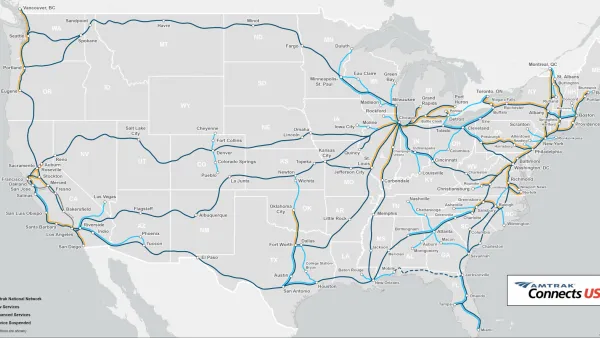
Political Support for Amtrak’s All Aboard Ohio Plans Follows Federal Infrastructure Funding
Gov. Mike DeWine’s sudden interest in working with Amtrak might have something to do with $66 billion in Infrastructure Investment and Jobs Act funding recently announced by the Federal Railroad Administration.

The state-sanctioned urbicide of Austin
People don’t kill cities. Freeways do.

US to reduce Colorado River water deliveries to Mexico
A new Colorado Treaty amendment reduces Mexico’s Colorado River water allocation by 250,000 acre feet.

New Jersey’s second-largest city bans standalone data centers
Jersey City will continue to allow co-location facilities, such as those meant for research institutions that store their own data.

Amtrak not solely to blame for New Jersey commuter rail's unreliability, report finds
A new study from the Garden State Initiative found that NJ Transit’s budget grew 20% across a 4 year period, but reliability declined significantly over the same period.

EPA erases limits on planet-warming pollution from power plants
Under Monday’s plan, power plants would still have some limits on how much mercury, arsenic and other contaminants they can emit.

Phoenix announces new on-demand transit service, more frequent RAPID buses
Both new services will launch in October, and are part of Phoenix's Project Effective Access Solutions for Easing Congestion.

FREE Course: Walkable City 1: Why Walkability?
After describing his path towards focusing on walkability as the essence of good planning, Jeff Speck marches through his five principal reasons for making more walkable places.
Reinventing Malls: Planning Alchemy—Turning Gray Fields Into Gold
The course focuses on the opportunities and imperatives that shape reinvention of mall sites.

Eagle County Government
Harvard University Graduate School of Design
Nashville Planning Department
The Architects Foundation
University of Cincinnati Online
The Pocatello Development Authority
The Urban Renewal Agency of the City of Pocatello
Journal of the American Planning Association