Eying European and Asian countries that have set, or are considering timelines to ban sales of cars that emit greenhouse gases, the California governor asked his chief air regulator to see why California couldn't follow suit.


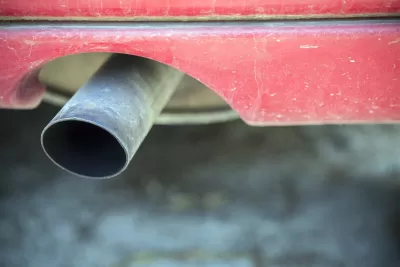
"California Gov. Jerry Brown has expressed interest in banning cars that burn fossil fuels, the state’s top climate change regulator said in an interview published Tuesday," reports David R. Baker, the San Francisco Chronicle's clean tech and energy reporter.
“The governor has certainly indicated an interest in why China can do this and not California,” Mary Nichols, chair of the California Air Resources Board [CARB], told Bloomberg News.
While China has yet to determine a timeline for banning gas and diesel-powered cars, others have already set dates, though not necessarily firm:
- Netherlands: 2025
- Norway: 2025
- India: 2030
- France: 2040
- Great Britain: 2040
A bill two years ago tackled oil consumption, requiring it to be reduced 50 percent by 2030, along with reducing natural gas consumption by power plants. The bill passed, but without the oil mandate, following a pattern reflected in CARB's June emissions inventory report which showed that while greenhouse gas emissions continue to decline overall, the exception is from transportation sources, which have been increasing.
Brown, arguably the foremost climate champion in the United States since President Obama left office, is driven not only be green envy but by legislation passed last year requiring greenhouse gas reduction of 40 percent below 1990 levels by 2030.
“Timing matters,” said Simon Mui, director of the California vehicles and fuels program at the Natural Resources Defense Council, an environmental group. “By 2050, the phaseout of combustion technologies is needed to meet our climate goals."
A bill that would have greatly increased funding for the state Clean Vehicle Rebate Project by "equalizing prices for electric and gas-powered compact cars" was unsuccessful, though a budget bill which will maintain the current funding for the program at $140 million was signed into law by Gov. Brown on Sept. 16.
FULL STORY: Could California ban gasoline cars?

California Doubles Carbon Intensity Reduction Requirement for Transportation Fuels
California regulators have found that transportation emissions are the most difficult to reduce, unlike those from electricity generation. The state just took a major step by approving significant changes to its Low Carbon Fuel Standard program.
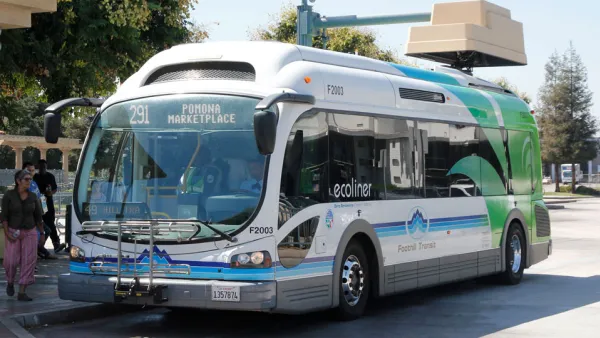
California to Invest $1 Billion in Electric Trucks, Buses, Charging Infrastructure
The investment comes not from the state legislature but from two regulatory bodies, the Air Resources Board and the Public Utilities Commission, authorizing the expenditure of VW settlement funds and utility ratepayer funds, respectively.

California Progress Report: GDP Increases While GHGs Fall
California is demonstrating that improving the economy and the environment go hand in hand. A new inventory report from the state's Air Resources Board notes changes in gross domestic product, population, and greenhouse gas emissions since 2000.

Planetizen Federal Action Tracker
A weekly monitor of how Trump’s orders and actions are impacting planners and planning in America.

The state-sanctioned urbicide of Austin
People don’t kill cities. Freeways do.

US to reduce Colorado River water deliveries to Mexico
A new Colorado Treaty amendment reduces Mexico’s Colorado River water allocation by 250,000 acre feet.

5 New England states march closer to 800 megawatt wind energy project
Securing federal approval for the project may be complicated under the Trump administration, which has historically been hostile towards domestic wind power.

Baltimore to break ground on $50 million Transit Priority Project
The project will bring faster bus trips, safer streets and better bike connections to Baltimore.

Airbnb launches $250 million 'last-dollar financing' housing accelerator, makes first investment in Austin
The company will put $6.4 million towards affordable housing development in Texas’ capital.

FREE Course: Walkable City 1: Why Walkability?
After describing his path towards focusing on walkability as the essence of good planning, Jeff Speck marches through his five principal reasons for making more walkable places.
Reinventing Malls: Planning Alchemy—Turning Gray Fields Into Gold
The course focuses on the opportunities and imperatives that shape reinvention of mall sites.

Eagle County Government
Harvard University Graduate School of Design
Nashville Planning Department
The Architects Foundation
University of Cincinnati Online
The Pocatello Development Authority
The Urban Renewal Agency of the City of Pocatello
Journal of the American Planning Association