The editorial board of the Los Angeles Times warns that along with new transit lines comes new housing for residents who want to enjoy the benefits of reduced auto-dependence. Plans need to ensure minimal housing displacement around the new stations.


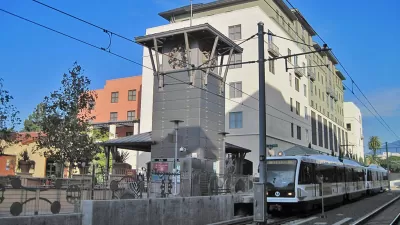
Kudos to the voters of Los Angeles County for passing what is likely the largest local transportation measure anywhere or at any time in U.S. history: $120 billion over four decades. Measure M passed with 69.82 percent of vote, a full three percentage points above the two-thirds requirement needed for approval of local tax increases that do not go to the county general fund.
Voters "authorize[d] a Los Angeles County Traffic Improvement Plan [PDF] through a ½ ¢ sales tax and continue[d] the existing ½ ¢ traffic relief tax until voters decide to end it," per Ballotpedia.
The work ahead lies not just in building new transit lines but in smart growth planning to avoid 'transit displacement' (see UCLA study below}.
"While many of the projects funded by Measure M are still years away from construction, much less completion, it would be wise to start planning now to ensure that these vital transportation projects don’t inadvertently displace the very residents and businesses they’re designed to serve," advises the editorial board. "That happens far too often."
While some neighborhoods may welcome the public investment and real estate boom that often follow the arrival of new metro lines, others have a legitimate fear that longtime residents will be pushed out as transit projects spur a sharp increase in housing prices and an influx of higher-income residents.
"A team of researchers at the UCLA Luskin School of Public Affairs created an interactive mapping tool to help community leaders better understand the effects of new light-rail and subway projects and related developments — especially on low-income communities," reported Stan Paul for UCLA on Aug. 29.
“There has been a strong interest in neighborhoods around subway stations and light-rail stops,” said Paul Ong, director of UCLA Luskin’s Center for Neighborhood Knowledge and a professor of Urban Planning. “These locations have the potential for extensive private investments because transit gives people an alternative to using cars. This is particularly attractive to today’s young professionals.”
Among the findings, Paul writes that "[a]reas around transit stations are changing and many of the changes are in the direction of neighborhood upscaling and gentrification."
One of the other measures that voters approved may mitigate that displacement. Measure JJJ, the "Affordable Housing and Labor Standards Initiative," will, among other things, require:
- All development projects that include 10 or more residential units and require changes to the General Plan or other zoning and construction rules would be required to make a percentage of the units affordable to low-income and working residents, or pay a fee to fund affordable housing and enforce laws that protect renters. [Ballotpedia]
However, the measure's passage could, ironically, exacerbate displacement. "Measure JJJ vividly illustrates why land-use planning by ballot initiative is so problematic," opines the LA Times editorial board on Sept. 27, which recommended a 'no' vote.
Measure JJJ would impose some of the nation’s most demanding affordable housing and wage mandates on privately-funded development. It was written without any analysis of whether the measure would actually relieve the city’s affordable housing crisis, as opposed to increasing the cost of new construction so much that developers build fewer units for low- and middle-income Angelenos.
Voters apparently did not see that controversy and overwhelmingly approved the measure with 63.63 percent of the vote. See also Planetizen corespondent Casey Brazeal's post on whether the passage of the measure may have the "unintended consequence of curbing building and constricting the supply of houses."
Homeless services supported on Election Day by even greater margin
A Nov. 9 editorial focuses on the passage of Measure M and Measure HHH, a homeless services bond measure which also need a two-thirds requirement. It passed with an incredible 76.02 percent of the vote. Like Measure JJJ, this was a City of Los Angeles ballot measure.
"The city homeless housing initiative would authorize $1.2 billion in borrowing to accelerate the pace at which mostly nonprofit developers build permanent supportive housing for chronically homeless people," according to the editorial. "The bonds would be repaid by a new property tax averaging just under $9.64 for each $100,000 in assessed valuation each year over 29 years."
City officials who placed the measure on the ballot say it would help fund 1,000 apartment units a year for 10 years. Los Angeles County would provide the support services for the city housing.
Related media articles:
- Investing in Place: Los Angeles County voters signal widespread support for improving quality of life for all, Nov. 10, 2016
- LA Times editorial: Los Angeles is poised to spend billions on two vexing problems: Traffic and homelessness, Nov. 9, 2016
- Preserve LA: Metro Transit-Oriented Projects Cause Displacement and Gentrification, UCLA Study Says, Aug 31, 2016
- UCLA Lusin School: Gentrification and Displacement in Southern California, August 29, 2016
Also in Planetizen:
- Affordable Housing Measure Passes in L.A. by Wide Margin. Now What?, Nov. 14, 2016
- FEATURE: Election Roundup: Planning's Big Day at the Ballot Box, November 9, 2016
- How Los Angeles Redefined Mobility as a Service, November 2, 2016
- This November, Four Major Transportation Measures at Stake, August 31, 2016
-
$120 Billion Transportation Bond May Be Headed to Los Angeles County Voters, March 16, 2016 [Correction: Title should have stated 'sales tax,' not bond.]
Hat tip to Preserve LA.
FULL STORY: Editorial: Will Measure M lead to gentrification and displacement across L.A. County?

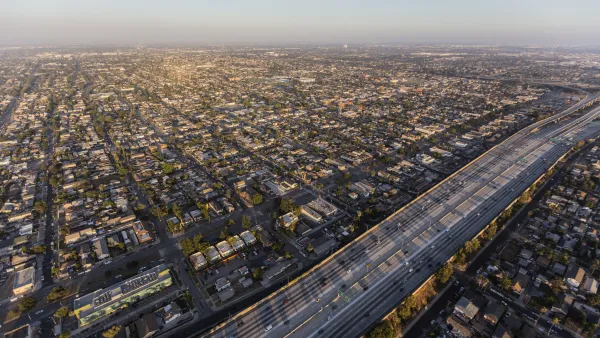
South L.A. Community Plans Tackle Gentrification
As public and private investment grow in South L.A., new community plans mark a victory for local organizers seeking to prevent displacement.
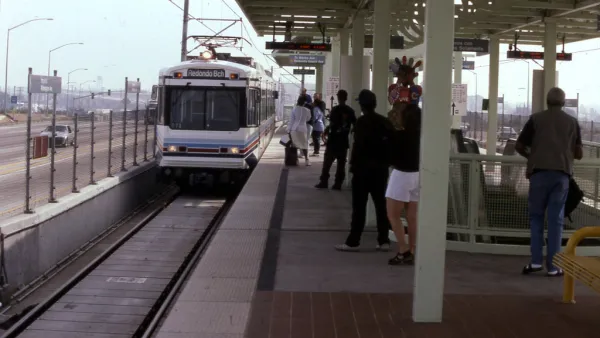
Review of November 2016 Transportation Ballot Measures
About 50 transportation measures appeared on local ballots on November 8, 2016. To date, Planetizen reviewed outcomes in nine regions in six states. Here we compare the measures in terms of revenue, taxes, projects, and reasons for failure.

High Housing Costs Driving Down Transit Ridership in LA
When neighborhoods gentrify and displace lower-income residents, transit ridership suffers, new research shows.

Planetizen Federal Action Tracker
A weekly monitor of how Trump’s orders and actions are impacting planners and planning in America.

The state-sanctioned urbicide of Austin
People don’t kill cities. Freeways do.

US to reduce Colorado River water deliveries to Mexico
A new Colorado Treaty amendment reduces Mexico’s Colorado River water allocation by 250,000 acre feet.

Mamdani overhauls NYC's Vision Zero plan with 100 new policy goals
The overhaul aims to reduce traffic deaths and make streets safer for pedestrians, cyclists and drivers through lower speed limits, new safety infrastructure and more.

Amtrak not solely to blame for New Jersey commuter rail's unreliability, report finds
A new study from the Garden State Initiative found that NJ Transit’s budget grew 20% across a 4 year period, but reliability declined significantly over the same period.

EPA erases limits on planet-warming pollution from power plants
Under Monday’s plan, power plants would still have some limits on how much mercury, arsenic and other contaminants they can emit.

FREE Course: Walkable City 1: Why Walkability?
After describing his path towards focusing on walkability as the essence of good planning, Jeff Speck marches through his five principal reasons for making more walkable places.
Reinventing Malls: Planning Alchemy—Turning Gray Fields Into Gold
The course focuses on the opportunities and imperatives that shape reinvention of mall sites.


Eagle County Government
Harvard University Graduate School of Design
Nashville Planning Department
The Architects Foundation
University of Cincinnati Online
The Pocatello Development Authority
The Urban Renewal Agency of the City of Pocatello
Journal of the American Planning Association