Don't tell that to the 18,000 residents of Shafter. However, the Legislative Analyst's Office made clear in its March 17 report that it questioned having the southern end of the first operating segment located "in an unpopulated agricultural area."



"The nonpartisan office that provides fiscal and policy analysis to the state legislature says it’s concerned about uncertain funding in the California High-Speed Rail Authority’s latest draft business plan and also the proposal to end the initial operating segment (IOS) miles from the nearest urban area in the San Joaquin Valley," writes
[Correspondent's note: A good description of Initial Operating Segments (IOS) can be found in the second paragraph of this Wikipedia description].
The new IOS, referred to as IOS North, resulting from a (literal) change of direction in the draft plan, may be "cheaper and quicker to build," but the southern end in Shafter, 18 miles northwest of Bakersfield in Kern County, creates problems for potential passengers. The Legislative Analyst's report states:
[T]he Legislature will want to consider whether the southern terminus of the proposed IOS makes sense. [U]nder the plan, the IOS North would have its southern terminus at an agricultural area north of the small city of Shafter, which is about 50 miles south of the last planned station on the IOS. In order to make the southernmost portion of the IOS usable, HSRA plans to build a temporary station or platform at this location.
....Even with a temporary station or platform, ending the IOS in an unpopulated agricultural area does not appear to be an effective approach. This is because this location would not have the types of facilities and nearby businesses, such as transit connections, rental car facilities, and shops necessary to meet the needs of train passengers.
As for the northern end, the high-speed rail train will provide another answer to the question, "Do you know the way to San Jose?" At Diridon Station, passengers can transfer to what will hopefully be an electrified Caltrain for the 47-mile trip to San Francisco. [Currently the diesel-powered trip takes 59 minutes for a 'baby-bullet' or about 90 minutes for a local.]
The other major concern the Legislative Analyst's Office (LAO) expressed was funding—nothing new there as opponents have been pointing this out since the 2008 bond measure authorizing the project was approved by voters. The authority itself recognizes that the train will need to operate before attracting private funds.
However, the Legislative Analyst indicated concerns with the main funding source until the nearly $10 billion in bonds can be tapped.
"[T]he review notes that the possible end of cap-and-trade funding in 2020 'means that without legislative action, the cap-and-trade funds [high-speed rail] plans to use to build the IOS would likely not be available' for the remainder of segment construction, which is expected to be completed in 2025," writes Meacham.
A review of past LAO reports [see two posts in 'related' below 'tags'] on the mega-project show this one could have been a lot worse for the authority.
Expect one more review of the draft business plan to come from a separate Peer Review Group before the draft business plan is sent to the legislature for approval.
For a brief audio account on the LAO's report, click on Capitol Public Radio's report. See Juliet Williams article in The Associated Press (via The Fresno Bee) for a thorough write-up on the report.
FULL STORY: High-speed rail's funding, southern station location concern Legislative Analyst's Office

Legislature Raises Questions on Draft 2016 California High-Speed Rail Business Plan
Uncertainty as to whether cap-and-trade funding would continue past 2020 and opposition to the initial operating segment leaving out the city of Merced were two issues that arose during a Assembly Transportation Committee hearing of the plan.
A Change of Direction for California High-Speed Rail
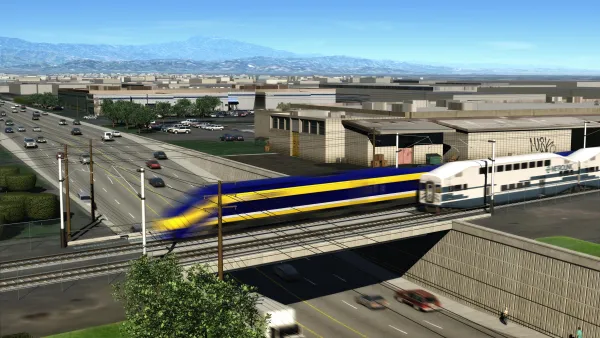
In the face of political opposition and mounting construction costs in Southern California, the state High-Speed Rail Authority has chosen to build north from the Central Valley to San Jose rather than south from Fresno to the San Fernando Valley.
California High-Speed Rail Project Seeking Change in Funding Plan
State lawmakers will have to approve a change in plans for how the California High-Speed Rail project will fund the ongoing work in the Central Valley.

The state-sanctioned urbicide of Austin
People don’t kill cities. Freeways do.

US to reduce Colorado River water deliveries to Mexico
A new Colorado Treaty amendment reduces Mexico’s Colorado River water allocation by 250,000 acre feet.

New Jersey’s second-largest city bans standalone data centers
Jersey City will continue to allow co-location facilities, such as those meant for research institutions that store their own data.

Amtrak not solely to blame for New Jersey commuter rail's unreliability, report finds
A new study from the Garden State Initiative found that NJ Transit’s budget grew 20% across a 4 year period, but reliability declined significantly over the same period.

EPA erases limits on planet-warming pollution from power plants
Under Monday’s plan, power plants would still have some limits on how much mercury, arsenic and other contaminants they can emit.

Phoenix announces new on-demand transit service, more frequent RAPID buses
Both new services will launch in October, and are part of Phoenix's Project Effective Access Solutions for Easing Congestion.

FREE Course: Walkable City 1: Why Walkability?
After describing his path towards focusing on walkability as the essence of good planning, Jeff Speck marches through his five principal reasons for making more walkable places.
Reinventing Malls: Planning Alchemy—Turning Gray Fields Into Gold
The course focuses on the opportunities and imperatives that shape reinvention of mall sites.


Eagle County Government
Harvard University Graduate School of Design
Nashville Planning Department
The Architects Foundation
University of Cincinnati Online
The Pocatello Development Authority
The Urban Renewal Agency of the City of Pocatello
Journal of the American Planning Association