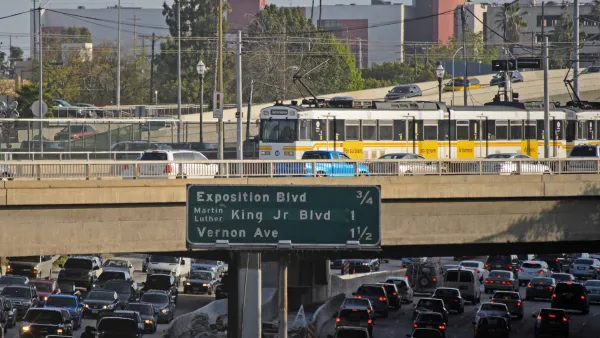
The transit and road measure, based on extending and increasing half-cent sales taxes, would fund a massive amount of light rail, bus, and road measures, including building a Sepulveda Pass tunnel which would accommodate a toll road and rail line.


"[Los Angeles] Metro's board of directors will vote in June whether to place the measure on the November ballot," reports Laura J. Nelson, who writes about transportation and mobility at the Los Angeles Times.
The ballot measure would extend an existing half-cent sales tax for two more decades, and raise the county's sales tax rate by an additional half-cent for four decades or longer. The measure, which needs a two-thirds majority to pass, would boost Los Angeles County's base sales tax rate to 9.5%.
The two-thirds requirement stems from the 1978 landmark taxpayers initiative known as Prop 13. "Reducing the voter-approval threshold from two-thirds to 55% would not only ensure that locals could more easily raise funds for badly needed infrastructure, it could make those measures more effective by not having to please everyone and their mother," writes Ethan Elkind in a related piece.

"As envisioned, the plan would funnel about one-third of the $120 billion into full or partial funding for five new transit lines and at least six extensions of lines that are already built or under construction, Metro officials said," writes Nelson. Among the eight additional projects she lists are:
- West Santa Ana Transit Corridor
- A further extension eastward of the foothill portion of the Gold Line
- One or more extensions of the Eastside Gold Line
- The final leg of the Wilshire Boulevard subway (Metro Purple Line Subway Extension)
Metro officials "spoke to The Times on condition of anonymity because they were not authorized to discuss the matter publicly," notes Nelson.
Hat tip to Paul Scott, whose letter to the editor appears here.
Read the full story: Metro to unveil mass transit blueprint that includes tunnel through the Sepulveda Pass
Proposed $120 Billion Sales Tax Measure Polling Well in L.A. County
A single sales tax measure that would add a new half cent sales tax to fund transportation projects in Los Angeles County for 40 years, and extend an existing half-cent sales tax that terminates in 2039, is supported by at least 68 percent of voters.
How High is Too High for Transportation Sales Taxes?
Sales taxes are regressive, but unlike the gas tax, they bear no relationship to transportation. Should a November transportation ballot measure pass, sales taxes in three cities in the county of Los Angeles would exceed 10 percent.
Auto Companies Prepare for Decline of Car Ownership
It's no longer just transit agencies that are trying to meet the first mile-last mile challenge—auto companies have also jumped in by offering "mobility services." And it's more profitable than selling cars!

Planetizen Federal Action Tracker
A weekly monitor of how Trump’s orders and actions are impacting planners and planning in America.

California plans to bury El Niño’s downpour
If the state plays its cards right, it may be able to store a billion acre-feet of El Niño’s water in aquifers.

Desperate measures: Advocates weigh draining Lake Powell to fill Colorado River
Draining the reservoir could reduce evaporation losses by a couple hundred thousand acre-feet.

Chicago voters approve permanent festival grounds, penalty for vacant property owners
Currently, major summer and fall festivals take over public parks for weeks at a time, drawing criticism from nearby residents

NYC votes to cut outdoor dining red tape, speed up permitting
New York City also voted to allow the Department of Transportation to begin work on urgent projects before notifying elected officials.

California appears to reject Prop. 45
The proposition would have expanded the projects that qualify for a streamlined environmental review, effectively paring down the California Environmental Quality Act.

FREE Course: Walkable City 1: Why Walkability?
After describing his path towards focusing on walkability as the essence of good planning, Jeff Speck marches through his five principal reasons for making more walkable places.
Reinventing Malls: Planning Alchemy—Turning Gray Fields Into Gold
The course focuses on the opportunities and imperatives that shape reinvention of mall sites.

City of Rosemead
Rutgers University, Edward J. Bloustein School of Planning and Public Policy
One Hundred Miles
Hunter College, City University of New York (CUNY)
The Architects Foundation
University of Cincinnati Online
City of Cambridge
Montrose County
The Pocatello Development Authority