Last month N.Y. Gov. Andrew Cuomo proposed that Empire Station replace Penn Station, but many challenging parts, e.g., the Hudson River Tunnels, moving Madison Square Garden, could derail it. A related piece delves into the prior ARC tunnel project.


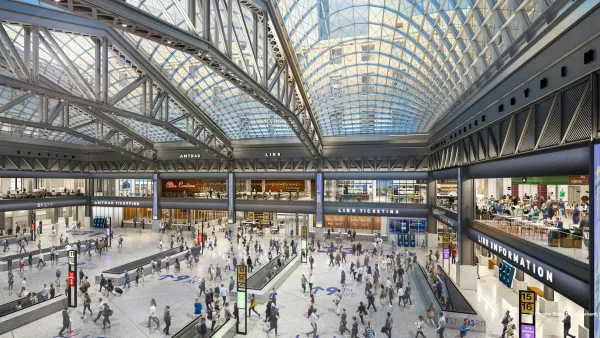
Proposal #6 in N.Y. Gov. Cuomo's ambitious "multibillion-dollar wish list," what some have dubbed his Robert Moses moment, is "Empire Station." Among the most formidable challenges necessary for the $3 billion modernization of the 1968 rail station, and certainly what may take the longest, is building the the new tunnel under the Hudson River for Amtrak and New Jersey Transit trains.
“It all starts with the tunnels,” Tom Wright, president of the Regional Plan Association, told FoxBusiness.com. More on the Amtrak Gateway project below.
Among the other challenges described by Marissa Piazzola, editor/reporter for Fox Business News, are:
- (E)stablish a rail connection from Penn Station to LaGuardia Airport as well as add a connection to Metro-North, which currently operates out of Grand Central Station [sic].
- (R)edevelopment of the James A. Farley Post Office, which sits across 8th Avenue from Penn, into Moynihan Station. It will increase Penn Station’s size by 50 percent and be connected to Penn by an underground pedestrian concourse.
- Perhaps the most divisive issue surrounding the redevelopment of Penn Station is Madison Square Garden located atop Penn Station between 7th and 8th avenues from 31st to 33rd streets.
See New York Times architectural critic, Michael Kimmelman's most recent piece on this topic, "How to Transform Penn Station: Move the Garden." He's been hammering the same message since at least 2012 if not earlier.
Most surprising in Piazzola's piece was learning that "(t)he Penn Station that we know today was praised as a first class train station upon completion in 1968, five years after the original was demolished."
Of course, ridership on the three rail lines utilizing the station, Long Island Rail Road, New Jersey Transit, and Amtrak, as well as the Seventh and Eighth Ave. subway lines has grown to the point that a "station designed to accommodate 200,000 daily commuters serves more than 650,000 each day," according to Piazzola.
How Will it be Paid for?
"The project will cost $3 billion and be funded by a public-private partnership," writes Piazzola. "Government sources will pay for $325 million of the Empire Station Complex, while the rest will be covered by private investment."
The state issued a 65-page Request for Proposals ([PDF], which outlines its plans for the site in great detail. Developers must submit proposals for either Penn, Farley, or both by April 22.
Access to the Region's Core becomes Amtrak Gateway
The most pressing issue for New Jersey commuters as well as Amtrak passengers using Penn Station going to/from New Jersey is the aforementioned tunnel construction. "Construction of a third train tunnel under the Hudson River was slated for completion by 2018," writes Dunstan Prial in a highly recommended piece that recaps the history of what was an essential project in 2010, and now is an urgent one.
But New Jersey Gov. Chris Christie killed the $12.4 billion ARC project in the fall of 2010 under the premise that New Jersey taxpayers were shouldering too much of the financial burden.
Now the massive infrastructure project is back on the drawing board but the projected cost has risen to more than $20 billion and the new tunnels won’t be completed for another decade and a half, perhaps longer.
“We will have lost 13 years or so as a result of [Gov. Christie's] decision that led to the cancellation of the ARC project,” said Martin E. Robins, a leading architect of New Jersey’s rail transit system over the past 25 years and the chief designer of the ARC tunnel.
Prial goes into the sordid details of how Christie "divert(ed) billions of dollars in ARC money to help bail out the state’s troubled finances without having to raise the state’s 14.50-cent gasoline tax," second lowest [PDF] in the nation after Alaska.
Former U.S. Senator Frank Lautenberg (D-N.J.) called it “one of the biggest policy blunders in New Jersey history.”
Hat tip to Peter Flieg.
Read the full story: Host of Factors Threaten to Derail Plans for a New Penn Station

Three Days of Delays on Northeast Corridor for Amtrak and NJ Transit
Once again, chronic delays on New Jersey Transit's rail lines in and out of Manhattan serve as a reminder of Gov. Christie's ill fated decision to cancel replacement of the two aging Hudson River tunnels to Penn Station.
Northeast Rail Corridor Woes Extend Far Beyond Hudson River Tunnels
While Amtrak's century-old Hudson River rail tunnels may capture the public's attention, particularly when they are closed, infrastructure problems on the Northeast Corridor also plague the line from Rhode Island to Washington, D.C.
In New York's Next Penn Station, Function Does Not Always Follow Form
Some of the time and money invested in the visually spectacular Moynihan Station should have been spent looking at how well it actually works for commuters, writes Alon Levy.

Planetizen Federal Action Tracker
A weekly monitor of how Trump’s orders and actions are impacting planners and planning in America.

Amtrak, CN end decades-long dispute with eight-year agreement
The new operating agreement establishes an updated framework for the companies to work together, including processes to resolve disputes.

Northwest rail fans eager for Sept. 30 debut of Amtrak’s Airo fleet
Get ready for that new train smell and more seats. But they won’t go faster or run more frequently on the Cascades route in Washington and Oregon.

St. Louis Metro to test if single-car trains can reduce operating costs, maintain rider satisfaction
The pilot program will run from October to spring 2027, and begin with one single-car train operating on Metrolink’s Red and Blue lines.

Pennsylvania is building data centers in abandoned mines
Housing data centers in mines provides an alternative to destroying local forests and may spare residents from data centers’ noise and air pollution.

If Corpus Christi can’t revive desalination plant project, it may owe Texas $235 million
Earlier this month, city officials declined to pursue developing the plant for the second time in a year.

FREE Course: Walkable City 1: Why Walkability?
After describing his path towards focusing on walkability as the essence of good planning, Jeff Speck marches through his five principal reasons for making more walkable places.
Reinventing Malls: Planning Alchemy—Turning Gray Fields Into Gold
The course focuses on the opportunities and imperatives that shape reinvention of mall sites.

City of Thousand Oaks
City of Wisconsin Rapids
Harvard University Graduate School of Design
The Architects Foundation
University of Cincinnati Online
The Pocatello Development Authority
The Urban Renewal Agency of the City of Pocatello