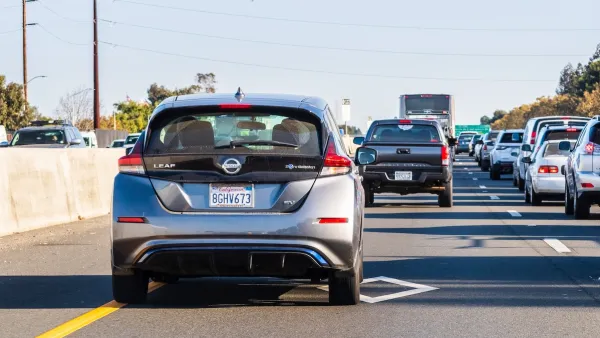
The new I-405 Express Toll Lanes between Bellevue and Lynnwood might be undercharging solo commuters at $10. Carpoolers, who drive for free, are increasingly hard to spot in the lanes, according to anecdotal reports.


A maximum toll was applied December 10 on Washington State's first Express Toll Lanes that opened September 27 outside of Seattle between King and Snohomish counties.
"The $10 designer toll lanes on Interstate 405 are fast becoming a symbol for Seattle rich," writes Seattle Times columnist Danny Westneat about the I-405 Express Toll Lanes Between Bellevue and Lynnwood. "But they also may be a sign of something that hasn’t gotten as much attention: the death of carpooling."
Ironically, before the Express Toll Lanes were created by converting the existing high-occupancy vehicle (HOV) lane to an express toll lane, and adding another such lane, the HOV line "was so well-used it started to become as congested as the regular lanes," writes Westneat.
According to data released by the state Department of Transportation, about 75 percent of weekday drivers in the express lanes in November didn’t have carpool status that allowed them to travel free.
What's more, what's happening in Washington may not be unusual.
In other cities that converted their HOV systems to high-occupancy toll (HOT) lanes, the carpoolers sometimes mysteriously vanished. In Atlanta there was an average loss of 2,500 carpools per day — about 20 percent of the total. Carpoolers stopped using the new HOT lane almost entirely — even though it was free to them. Many shifted to the general lanes. Nobody knows why.
Correspondent's note: While HOT lanes are a generic term for lanes that permit solo drivers to access carpool lanes for a toll, Washington has designated HOT lanes and express toll lanes, as explained here previously.
“Overall, we see a pattern of substantial decreases in carpools on many of the HOT lanes,” concluded researchers [PDF] at Texas A&M who looked at projects in eight cities, including the one in Atlanta.
Westneat goes on to describe findings of the Texas A&M study, the loss of carpooling in Los Angeles on the 110 High Occupancy Toll Lanes, and recognizes that carpooling has been in decline since 1980.
I was surprised to learn that one problem that The Evergreen State does not have in terms of oversubscription to its Express Toll Lanes are electric vehicles (EVs) that are permitted free access. And yet, "Washington leads the nation in recent per-capita sales of all electric passenger cars."
FULL STORY: Why travel free with others when a solo commute is only 10 bucks?

HOV-to-HOT Conversion Seen as Key to Easing Congestion
Robert Poole reports on efforts across the country to reduce freeway congestion through HOV-to-HOT conversion and public-private partnerships.
Washington State's First Express Toll Lanes Open
Washington has Express Lanes on I-5 and I-90 and HOT Lanes on SR 167, but the 17 miles of lanes that opened Sunday on I-405 from Bellevue to Lynnwood will be the state's first Express Toll Lanes.
When Carpool Lanes Cause Mayhem
A newly widened Bay Area freeway serves as a reminder of the futility of HOV lanes. There are better ways to manage and mitigate traffic.

The state-sanctioned urbicide of Austin
People don’t kill cities. Freeways do.

US to reduce Colorado River water deliveries to Mexico
A new Colorado Treaty amendment reduces Mexico’s Colorado River water allocation by 250,000 acre feet.

New Jersey’s second-largest city bans standalone data centers
Jersey City will continue to allow co-location facilities, such as those meant for research institutions that store their own data.

Amtrak not solely to blame for New Jersey commuter rail's unreliability, report finds
A new study from the Garden State Initiative found that NJ Transit’s budget grew 20% across a 4 year period, but reliability declined significantly over the same period.

EPA erases limits on planet-warming pollution from power plants
Under Monday’s plan, power plants would still have some limits on how much mercury, arsenic and other contaminants they can emit.

Phoenix announces new on-demand transit service, more frequent RAPID buses
Both new services will launch in October, and are part of Phoenix's Project Effective Access Solutions for Easing Congestion.

FREE Course: Walkable City 1: Why Walkability?
After describing his path towards focusing on walkability as the essence of good planning, Jeff Speck marches through his five principal reasons for making more walkable places.
Reinventing Malls: Planning Alchemy—Turning Gray Fields Into Gold
The course focuses on the opportunities and imperatives that shape reinvention of mall sites.

Eagle County Government
Harvard University Graduate School of Design
Nashville Planning Department
The Architects Foundation
University of Cincinnati Online
The Pocatello Development Authority
The Urban Renewal Agency of the City of Pocatello
Journal of the American Planning Association