New express lanes on I-66 inside the Capital Beltway on I-66 will be significant for two reasons. First, no lanes will be added. HOV lanes will be converted to HOT lanes. Second, revenue will go to options to get drivers out of cars, such as transit


"For the first time, the Virginia Department of Transportation plans to set up [high occupancy toll] HOT lanes without first adding lane capacity," writes Robert Thomson for the Dr. Gridlock column.
The state government’s plan is to convert today’s rush-hour High Occupancy Vehicle (HOV or carpool) lanes to high-occupancy toll lanes in the middle of 2017. The construction work — basically a matter of setting up tolling gantries and their support system — is simple compared to the politics behind it.
Thomson explored those politics in two earlier pieces posted here: one on the I-66 HOT lane project last June and a January piece that dealt with the principles behind HOT lanes. More recently, a Vox piece posted in November delved into false claims made by opponents of these lanes.
Note: While The Washington Post refers to toll/carpool lanes using the generic high-occupancy toll, or HOT, abbreviation, the Virginia Department of Transportation (VDOT) uses "express lanes," e.g., 95 and 495 Express Lanes, as do most other public transportation agencies and state departments of transportation (DOTs).
"The Commonwealth Transportation Board, Virginia’s policy-making panel on transportation projects, voted (December 9) to approve the creation of HOT lanes on Interstate 66 inside the Capital Beltway," writes Thompson.
The board also accepted a deal with the Northern Virginia Transportation Commission that gives the commission control over distributing toll revenue for programs, such as carpooling and commuter buses, that are designed to help commuters leave their cars behind and avoid the tolls before getting on I-66.
“Before spending a minimum of $100 million to widen the road, it is fiscally responsible for the commonwealth to exhaust all common-sense options that will get traffic to move more efficiently through increased bus use, transit options and better managing the space we have by encouraging carpooling," states Transportation Secretary Aubrey L. Layne, Jr. in a VDOT press release.
Improvements can start quickly in a cost efficient manner. This project finances itself, with every cent raised from toll revenues going back into the corridor.
"For solo divers who choose to pay the toll during the four peak hours eastbound in the morning and westbound in the afternoon, the Virginia Department of Transportation estimates the average toll at $6 each way," adds Thompson.
If you questioned the ability of states to toll existing interstates, "there is general permission for state DOTs to convert HOV lanes on Interstates to HOT lanes, and to add new tolled lanes to Interstates," wrote Bob Poole, Director of Transportation Policy for Reason Foundation in an email.
In addition to tolling individual lanes on interstates, there are three states, North Carolina, Virginia, and Missouri that are authorized to toll all lanes of specified interstates per the 1998 Interstate System Reconstruction And Rehabilitation Pilot Program, a provision of TEA-21. However, they are in danger of losing that ability per the FAST Act, according to a recent New York Times article:
Under the new transportation bill, these states will have one year to move ahead with plans to add tolls or lose their slots to other states ready to add tolls to their highways. The new states then would have three years to complete projects or be removed from the pilot.
Hat tip to AASHTO Journal.
FULL STORY: Dr. Gridlock: Virginia panel okays I-66 HOT lanes inside Beltway

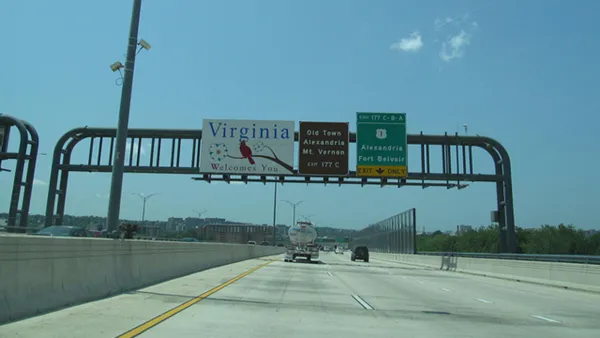
Popularity of Express Lanes Spreads Beyond Virginia
Dan Vock of Governing takes a broad look at congestion pricing, beginning with the success of Virginia's 66 Express Lanes, the ones where tolls initially topped $40. Notwithstanding complaints, managed lanes are spreading, but challenges remain.
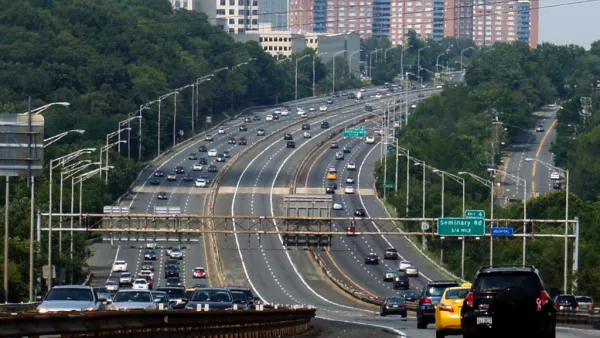
Solo-Occupant Hybrid Vehicles Lose Access to Carpool Lanes
A change in federal law on Monday meant that over 16,000 Virginia motorists must double or triple-up when using carpool lanes in Virginia. Next month, electric vehicles will need three occupants to drive free on I-395 when HOV lanes become HOT.
Construction of I–66 Toll Lanes Outside the Capital Beltway Begins this Weekend
Widening of Interstate 66 for 22.5 miles in Northern Virginia will accommodate two toll lanes in each direction, accessible to trucks. The $3.7 billion project, to be built by public-private partnership at no cost to the state, will open in 2022.

The state-sanctioned urbicide of Austin
People don’t kill cities. Freeways do.

US to reduce Colorado River water deliveries to Mexico
A new Colorado Treaty amendment reduces Mexico’s Colorado River water allocation by 250,000 acre feet.

New Jersey’s second-largest city bans standalone data centers
Jersey City will continue to allow co-location facilities, such as those meant for research institutions that store their own data.

Amtrak not solely to blame for New Jersey commuter rail's unreliability, report finds
A new study from the Garden State Initiative found that NJ Transit’s budget grew 20% across a 4 year period, but reliability declined significantly over the same period.

EPA erases limits on planet-warming pollution from power plants
Under Monday’s plan, power plants would still have some limits on how much mercury, arsenic and other contaminants they can emit.

Phoenix announces new on-demand transit service, more frequent RAPID buses
Both new services will launch in October, and are part of Phoenix's Project Effective Access Solutions for Easing Congestion.

FREE Course: Walkable City 1: Why Walkability?
After describing his path towards focusing on walkability as the essence of good planning, Jeff Speck marches through his five principal reasons for making more walkable places.
Reinventing Malls: Planning Alchemy—Turning Gray Fields Into Gold
The course focuses on the opportunities and imperatives that shape reinvention of mall sites.

Eagle County Government
Harvard University Graduate School of Design
Nashville Planning Department
The Architects Foundation
University of Cincinnati Online
The Pocatello Development Authority
The Urban Renewal Agency of the City of Pocatello
Journal of the American Planning Association