The first protected intersection opened in August in Davis, Calif., a university town with the nation's highest percentage of bike commuters. Salt Lake City's new protected intersection is explained on NPR's "Here & Now" report with audio and videos.


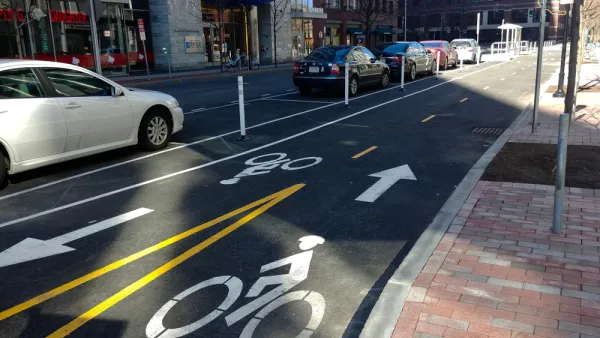
Here & Now’s Robin Young gives an excellent introduction to protected bike lanes and the protected bike intersection, mentioning the rise in bike fatalities and recent controversies:
- "In 2013, there 743 bicycle fatalities across the country," and the controversy in some bike lanes, including
- the recent removal of a small stretch of protected bike lanes in Boulder, Colo.
"'Protected intersections,' designed to prevent car-bicycle collisions, have long existed in the Netherlands, but they are just catching on in the U.S.," states Young. She credits "a young, former video designer named Nick Falbo (who) made a video that urban planners understood" for the recent interest.
That video is available here in an earlier post on the protected intersection. Four key elements of Falbo's design are posted here.

YouTube fly-through of protected intersection, 200 West at 300 South - Link
Credit: SLC Moves: Transportation - 200 West Improvement Project
If you had problems following the Falbo video, particularly with left turns, click on the above link for an aerial simulation. Some cyclists may prefer to "take" or share a left-turn lane in one "unprotected turn" versus two protected crossings of traffic. [See my comment under the Davis "Dutch Junction" post as it is referred to locally.]
The Salt Lake City intersection is the third and final phase of the 200 West Improvement Project that was scheduled to open in October. It appears to have opened early!
Young discusses the protected bicycle intersection—which protects pedestrians as well, with
- Robin Hutcheson, transportation director for Salt Lake City.
- Jennifer Dill, director of the National Institute for Transportation & Communities at Portland State University.
Dill notes proudly that Falbo was a one of her students.
Hat tip to The AASHTO Daily Transportation Update (Oct. 1).
FULL STORY: ‘Protected Intersection’ For Bikes Opens In Salt Lake City

Nation's Top Safety Board Recommends Protected Bike Lanes
The NTSB chair issued a stark warning on Nov. 5: "If we do not improve roadway infrastructure for bicyclists, bicyclists will die who otherwise would not," stated Robert Sumwalt in introducing their first report in 47 years devoted to bike safety.
First U.S. City to Build Protected Intersection for Bikes: Salt Lake City
An intersection configuration mastered by the Dutch is about to get its first showcase in the capital of Utah as part of a larger bike lane project through the center of the city.
Op-ed: True bike safety requires more than the 'Dutch reach'
Making roads safe for all users takes policy and cultural changes that go beyond small behavioral interventions.

The state-sanctioned urbicide of Austin
People don’t kill cities. Freeways do.

US to reduce Colorado River water deliveries to Mexico
A new Colorado Treaty amendment reduces Mexico’s Colorado River water allocation by 250,000 acre feet.

New Jersey’s second-largest city bans standalone data centers
Jersey City will continue to allow co-location facilities, such as those meant for research institutions that store their own data.

Amtrak not solely to blame for New Jersey commuter rail's unreliability, report finds
A new study from the Garden State Initiative found that NJ Transit’s budget grew 20% across a 4 year period, but reliability declined significantly over the same period.

EPA erases limits on planet-warming pollution from power plants
Under Monday’s plan, power plants would still have some limits on how much mercury, arsenic and other contaminants they can emit.

Phoenix announces new on-demand transit service, more frequent RAPID buses
Both new services will launch in October, and are part of Phoenix's Project Effective Access Solutions for Easing Congestion.

FREE Course: Walkable City 1: Why Walkability?
After describing his path towards focusing on walkability as the essence of good planning, Jeff Speck marches through his five principal reasons for making more walkable places.
Reinventing Malls: Planning Alchemy—Turning Gray Fields Into Gold
The course focuses on the opportunities and imperatives that shape reinvention of mall sites.

Eagle County Government
Harvard University Graduate School of Design
Nashville Planning Department
The Architects Foundation
University of Cincinnati Online
The Pocatello Development Authority
The Urban Renewal Agency of the City of Pocatello
Journal of the American Planning Association