Cities in Latin America and Europe have embraced aerial transitways — AKA gondolas — as sustainable, convenient urban transport, especially in tricky geographies. American cities have yet to catch up.


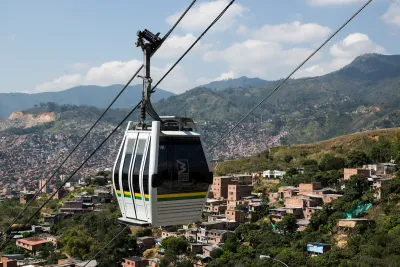
“For all of their usefulness at Mammoth, Vail, Jackson Hole, and Disney World, gondolas have, with scant exceptions, played no role in urban transport in the United States. But, backers in at least a half-dozen cities are touting the reliability, sustainability, and, yes, fun of gondolas and similar modes of aerial mass transit.”
According to an article by Josh Stephens in InTransition Magazine, “Gondolas have taken hold in Latin America, where systems in Medellin, Colombia; Mexico City; and La Paz, Bolivia, have revolutionized mobility in mountainous, but densely populated, neighborhoods. They’ve also made transit safer, literally taking commuters off the streets, where pedestrians are vulnerable to vehicular violence and crime.”
Although a handful of U.S. cities have considered gondolas — “Proposals have included: spanning the Potomac River between Washington, D.C. and Rosslyn, Virginia; Clearwater and Clearwater Beach, Fla.; the San Diego waterfront; and Laguna Honda Hospital in San Francisco” — none of these systems have begun development. For now, “Each exists only in planning documents — or simply in backers’ imaginations.”
FULL STORY: Transit Advocates Consider How To Elevate Gondolas In American Cities


Anaheim Proposes Gondola Connecting Disneyland, Stadiums, Transit Center
The as-yet-unfunded project would connect major attractions along the city’s main artery.

Mexico City Aerial ‘Cablebus’ Provides Key Connection to Peripheral Neighborhoods
Unlike many aerial gondolas, Mexico City’s Cablebus is largely used by commuters and residents from communities farther from the city center.
Multiple Aerial Trams Proposed in Clearwater, Florida
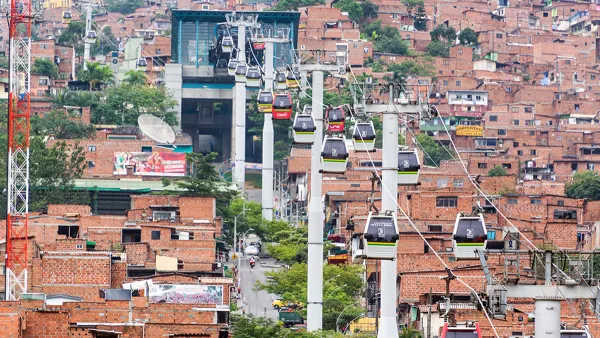
The city of Clearwater added another aerial tram project to its list of planning proposals. It's the second aerial tram proposal to move forward in the city this year.

Planetizen Federal Action Tracker
A weekly monitor of how Trump’s orders and actions are impacting planners and planning in America.

The state-sanctioned urbicide of Austin
People don’t kill cities. Freeways do.

US to reduce Colorado River water deliveries to Mexico
A new Colorado Treaty amendment reduces Mexico’s Colorado River water allocation by 250,000 acre feet.

5 New England states march closer to 800 megawatt wind energy project
Securing federal approval for the project may be complicated under the Trump administration, which has historically been hostile towards domestic wind power.

Baltimore to break ground on $50 million Transit Priority Project
The project will bring faster bus trips, safer streets and better bike connections to Baltimore.

Airbnb launches $250 million 'last-dollar financing' housing accelerator, makes first investment in Austin
The company will put $6.4 million towards affordable housing development in Texas’ capital.

FREE Course: Walkable City 1: Why Walkability?
After describing his path towards focusing on walkability as the essence of good planning, Jeff Speck marches through his five principal reasons for making more walkable places.
Reinventing Malls: Planning Alchemy—Turning Gray Fields Into Gold
The course focuses on the opportunities and imperatives that shape reinvention of mall sites.

Eagle County Government
Harvard University Graduate School of Design
Nashville Planning Department
The Architects Foundation
University of Cincinnati Online
The Pocatello Development Authority
The Urban Renewal Agency of the City of Pocatello
Journal of the American Planning Association