An intersection configuration mastered by the Dutch is about to get its first showcase in the capital of Utah as part of a larger bike lane project through the center of the city.


"Salt Lake City is on track to implement America’s first protected intersection for bicycling this summer," reports Angie Schmitt.
"The intersection design is based on a Dutch template that minimizes potential conflicts between people biking, driving, and walking. For example, it allows cyclists to make a left turn in two stages without crossing against oncoming car traffic." Schmitt's article also includes a few renderings and diagrams breaking down the configuration of the Dutch intersection treatment.
The intersection will be included in a bike lane project on 200 West between 900 South and North Temple. Construction will begin in August, according to a separate article by Celeste Tholen Rosenlof. Tholen Rosenlof also notes that 200 West falls short of its vehicle capacity by 90 percent, "making it an ideal location to integrate “low stress” bikeways, according to the city [pdf]."
The design for the protected intersection will be familiar to Planetizen readers thanks to the work of Nick Falbo, a Portland-based planner who made the case for the design last year.
FULL STORY: Salt Lake City to Install Nation’s First Protected Intersection for Bicycling

America's Second Protected Intersection Now Open
The first protected intersection opened in August in Davis, Calif., a university town with the nation's highest percentage of bike commuters. Salt Lake City's new protected intersection is explained on NPR's "Here & Now" report with audio and videos.
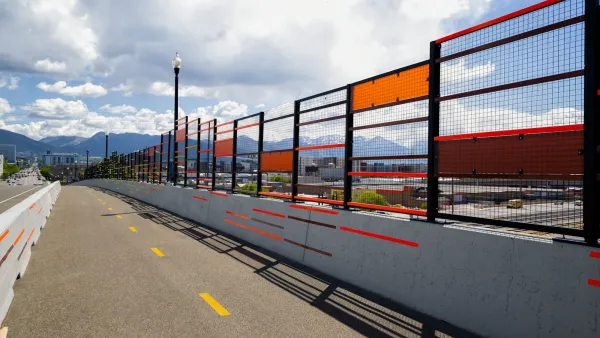
Salt Lake City opens protected bike path on viaduct trail
The 400 South Viaduct Trail features the state's longest continuous piece of public art.
Utah State Bill Could Force Removal of SLC Bike Lanes
If state lawmakers have their way, the city could be forced to remove several bikeways.

Planetizen Federal Action Tracker
A weekly monitor of how Trump’s orders and actions are impacting planners and planning in America.

The state-sanctioned urbicide of Austin
People don’t kill cities. Freeways do.

US to reduce Colorado River water deliveries to Mexico
A new Colorado Treaty amendment reduces Mexico’s Colorado River water allocation by 250,000 acre feet.

Mamdani overhauls NYC's Vision Zero plan with 100 new policy goals
The overhaul aims to reduce traffic deaths and make streets safer for pedestrians, cyclists and drivers through lower speed limits, new safety infrastructure and more.

Amtrak not solely to blame for New Jersey commuter rail's unreliability, report finds
A new study from the Garden State Initiative found that NJ Transit’s budget grew 20% across a 4 year period, but reliability declined significantly over the same period.

EPA erases limits on planet-warming pollution from power plants
Under Monday’s plan, power plants would still have some limits on how much mercury, arsenic and other contaminants they can emit.

FREE Course: Walkable City 1: Why Walkability?
After describing his path towards focusing on walkability as the essence of good planning, Jeff Speck marches through his five principal reasons for making more walkable places.
Reinventing Malls: Planning Alchemy—Turning Gray Fields Into Gold
The course focuses on the opportunities and imperatives that shape reinvention of mall sites.

Eagle County Government
Harvard University Graduate School of Design
Nashville Planning Department
The Architects Foundation
University of Cincinnati Online
The Pocatello Development Authority
The Urban Renewal Agency of the City of Pocatello
Journal of the American Planning Association